SME Growth Fund: Empowering Indian MSMEs to Become Global Champions
#GS-2 #GS-3 #Governance & Social Justice #Economy #Government Policies & Interventions #Inclusive Growth #Skill Development #Infrastructure #Employment
Key takeaways
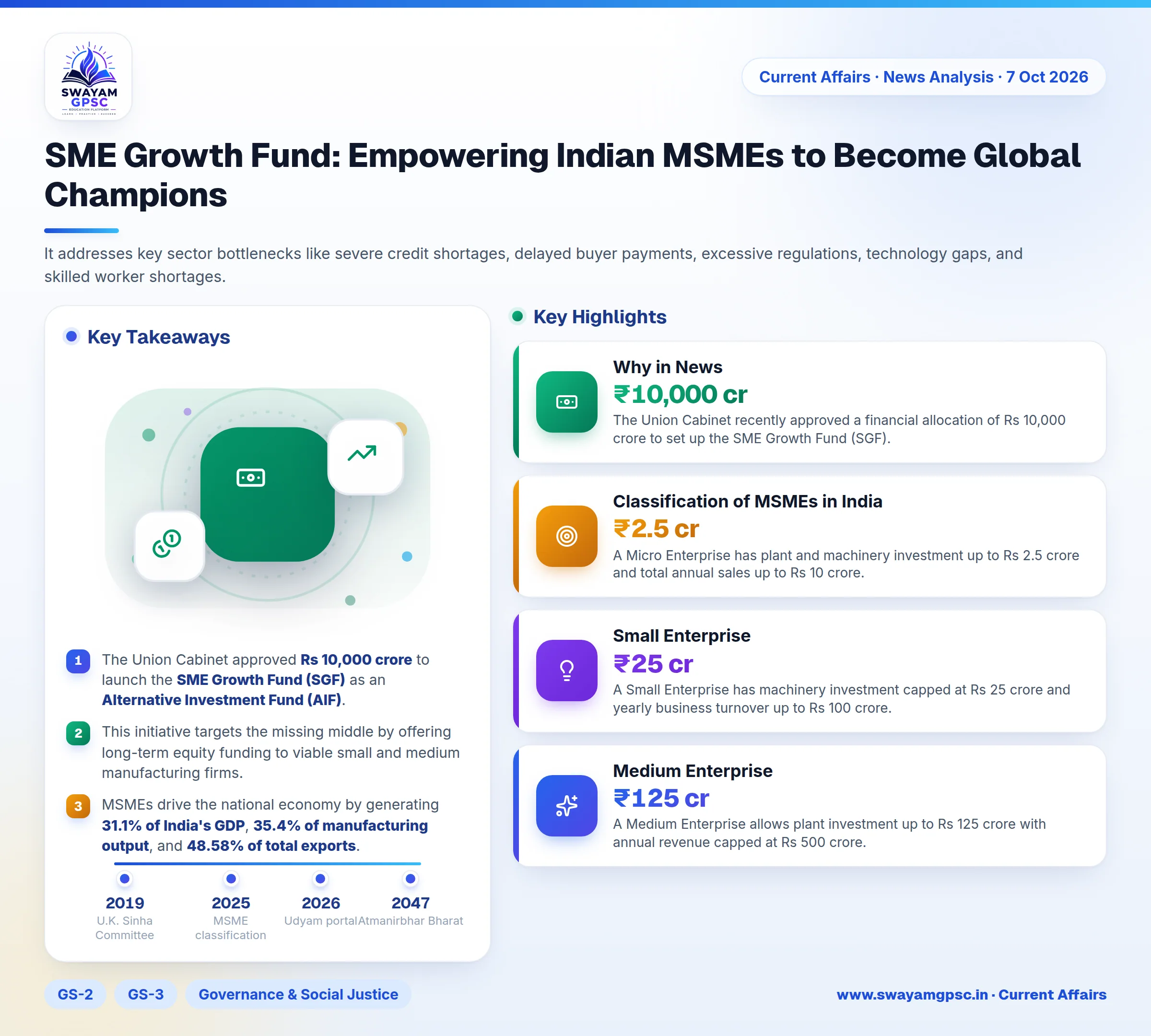
- The Union Cabinet approved Rs 10,000 crore to launch the SME Growth Fund (SGF) as an Alternative Investment Fund (AIF).
- This initiative targets the missing middle by offering long-term equity funding to viable small and medium manufacturing firms.
- MSMEs drive the national economy by generating 31.1% of India's GDP, 35.4% of manufacturing output, and 48.58% of total exports.
- The sector faces a massive credit shortage of Rs 20 to Rs 25 lakh crore and deals with Rs 10.7 lakh crore locked up in delayed payments annually.
- Under updated 2025 rules, Medium Enterprises can invest up to Rs 125 crore in plant machinery with annual sales capped at Rs 500 crore.
Why in News
- The Union Cabinet recently approved a financial allocation of Rs 10,000 crore to set up the SME Growth Fund (SGF).
- This fund aims to provide direct equity support to high-potential Small and Medium Enterprises (SMEs).
- The primary goal is to help these viable businesses scale up and transform into competitive global market leaders.
Summary of the Initiative
- The SME Growth Fund offers Rs 10,000 crore in patient equity capital to assist top-performing SMEs in expanding their business operations globally.
- It addresses key sector bottlenecks like severe credit shortages, delayed buyer payments, excessive regulations, technology gaps, and skilled worker shortages.
What is the SME Growth Fund?
- The government first announced this state-backed financial setup during the Union Budget 2026-27 to deliver long-term equity funding to promising SMEs.
- It directly targets the missing middle equity gap and supports national economic visions like Atmanirbhar Bharat and Viksit Bharat @ 2047.
- The initiative focuses on providing patient equity capital to businesses that have proven financial viability and strong potential for expansion.
- It aims to build industrial leaders across various domain areas including manufacturing, services, technology, and strategic supply chains.
- A large portion of the fund will specifically target small and medium manufacturing units looking to increase factory capacity and adopt modern tools.
- The scheme prioritizes funding for SMEs in Tier-II and Tier-III cities to encourage balanced industrial development across different regions.
- The entity will operate as a direct equity investment vehicle structured as an Alternative Investment Fund (AIF) under SEBI regulations.
- An AIF gathers funds from sophisticated domestic and foreign investors to invest based on a defined commercial strategy.
Classification of MSMEs in India
- India updated its official MSME classification framework starting April 2025, using combined limits for equipment investment and annual revenue.
- A Micro Enterprise has plant and machinery investment up to Rs 2.5 crore and total annual sales up to Rs 10 crore.
- A Small Enterprise has machinery investment capped at Rs 25 crore and yearly business turnover up to Rs 100 crore.
- A Medium Enterprise allows plant investment up to Rs 125 crore with annual revenue capped at Rs 500 crore.
Significance of India's MSME Ecosystem
- The Economic Survey 2025-26 shows that MSMEs generate 31.1% of India's GDP, 35.4% of total manufacturing output, and 48.58% of national exports.
- Official registrations on the Udyam portal and Udyam Assist Platform (UAP) reached ~9.78 crore by October 2026.
- Registered small businesses serve as massive employment providers, reporting nearly 43.28 crore jobs across the country.
- Women entrepreneurs hold a strong position in this sector, operating 37.6% of all registered units.
- The registered user base covers diverse areas, with ~4.08 crore units in trading, ~3.77 crore in services, and ~1.93 crore in manufacturing.
- Small businesses are turning to green practices like renewable power and recycling through programs like RAMP and ZED Certification.
Challenges Faced by the MSME Sector
- A vast majority of small businesses lack organized financial records, making it difficult for commercial banks to assess risk levels.
- The U.K. Sinha Committee set up by the RBI in 2019 estimated a massive formal credit gap of Rs 20 to Rs 25 lakh crore.
- Delayed payments from large corporate buyers and PSUs create major cash flow problems for small firms.
- A study by GAME found that nearly Rs 10.7 lakh crore remains trapped each year in overdue payments, representing 5.9% of Gross Value Added (GVA).
- Businesses face severe regulatory burdens across labor rules, GST filings, and environmental approvals.
- Fears of heavy compliance requirements and potential imprisonment penalties keep small businesses from expanding into larger legal units.
- Around 95% of registered MSMEs remain stuck in Micro or Small categories, failing to grow into medium-sized operations.
- Only 23% of small units have integrated modern tools like AI or IoT, leading to low factory productivity.
- More than 50% of MSMEs face a shortage of skilled technical staff because they cannot match the high salaries paid by big corporations.
- About 70% of MSMEs rely on old marketing methods, while high logistics costs and rules like the EU CBAM restrict export growth.
Measures Needed to Empower MSMEs
- The government must strictly enforce invoice payments through the MSME Samadhaan portal and mandate large firms to register on TReDS.
- Expanding TReDS has already freed up over Rs 7 lakh crore in cash flow for small suppliers.
- Lenders should adopt dynamic credit assessment models based on GST filings and digital payment trails instead of physical property collateral.
- Providing targeted financial incentives for factory automation and shared R&D hubs will help lower modern technology costs for small firms.
- Simplifying business regulations, digitizing official permissions, and decriminalizing minor technical errors will reduce administrative costs.
- Strengthening ties between technical training institutes (ITIs) and local industrial hubs will build a steady pool of skilled workers.
Way Forward
- Providing patient equity through equity funds will strengthen business balance sheets and increase bank creditworthiness without raising debt burdens.
- Combining equity support with credit guarantee schemes like CGTMSE, skill programs like PM Vishwakarma, and growth schemes like RAMP will build a competitive MSME ecosystem.