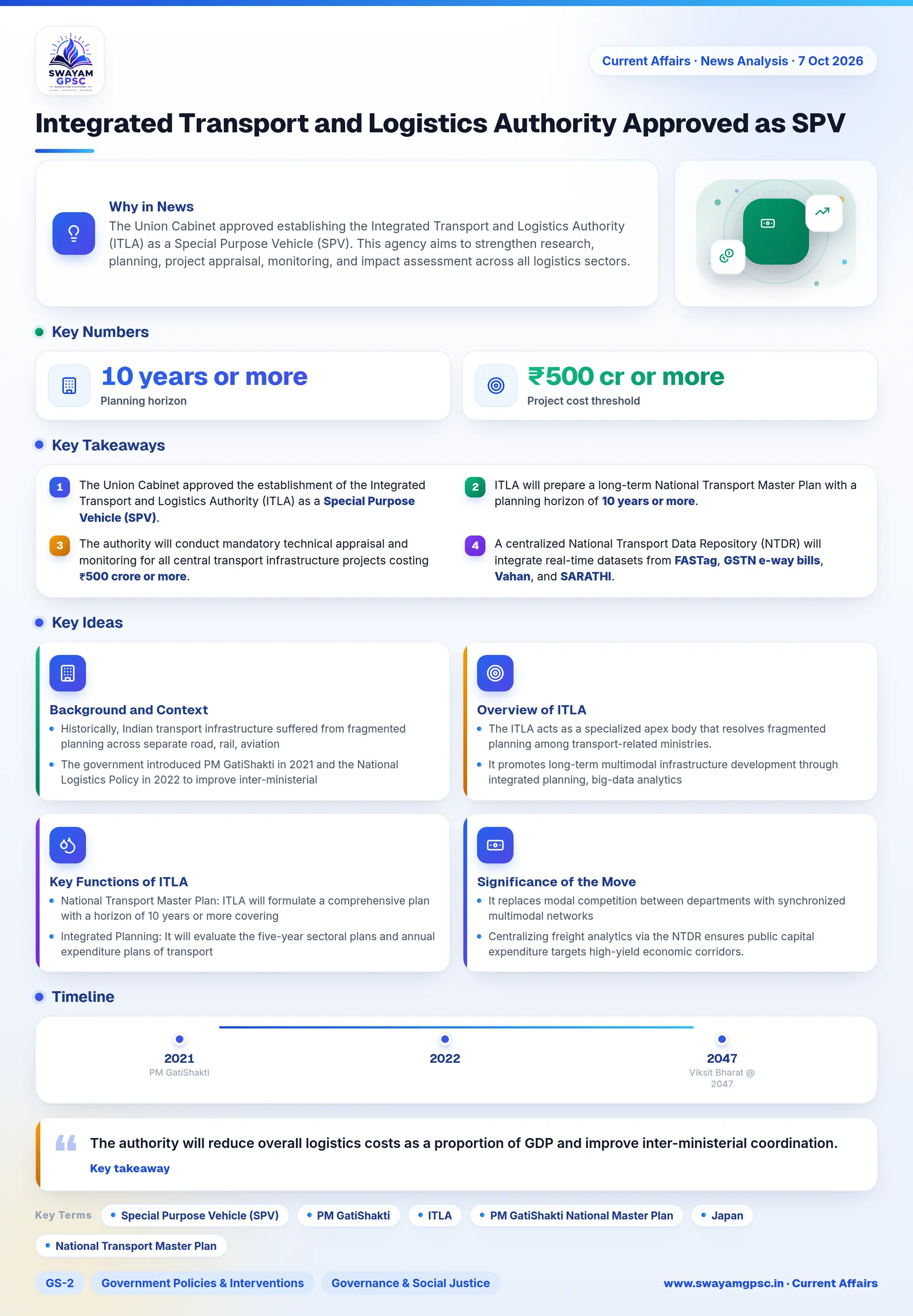
Integrated Transport and Logistics Authority Approved as SPV
#GS-2 #Government Policies & Interventions #Governance & Social Justice #GS-3 #Infrastructure #Economy #Quick Facts For Prelims
Key takeaways
- The Union Cabinet approved the establishment of the Integrated Transport and Logistics Authority (ITLA) as a Special Purpose Vehicle (SPV).
- ITLA will prepare a long-term National Transport Master Plan with a planning horizon of 10 years or more.
- The authority will conduct mandatory technical appraisal and monitoring for all central transport infrastructure projects costing ₹500 crore or more.
- A centralized National Transport Data Repository (NTDR) will integrate real-time datasets from FASTag, GSTN e-way bills, Vahan, and SARATHI.
- This initiative aims to lower logistics costs as a percentage of GDP to support the Viksit Bharat @ 2047 vision.
Why in News
- The Union Cabinet approved establishing the Integrated Transport and Logistics Authority (ITLA) as a Special Purpose Vehicle (SPV).
- This agency aims to strengthen research, planning, project appraisal, monitoring, and impact assessment across all logistics sectors.
Background and Context
- Historically, Indian transport infrastructure suffered from fragmented planning across separate road, rail, aviation, and shipping ministries.
- The government introduced PM GatiShakti in 2021 and the National Logistics Policy in 2022 to improve inter-ministerial coordination.
- A statutory mechanism was still necessary for technical appraisal, centralized data management, and continuous multimodal monitoring.
Overview of ITLA
- The ITLA acts as a specialized apex body that resolves fragmented planning among transport-related ministries.
- It promotes long-term multimodal infrastructure development through integrated planning, big-data analytics, and policy support.
- This institutional body complements existing initiatives like the PM GatiShakti National Master Plan and the National Logistics Policy.
- The agency is modeled after successful integrated transport planning bodies in countries like Japan, the United States, South Korea, China, and Australia.
Key Functions of ITLA
- National Transport Master Plan: ITLA will formulate a comprehensive plan with a horizon of 10 years or more covering roads, railways, ports, civil aviation, inland waterways, coastal shipping, urban mobility, and logistics.
- Integrated Planning: It will evaluate the five-year sectoral plans and annual expenditure plans of transport ministries to ensure alignment with national priorities.
- Project Appraisal and Monitoring: ITLA will conduct mandatory technical appraisal for central government infrastructure projects costing ₹500 crore or more, while existing financial appraisal systems continue as usual.
- National Transport Data Repository (NTDR): It will operate a centralized big-data engine integrating datasets like GSTN e-way bills, FASTag, Vahan, SARATHI, GPS fleet tracking, and urban traffic systems for freight-flow analysis.
- Policy and Impact Assessment: ITLA will regularly review the National Logistics Policy, track physical progress on mega-projects above ₹500 crore, and perform post-commissioning economic and environmental impact assessments.
Significance of the Move
- The authority will reduce overall logistics costs as a proportion of GDP and improve inter-ministerial coordination.
- It replaces modal competition between departments with synchronized multimodal networks, making Indian manufacturing more globally competitive.
- Centralizing freight analytics via the NTDR ensures public capital expenditure targets high-yield economic corridors.
- This approach prevents redundant infrastructure investments and chronic project cost overruns, supporting the vision of Viksit Bharat @ 2047.