Nobel Prize in Physics 2026: IceCube Neutrino Observatory
#GS-3 #Science & Technology #Space #Current Events #National #International #IceCube Neutrino Observatory #India-based Neutrino Observatory (INO) #Nobel Prize in Physics 2026 #Particle Physics
Key takeaways
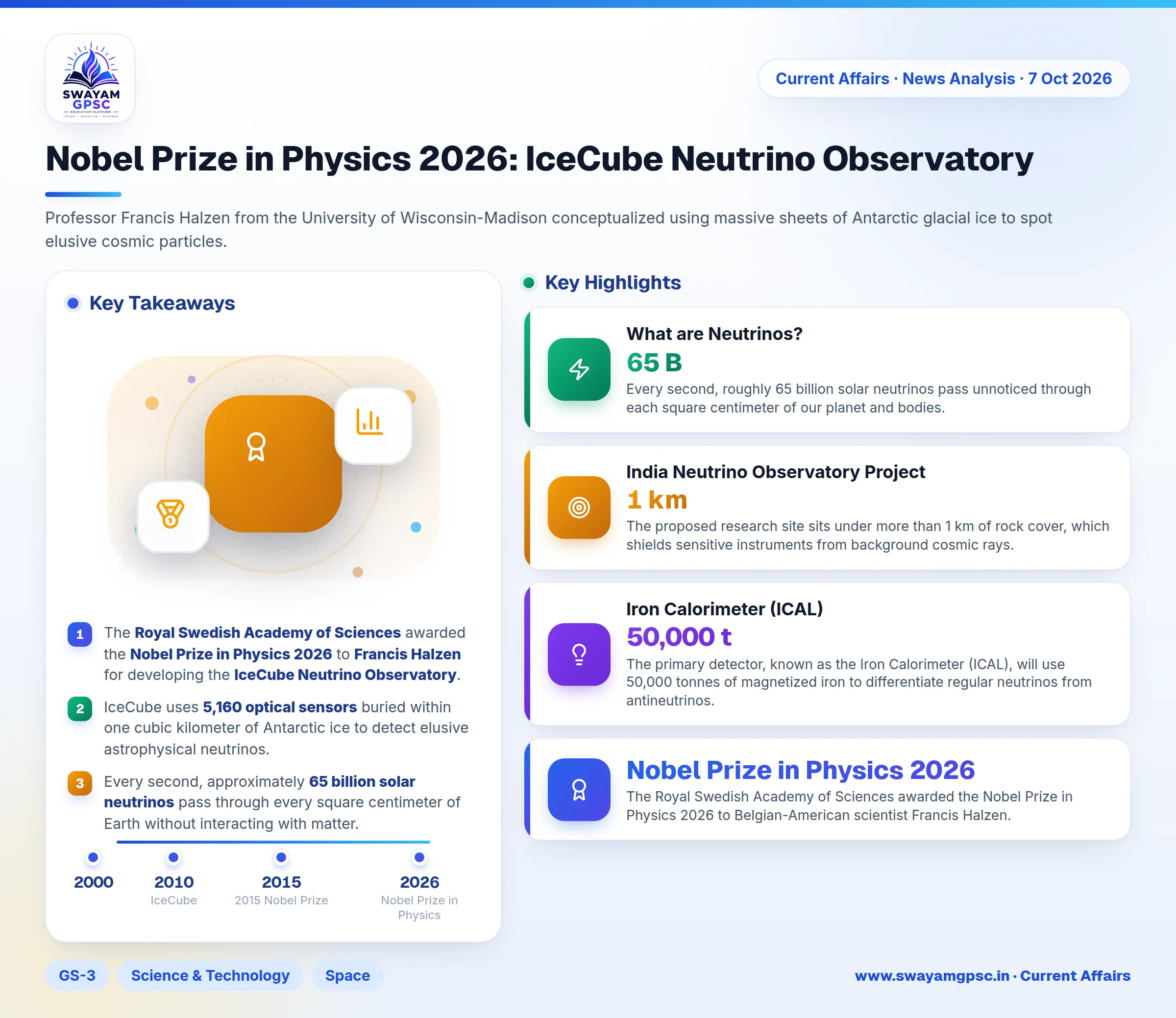
- The Royal Swedish Academy of Sciences awarded the Nobel Prize in Physics 2026 to Francis Halzen for developing the IceCube Neutrino Observatory.
- IceCube uses 5,160 optical sensors buried within one cubic kilometer of Antarctic ice to detect elusive astrophysical neutrinos.
- Every second, approximately 65 billion solar neutrinos pass through every square centimeter of Earth without interacting with matter.
- India's proposed India-based Neutrino Observatory (INO) in Theni, Tamil Nadu, remains stalled despite plans for a 50,000-tonne ICAL detector under 1 km of rock cover.
Why in News
- The Royal Swedish Academy of Sciences awarded the Nobel Prize in Physics 2026 to Belgian-American scientist Francis Halzen.
- The committee honored him for designing and building the IceCube Neutrino Observatory at the South Pole, which led to discovering high-energy astrophysical neutrinos.
Summary
- The 2026 Nobel Prize in Physics honored Francis Halzen for establishing neutrino astronomy by detecting high-energy cosmic neutrinos.
- Meanwhile, India's planned India-based Neutrino Observatory (INO) featuring a 50,000-tonne ICAL detector remains delayed due to environmental and wildlife issues.
Key Facts About the 2026 Nobel Prize in Physics
- Professor Francis Halzen from the University of Wisconsin-Madison conceptualized using massive sheets of Antarctic glacial ice to spot elusive cosmic particles.
- He initially suggested detecting high-energy neutrinos in deep Antarctic ice in 1988, which led to the prototype array AMANDA (Antarctic Muon And Neutrino Detector Array) and culminated in the completion of IceCube in December 2010.
The IceCube Neutrino Observatory
- Located at the Amundsen-Scott South Pole Station in Antarctica, IceCube stands as the world's largest particle detector spanning an entire cubic kilometer of clear glacial ice.
- The facility houses 5,160 optical sensors buried deep inside one cubic kilometer of Antarctic ice.
- Scientists selected the South Pole because its deep ice layer is exceptionally clear, stable, dark, and shielded from surface interference.
- When an incoming high-energy neutrino strikes an atomic nucleus within the ice, it generates secondary charged particles that emit faint blue light flashes.
- Sensors capture these subtle flashes, which helps researchers calculate both the neutrino's energy level and its precise astrophysical point of origin.
- Astronomers traditionally relied on the electromagnetic spectrum, including visible light, radio waves, X-rays, and gamma rays, to study cosmic events.
- Halzen's work on the IceCube Neutrino Observatory founded neutrino astronomy, letting humanity examine outer space using subatomic particles rather than standard light.
- Unlike cosmic rays that magnetic fields bend or gamma rays that dust clouds block, neutral neutrinos travel in straight lines across billions of light-years without interference.
- Because these particles travel through matter largely unaffected, physicists can trace their exact paths back to initial cosmic sources.
- Capturing these high-energy particles allows researchers to study turbulent cosmic regions, including supermassive black holes, active galactic nuclei such as galaxy NGC 1068, and explosive supernovae.
- Tracking high-energy neutrinos helps scientists identify where ultra-high-energy cosmic rays originate and reveals the universe's natural particle accelerators.
What are Neutrinos?
- Neutrinos are fundamental subatomic particles belonging to the lepton family of matter.
- Because they interact so weakly with normal physical matter, researchers commonly call them ghost particles.
- Apart from photons, neutrinos represent the second most abundant type of particle across the universe.
- Every second, roughly 65 billion solar neutrinos pass unnoticed through each square centimeter of our planet and bodies.
- They originate primarily from stars, cosmic rays, supernovae explosions, radioactive decay processes, nuclear reactors, and particle accelerators.
- Neutrinos carry zero electrical charge, meaning interstellar electromagnetic fields cannot alter their paths.
- They interact only through gravity and the weak nuclear force, allowing them to stream through solid objects effortlessly.
- Physicists once thought neutrinos lacked mass entirely, but the 2015 Nobel Prize in Physics confirmed that they possess a tiny non-zero mass.
- Scientists classify them into three flavors: electron neutrino, muon neutrino, and tau neutrino.
- Electron neutrinos arise from atomic beta decay, especially within the nuclear fusion core of the Sun.
- Muon neutrinos form when cosmic rays strike gases in Earth's upper atmosphere and produce decaying muons.
- Tau neutrinos are the rarest type, linked to tau leptons and experimentally confirmed in the year 2000.
India Neutrino Observatory Project
- The Planning Commission approved the INO as a Mega Science Project under the 11th Five-Year Plan to study atmospheric neutrinos at Bodi West Hills, Theni district, Tamil Nadu.
- The proposed research site sits under more than 1 km of rock cover, which shields sensitive instruments from background cosmic rays.
- Project blueprints require digging a 2,100-meter-long access tunnel toward a massive subterranean cavern holding the main detector.
- The primary detector, known as the Iron Calorimeter (ICAL), will use 50,000 tonnes of magnetized iron to differentiate regular neutrinos from antineutrinos.
- When a rare collision occurs within the detector, the magnetized iron bends the resulting muon's path.
- The curved trajectory allows the ICAL detector to distinguish between neutrinos and antineutrinos, providing a key scientific edge over other observatories.
- India's neutrino legacy traces back to 1964-65, when scientists placed underground detectors inside the Kolar Gold Fields in Karnataka and recorded atmospheric neutrinos in 1965.
- The INO project is currently stalled due to environmental concerns, pending wildlife clearances near a tiger corridor, and local misconceptions about radiation.
Frequently Asked Questions
- IceCube is a one-cubic-kilometer neutrino telescope situated at the South Pole that detects cosmic particles using sensors embedded in Antarctic ice.
- People call them ghost particles because they have no electric charge and interact only through the weak nuclear force, letting them glide through matter undisturbed.
- The INO is a proposed underground science facility planned for Theni, Tamil Nadu, to examine the properties of atmospheric neutrinos.
- The ICAL detector is INO's primary instrument, designed with 50,000 tonnes of magnetized iron to differentiate neutrinos from antineutrinos.
- Opposition to INO centers around its location in the Western Ghats, nearby tiger corridors, required wildlife clearances, and false fears regarding radioactivity.