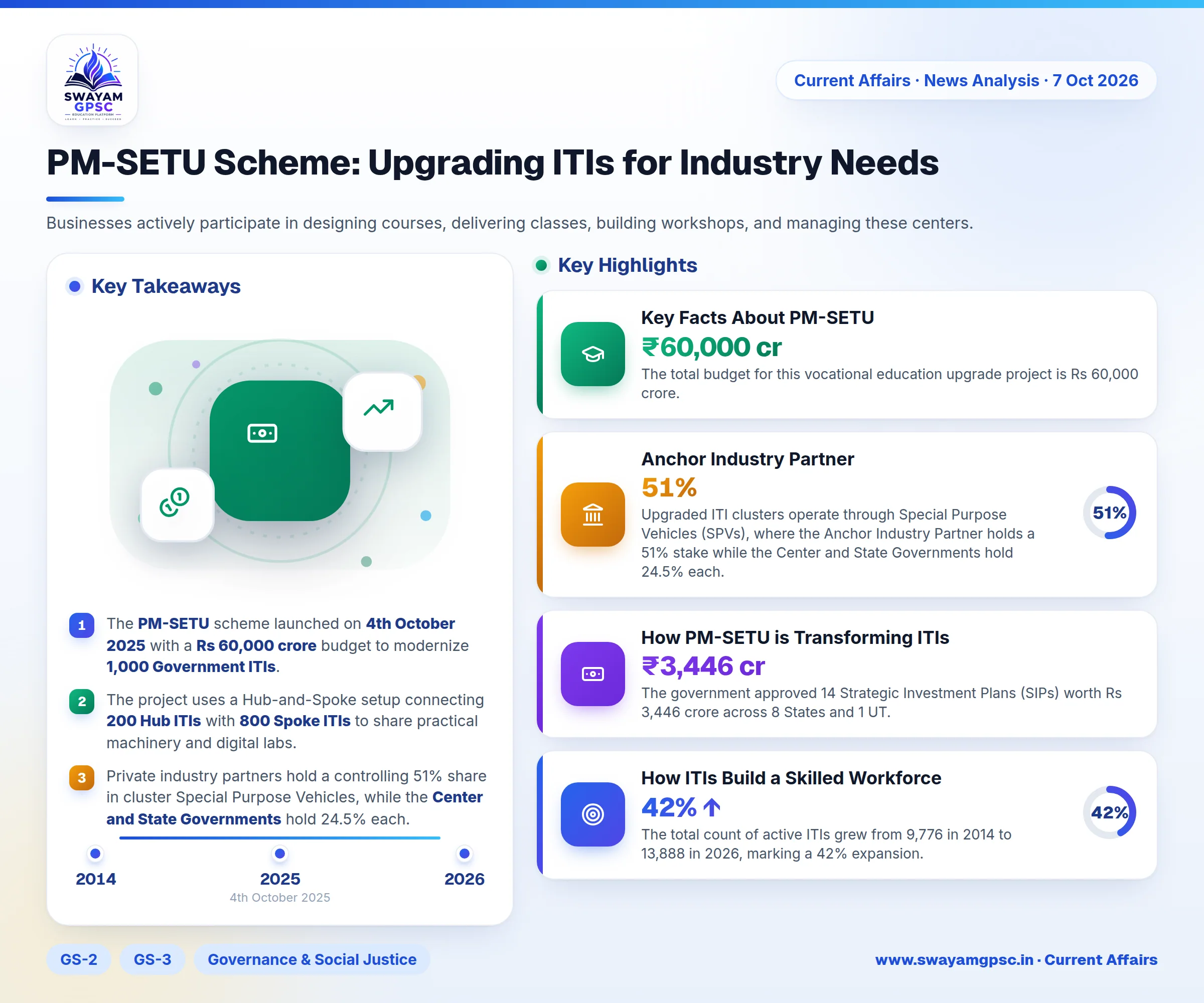
PM-SETU Scheme: Upgrading ITIs for Industry Needs
#GS-2 #GS-3 #Governance & Social Justice #Economy #Employment #Government Policies & Interventions #Education
Key takeaways
- The PM-SETU scheme launched on 4th October 2025 with a Rs 60,000 crore budget to modernize 1,000 Government ITIs.
- The project uses a Hub-and-Spoke setup connecting 200 Hub ITIs with 800 Spoke ITIs to share practical machinery and digital labs.
- Private industry partners hold a controlling 51% share in cluster Special Purpose Vehicles, while the Center and State Governments hold 24.5% each.
- The Directorate General of Training (DGT) introduced 32 new-age courses in advanced areas like AI, Cyber Security, Semiconductors, and Drones.
- Total ITI student admissions grew 54% from 9.51 lakh in 2014-15 to 14.70 lakh in 2025-26 across 13,888 institutions.
Why in News
- The PM-SETU scheme completed its first year of operations recently.
- Officials have selected 850 Industrial Training Institutes (ITIs) and approved 14 ITI clusters under the scheme's Hub-and-Spoke model.
Key Facts About PM-SETU
- The central government launched PM-SETU on 4th October 2025 to upgrade government ITIs and match their training with market demand.
- The total budget for this vocational education upgrade project is Rs 60,000 crore.
- Businesses actively participate in designing courses, delivering classes, building workshops, and managing these centers.
- Under Component I, the Hub-and-Spoke model links 1,000 Government ITIs, consisting of 200 Hub ITIs and 800 Spoke ITIs.
- Each central Hub connects to about four Spoke ITIs, giving smaller centers shared access to advanced machines, labs, and incubation facilities.
- Hub ITIs feature innovation centers, teacher training facilities, production units, and job placement cells.
- Under Component II, the government expands five National Skill Training Institutes (NSTIs) in Bhubaneswar, Chennai, Hyderabad, Kanpur, and Ludhiana.
- State governments select participating ITIs alongside industry partners and propose plans based on local factory needs.
- The National Steering Committee (NSC), led by the Secretary of MSDE, directs policy decisions and monitors performance across the country.
- Upgraded ITI clusters operate through Special Purpose Vehicles (SPVs), where the Anchor Industry Partner holds a 51% stake while the Center and State Governments hold 24.5% each.
- Participating companies must present a Strategic Investment Plan (SIP) to guide regional training and infrastructure.
How PM-SETU is Transforming ITIs
- During its first year, the scheme identified 850 government centers, including 172 Hub ITIs and 678 Spoke ITIs.
- The National Steering Committee approved scaling up the initiative from pilot projects to 200 ITI clusters across India.
- The government approved 14 Strategic Investment Plans (SIPs) worth Rs 3,446 crore across 8 States and 1 UT.
- These industrial investments cover key sectors like steel, healthcare, pharmaceuticals, manufacturing, defense electronics, and cars.
- The Directorate General of Training (DGT) launched 32 new-age courses covering AI, Cyber Security, Semiconductors, Drones, Green Hydrogen, and 5G.
- India signed global agreements with Singapore, France, Australia, and Germany to improve teaching standards at NSTI centers.
How ITIs Build a Skilled Workforce
- ITIs offer hands-on trade training in engineering and non-engineering fields under the Craftsmen Training Scheme (CTS).
- Students can choose practical skill courses lasting between six months to two years.
- The Directorate General of Training (DGT) under the Ministry of Skill Development and Entrepreneurship (MSDE) sets curriculum standards and trade testing nationally.
- Individual State Governments and Union Territory Administrations handle the daily operational and financial management of ITIs.
- The total count of active ITIs grew from 9,776 in 2014 to 13,888 in 2026, marking a 42% expansion.
- Student admissions jumped by 54%, growing from 9.51 lakh in 2014-15 to 14.70 lakh in 2025-26.
Conclusion
- PM-SETU shifts traditional vocational education toward a modern, factory-ready, and technology-focused system.
- Connecting practical learning directly with factory demand builds stronger human capital to support the Viksit Bharat mission.