SHANTI Act 2025 and Nuclear Liability Concerns in India
#GS-2 #GS-3 #Government Policies & Interventions #Nuclear Technology #Governance & Social Justice #Science & Technology #Constitution
Key takeaways
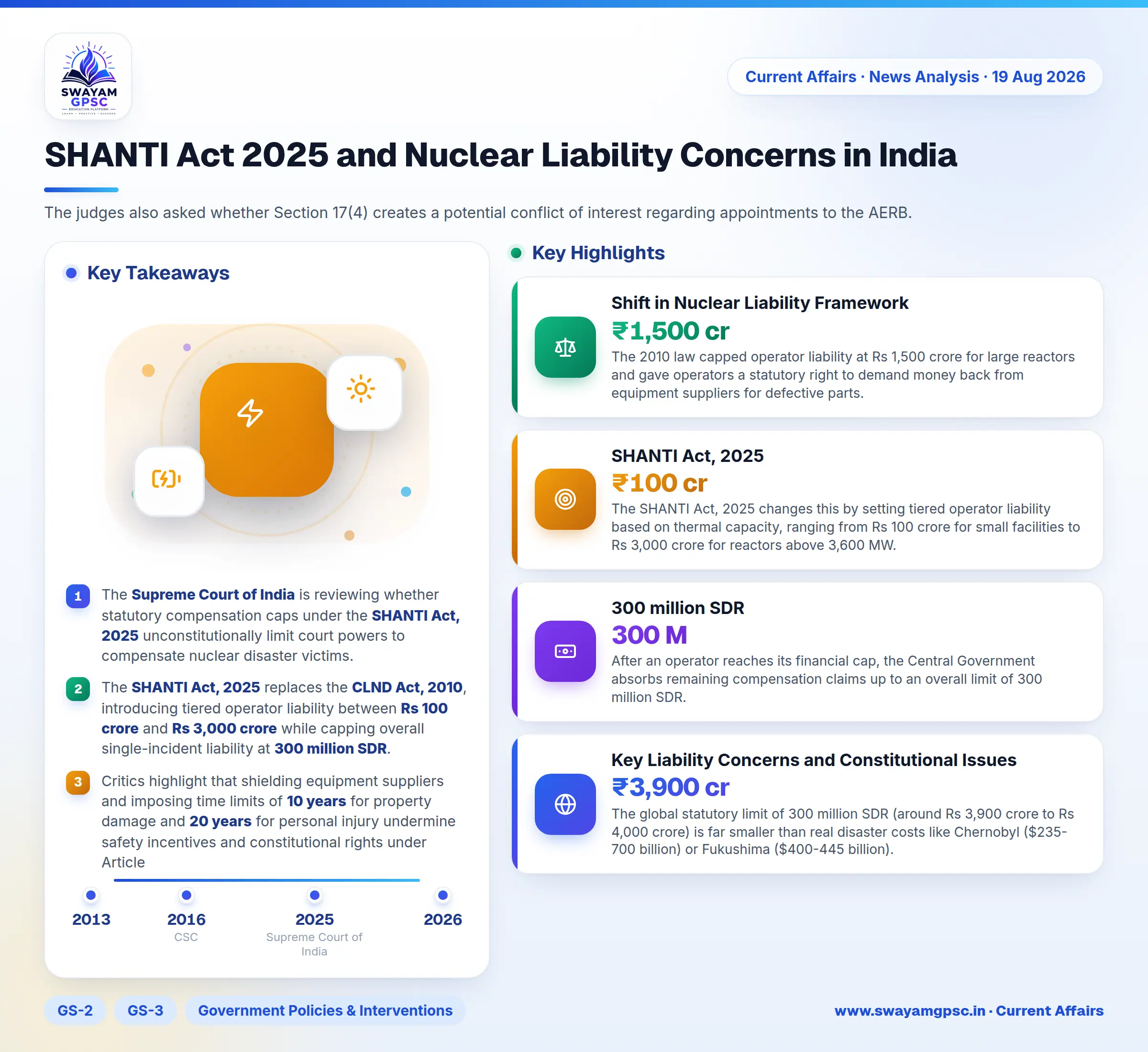
- The Supreme Court of India is reviewing whether statutory compensation caps under the SHANTI Act, 2025 unconstitutionally limit court powers to compensate nuclear disaster victims.
- The SHANTI Act, 2025 replaces the CLND Act, 2010, introducing tiered operator liability between Rs 100 crore and Rs 3,000 crore while capping overall single-incident liability at 300 million SDR.
- Critics highlight that shielding equipment suppliers and imposing time limits of 10 years for property damage and 20 years for personal injury undermine safety incentives and constitutional rights under Article 21.
- Experts urge establishing an independent regulatory body like the proposed Nuclear Safety Regulatory Authority (NSRA) and expanding the India Nuclear Insurance Pool (INIP) to strengthen safety and financial coverage.
Why in News
- The Supreme Court of India has started a legal review of the SHANTI Act, 2025.
- The court wants to decide if statutory liability limits can legally restrict constitutional courts from granting fair compensation to nuclear accident victims.
- A three-judge Bench led by the Chief Justice of India issued notices to the Union government and the Atomic Energy Regulatory Board (AERB).
- The judges also asked whether Section 17(4) creates a potential conflict of interest regarding appointments to the AERB.
Summary of the SHANTI Act, 2025
- The SHANTI Act, 2025 aims to expand India's nuclear energy sector by encouraging private and foreign investments.
- Critics worry that lower supplier accountability and strict financial limits could harm public safety and victim compensation.
- The Supreme Court review emphasizes the need to balance nuclear expansion with safety, regulatory independence, and financial protection through tools like the Convention on Supplementary Compensation (CSC) and the India Nuclear Insurance Pool (INIP).
Core Provisions of the SHANTI Act, 2025
- The SHANTI Act, 2025 replaces the earlier Civil Liability for Nuclear Damage (CLND) Act, 2010 to make nuclear investment rules predictable.
- The law defines a company under Section 2(20) of the Companies Act, 2013, but explicitly excludes foreign-incorporated firms.
- It grants formal statutory backing to the Atomic Energy Regulatory Board (AERB) to boost regulatory oversight.
- The Central Government keeps exclusive control over sensitive activities such as uranium enrichment, spent-fuel reprocessing, high-level waste management, and heavy-water production.
- Disagreements will go to an Atomic Energy Redressal Advisory Council, with the Appellate Tribunal for Electricity acting as the higher appeal body.
Shift in Nuclear Liability Framework
- Under the old CLND Act, 2010, victims benefited from a no-fault system where they only needed to prove damage rather than operator negligence.
- The 2010 law capped operator liability at Rs 1,500 crore for large reactors and gave operators a statutory right to demand money back from equipment suppliers for defective parts.
- The SHANTI Act, 2025 changes this by setting tiered operator liability based on thermal capacity, ranging from Rs 100 crore for small facilities to Rs 3,000 crore for reactors above 3,600 MW.
- After an operator reaches its financial cap, the Central Government absorbs remaining compensation claims up to an overall limit of 300 million SDR.
- If total claims cross this threshold, the government may seek additional funds from international groups under the Convention on Supplementary Compensation (CSC).
- The new law reduces supplier liability, shielding equipment makers unless a contract explicitly specifies liability or damage is caused intentionally.
Adjudication and Information Access
- The act sets up specialized bodies like a Claims Commissioner or a Nuclear Damage Claims Commission while barring regular civil courts.
- Claimants must file claims within 10 years for property losses and 20 years for personal health injuries.
- Section 39 allows the government to classify operational details as restricted, taking nuclear safety data outside the reach of the Right to Information Act, 2005.
Understanding Nuclear Liability
- Nuclear liability is a set of legal rules that determines who pays for off-site damage caused by a nuclear accident.
- It clearly defines eligible damages, responsible parties, funding sources, and designated claims authorities.
- Setting these rules in advance prevents long court fights and offers certainty to nuclear operators, suppliers, and the public.
Major International Nuclear Liability Frameworks
- The Paris Convention (1960) created a regional framework under the OECD Nuclear Energy Agency for strict channelled liability.
- The Vienna Convention (1963) established global standards under the International Atomic Energy Agency (IAEA) for compensation and safety protection.
- The Brussels Supplementary Convention (1963) added public funding to support victims when operator money runs out.
- The Convention on Supplementary Compensation (CSC), 1997 creates an international public fund to offer extra payout beyond national limits.
- India ratified the CSC in 2016 but has not joined the Paris Convention, Vienna Convention, or the 2026 CSC amendment.
Key Liability Concerns and Constitutional Issues
- The global statutory limit of 300 million SDR (around Rs 3,900 crore to Rs 4,000 crore) is far smaller than real disaster costs like Chernobyl ($235-700 billion) or Fukushima ($400-445 billion).
- Time limits of 10 years and 20 years ignore medical facts, as radiation causes health issues like cancer that can take decades to show up.
- Capping operator liability and protecting equipment suppliers can lower incentives to maintain strict safety standards and build high-quality machinery.
- The law conflicts with the Absolute Liability principle under Article 21, established in the landmark M.C. Mehta (1987) case.
- It also violates the Polluter Pays principle from the Indian Council for Enviro-Legal Action (1996) case by shifting private industry liability onto taxpayers.
- Setting liability as low as Rs 100 crore for smaller reactors creates an arbitrary classification that fails the test of Article 14.
- Restricting safety data under Section 39 violates the right to information under Article 19(1)(a), making it hard for citizens to gather evidence for claims.
- Executive control over AERB appointments creates a conflict of interest because the government both promotes and regulates nuclear energy.
Measures to Strengthen Nuclear Governance
- India should establish an autonomous regulator like the proposed Nuclear Safety Regulatory Authority (NSRA), following the Raja Ramanna Committee (1997) recommendations.
- The government should use international funds available through the Convention on Supplementary Compensation (CSC) to shield public finances.
- Authorities should expand the India Nuclear Insurance Pool (INIP) and explore financial tools like Catastrophe Bonds to cover high-risk events.
- State entities like Nuclear Power Corporation of India Limited (NPCIL) must mandate supplier liability clauses in all equipment purchase contracts.