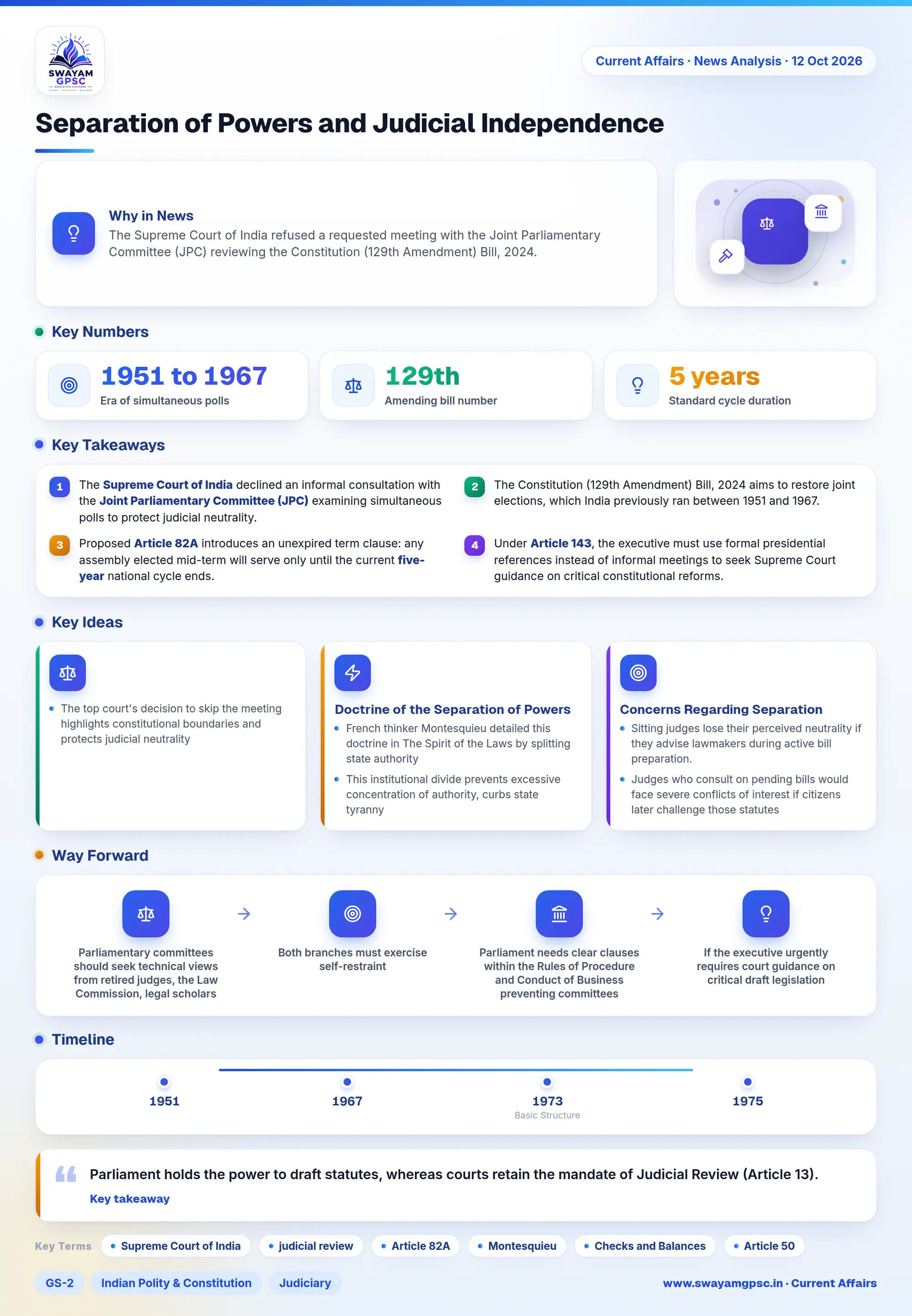
Separation of Powers and Judicial Independence
#GS-2 #Indian Polity & Constitution #Judiciary #Parliament #Constitution #One Nation One Election #Separation of Powers
Key takeaways
- The Supreme Court of India declined an informal consultation with the Joint Parliamentary Committee (JPC) examining simultaneous polls to protect judicial neutrality.
- The Constitution (129th Amendment) Bill, 2024 aims to restore joint elections, which India previously ran between 1951 and 1967.
- Proposed Article 82A introduces an unexpired term clause: any assembly elected mid-term will serve only until the current five-year national cycle ends.
- Under Article 143, the executive must use formal presidential references instead of informal meetings to seek Supreme Court guidance on critical constitutional reforms.
Why in News
- The Supreme Court of India refused a requested meeting with the Joint Parliamentary Committee (JPC) reviewing the Constitution (129th Amendment) Bill, 2024.
- Both judicial leaders and opposition figures raised serious objections regarding the core doctrine of the separation of powers and potential future judicial review.
Summary
- The top court's decision to skip the meeting highlights constitutional boundaries and protects judicial neutrality from parliamentary influence.
- The proposed Constitution (129th Amendment) Bill, 2024 introduces Article 82A to align national and state election cycles under a unified schedule.
Doctrine of the Separation of Powers
- French thinker Montesquieu detailed this doctrine in The Spirit of the Laws by splitting state authority across the Executive, the Legislature, and the Judiciary.
- This institutional divide prevents excessive concentration of authority, curbs state tyranny, and protects citizens' fundamental liberties.
- Rather than adopting strict boundaries like the United States, India relies on functional power division supported by mutual Checks and Balances.
- Under Article 50, the Directive Principle of State Policy (DPSP) instructs the state to detach the judiciary from executive control in public services.
- Provisions under Articles 121 & 211 forbid national and state lawmakers from debating judicial conduct during court duty execution.
- According to Articles 122 & 212, courts cannot question parliamentary or legislative assembly procedures, protecting legislative independence.
- Landmark verdicts like *Kesavananda Bharati v. State of Kerala (1973)* and *Indira Nehru Gandhi v. Raj Narain (1975)* declared power separation an unalterable element of the Basic Structure.
Concerns Regarding Separation of Powers
- Parliament holds the power to draft statutes, whereas courts retain the mandate of Judicial Review (Article 13).
- Sitting judges lose their perceived neutrality if they advise lawmakers during active bill preparation.
- Judges who consult on pending bills would face severe conflicts of interest if citizens later challenge those statutes in court.
- The judicial branch depends heavily on public faith regarding its complete impartiality.
- Private meetings between sitting judges and parliamentary committees can make courts appear aligned with the ruling government's legislative plans.
- The Indian Constitution already provides a transparent consultation mechanism through Article 143 (Advisory Jurisdiction) under presidential referral.
- Skipping this open presidential channel in favor of informal study visits disrupts institutional balance.
- Involving sitting judges in drafting laws breaches constitutional safeguards and muddles distinct institutional roles.
- This inappropriate crossover could turn judges into co-authors of legislation, sparking institutional overreach.
Constitution (129th Amendment) Bill, 2024
- India conducted unified general and state polls between 1951 and 1967 before premature assembly dissolutions broke the cycle.
- A panel led by former President Ram Nath Kovind examined the proposal from September 2023 and recommended staggered rollout steps in March 2024.
- The Union government introduced the Constitution (129th Amendment) Bill, 2024 in December 2024 as the primary vehicle for simultaneous elections.
- This bill seeks to synchronize polls to lower public spending, ease security deployments, and prevent administrative paralysis caused by the Model Code of Conduct.
- The current amendment intentionally leaves local governance bodies like panchayats and urban municipalities out of this bill's framework.
- The bill inserts Article 82A, directing the Election Commission of India (ECI) to execute joint elections across the Lok Sabha and state assemblies.
- By modifying Articles 83 & 172, any newly elected legislature following mid-term dissolution will only serve the unexpired remainder of the five-year cycle.
- Under proposed Article 82A, the ECI can advise the President to defer state polls during localized emergencies without extending the broader term beyond the Lok Sabha.
- An amendment to Article 327 explicitly grants Parliament authority over simultaneous election conduct alongside regular constituency delimitation powers.
Way Forward
- Parliamentary committees should seek technical views from retired judges, the Law Commission, legal scholars, and the Attorney General of India (Article 76) rather than active judges.
- Both branches must exercise self-restraint, following the Supreme Court's refusal to attend informal meetings as a positive constitutional standard.
- Parliament needs clear clauses within the Rules of Procedure and Conduct of Business preventing committees from pursuing informal consultations with judges.
- If the executive urgently requires court guidance on critical draft legislation, the government should advise the President to formally invoke Article 143.
Conclusion
- Preserving this power division ensures Parliament creates laws without interference while the judiciary serves as an unbiased arbiter of constitutional rights.