Seafarer Safety and Maritime Security in Conflict Zones
#GS-2 #Governance & Social Justice #Current Events #National #International #Economy #Infrastructure #Indian Diaspora
Key takeaways
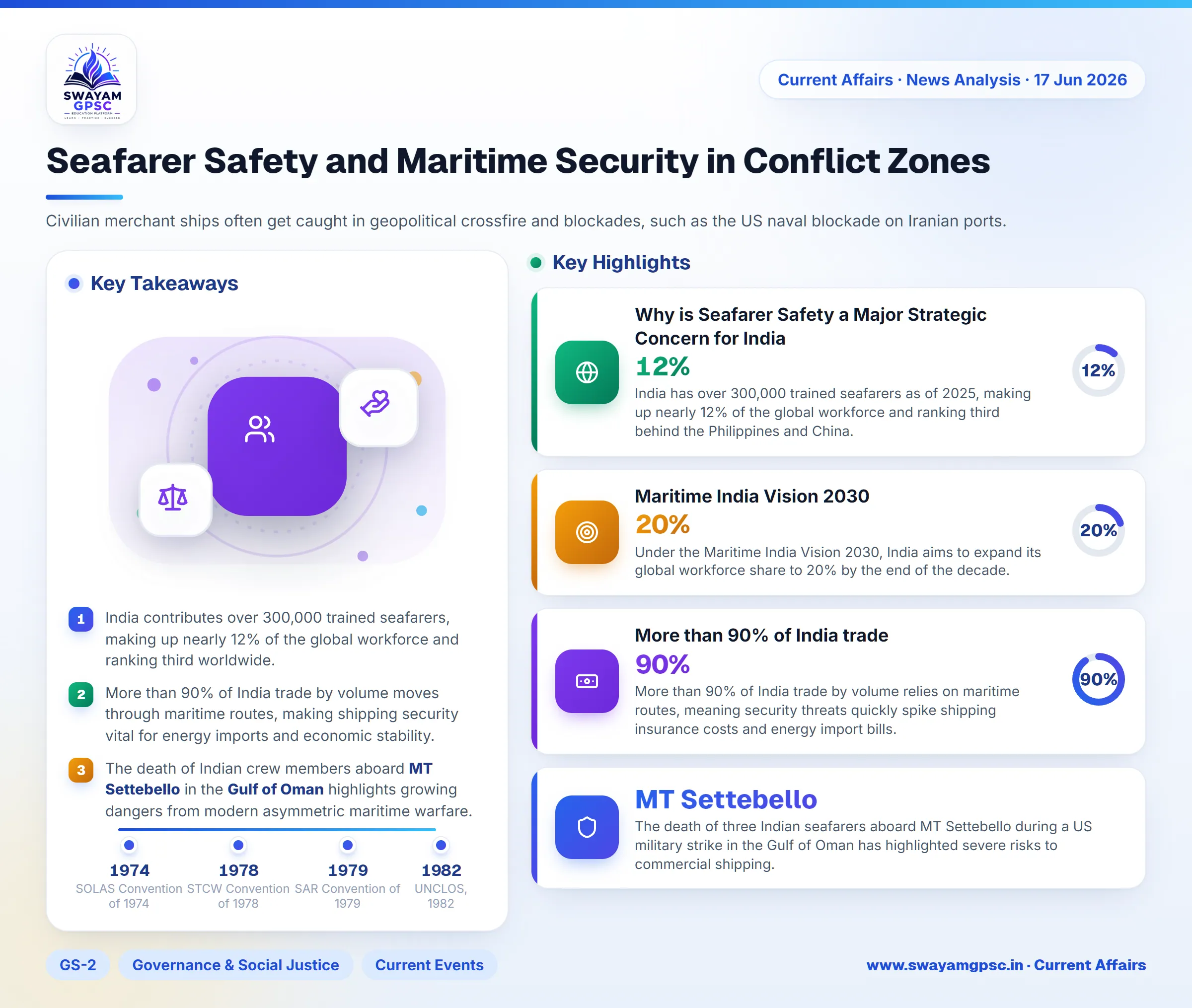
- India contributes over 300,000 trained seafarers, making up nearly 12% of the global workforce and ranking third worldwide.
- More than 90% of India trade by volume moves through maritime routes, making shipping security vital for energy imports and economic stability.
- The death of Indian crew members aboard MT Settebello in the Gulf of Oman highlights growing dangers from modern asymmetric maritime warfare.
- India aims to expand its share of the global seafaring workforce to 20% by 2030 under the Maritime India Vision 2030.
Why in News
- The death of three Indian seafarers aboard MT Settebello during a US military strike in the Gulf of Oman has highlighted severe risks to commercial shipping.
- This tragic incident brings maritime security and the safety of workers in conflict zones directly into focus for policymakers.
What is the Core Issue Affecting Seafarer Safety
- Modern maritime threats have shifted far beyond traditional piracy into the realm of Asymmetric Maritime Warfare.
- Commercial cargo ships now face military-grade precision munitions and drone strikes launched by both sovereign states and non-state actors.
- Civilian merchant ships often get caught in geopolitical crossfire and blockades, such as the US naval blockade on Iranian ports.
- Unarmed cargo vessels carrying combustible materials easily become vulnerable collateral damage in disputes that do not involve them.
- Ships accused of breaking international rules frequently lose vital safeguards like Protection and Indemnity (P&I) insurance cover.
- Global treaties like UNCLOS and the Maritime Labour Convention (MLC) lack strong enforcement powers when armed groups or militaries launch attacks on the high seas.
Sanctioned Vessels
- A sanctioned vessel is a commercial ship blacklisted under official trade, economic, or security laws.
- These restrictions are imposed globally through binding UN Security Council resolutions or unilaterally by regional blocs like the US, UK, or EU.
- Ships face sanctions due to links with blacklisted entities, transnational terrorism, or the illegal transport of weapons and prohibited oil.
- Vessels also face penalties for deceptive practices, such as disabling Automatic Identification Systems (AIS) and carrying out unauthorized transfers at sea.
- Unilateral sanctions only apply within the imposing nation unless backed by a formal UN Security Council resolution.
- Because of this distinction, a ship blacklisted by the United States is not automatically illegal under Indian law since India only enforces UN mandates.
Why is Seafarer Safety a Major Strategic Concern for India
- India has over 300,000 trained seafarers as of 2025, making up nearly 12% of the global workforce and ranking third behind the Philippines and China.
- Under the Maritime India Vision 2030, India aims to expand its global workforce share to 20% by the end of the decade.
- Thousands of Indian sailors operate in volatile chokepoints like the Strait of Hormuz and the Bab-el-Mandeb in the Red Sea.
- Many Indian sailors work on foreign ships registered under Flags of Convenience (FoC) like Panama, Liberia, and Palau.
- When global powers target these ships, Indian crew members become unintentional victims, and home countries have limited power to intervene directly.
- Indian seafarers send home billions of dollars in foreign remittances, supporting coastal families and the broader domestic economy.
- More than 90% of India trade by volume relies on maritime routes, meaning security threats quickly spike shipping insurance costs and energy import bills.
Legal Provisions for Seafarers' Safety
- The UNCLOS, 1982 treaty guarantees essential global principles including freedom of navigation and transit passage through international waters.
- The Maritime Labour Convention (MLC), 2006, ratified by India, acts as the Seafarers' Bill of Rights under the International Labour Organization (ILO).
- It sets clear rules ensuring fair working conditions, health protection, proper welfare, and repatriation rights for sailors.
- The STCW Convention of 1978 establishes global baseline training and qualification standards for ship masters and watch personnel.
- The SOLAS Convention of 1974, governed by the International Maritime Organization (IMO), sets minimum safety standards for merchant ship construction and equipment.
- The SAR Convention of 1979 coordinates international rescue efforts to assist any person or sailor in distress at sea.
- Domestically, the Merchant Shipping Act, 1958 serves as the core legislation regulating Indian-registered vessels and employment standards.
- The Directorate General of Shipping (DGS) acts as the top regulator under the Ministry of Ports, Shipping and Waterways.
- The Information Fusion Centre - Indian Ocean Region (IFC-IOR) located in Gurugram serves as the central hub for maritime domain awareness and intelligence sharing.
What Measures can Strengthen Seafarer Safety
- India must expand naval operations like Operation Sankalp to provide better surveillance and rapid rescue support in high-risk Arabian Sea zones.
- Authorities must adopt a risk-based approach involving regular safety assessments and clear advisories instead of applying blanket shipping bans.
- The Directorate General of Shipping (DGS) must audit placement agencies strictly to ensure crews give informed consent before entering dangerous waters.
- Sailors who refuse assignments in active war zones must receive legal protection against professional penalties.
- The government should build an inter-ministerial framework to coordinate crisis response, share real-time intelligence, and support affected families.
- India should use its leadership role in the Indian Ocean Rim Association (IORA) and the IMO to push for binding rules protecting civilian mariners in wartime.