The SBI Data Breach 2026
#GS-2 #GS-3 #Governance & Social Justice #Economy #Science & Technology #Good Governance #Cyber Security #Infrastructure #Current Events #National
Key takeaways
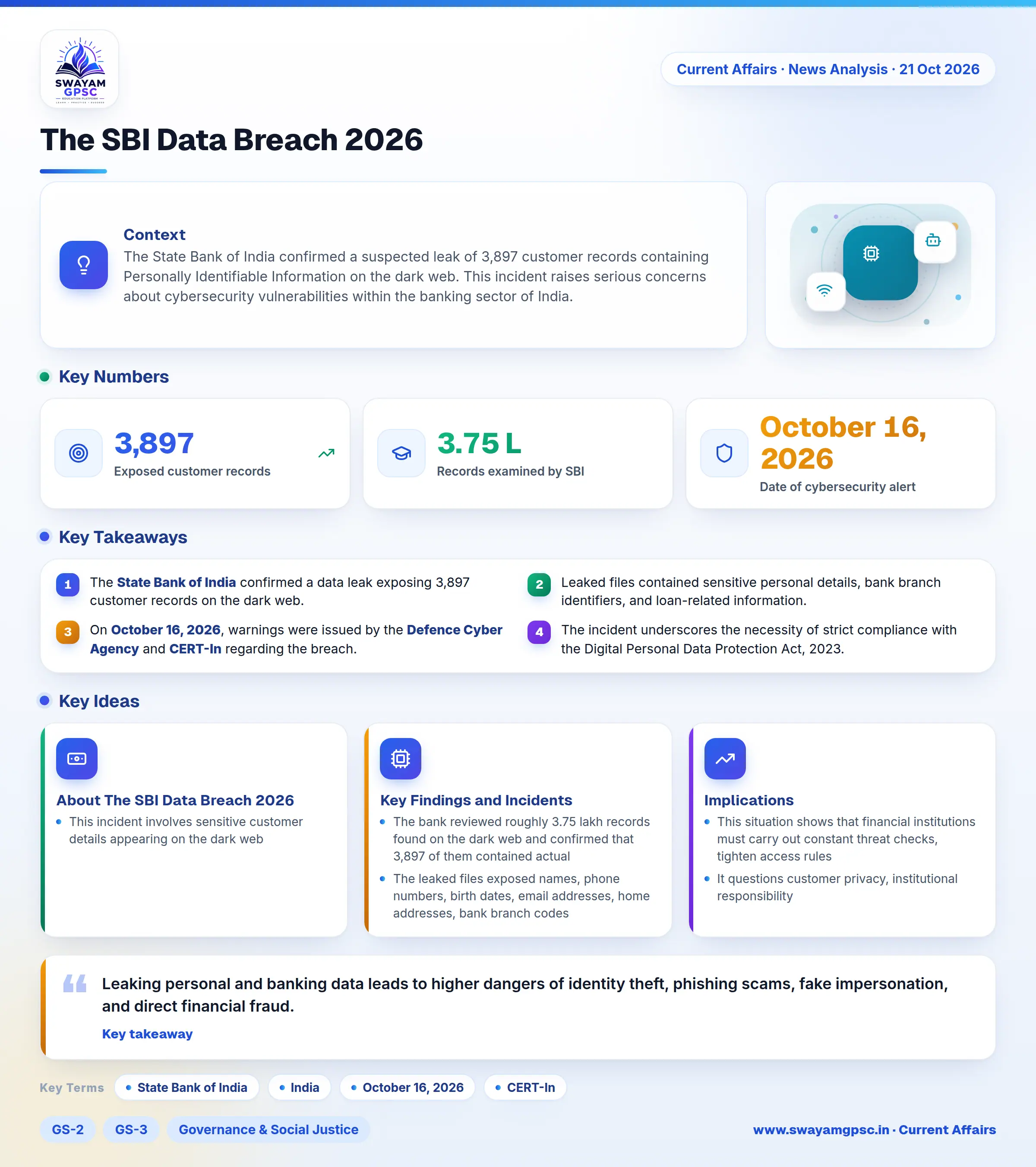
- The State Bank of India confirmed a data leak exposing 3,897 customer records on the dark web.
- Leaked files contained sensitive personal details, bank branch identifiers, and loan-related information.
- On October 16, 2026, warnings were issued by the Defence Cyber Agency and CERT-In regarding the breach.
- The incident underscores the necessity of strict compliance with the Digital Personal Data Protection Act, 2023.
Context
- The State Bank of India confirmed a suspected leak of 3,897 customer records containing Personally Identifiable Information on the dark web.
- This incident raises serious concerns about cybersecurity vulnerabilities within the banking sector of India.
About The SBI Data Breach 2026
- This incident involves sensitive customer details appearing on the dark web, which threatens personal privacy and raises the risk of financial fraud and identity theft.
Key Findings and Incidents
- The bank reviewed roughly 3.75 lakh records found on the dark web and confirmed that 3,897 of them contained actual customer data.
- The leaked files exposed names, phone numbers, birth dates, email addresses, home addresses, bank branch codes, and loan details.
- On October 16, 2026, the State Bank of India received warnings from its threat intelligence partner, the Defence Cyber Agency, and CERT-In about the suspected leak.
- The bank launched its emergency response plan and hired an independent cybersecurity firm approved by CERT-In to investigate the issue and fix security gaps.
- Separately, CERT-In warned that artificial intelligence agents gained unauthorized entry into Indian company systems by using exposed login details and loose cloud permissions.
Implications
- Leaking personal and banking data leads to higher dangers of identity theft, phishing scams, fake impersonation, and direct financial fraud.
- This situation shows that financial institutions must carry out constant threat checks, tighten access rules, report incidents quickly, and run independent security audits.
- It questions customer privacy, institutional responsibility, and compliance with the Digital Personal Data Protection Act, 2023.