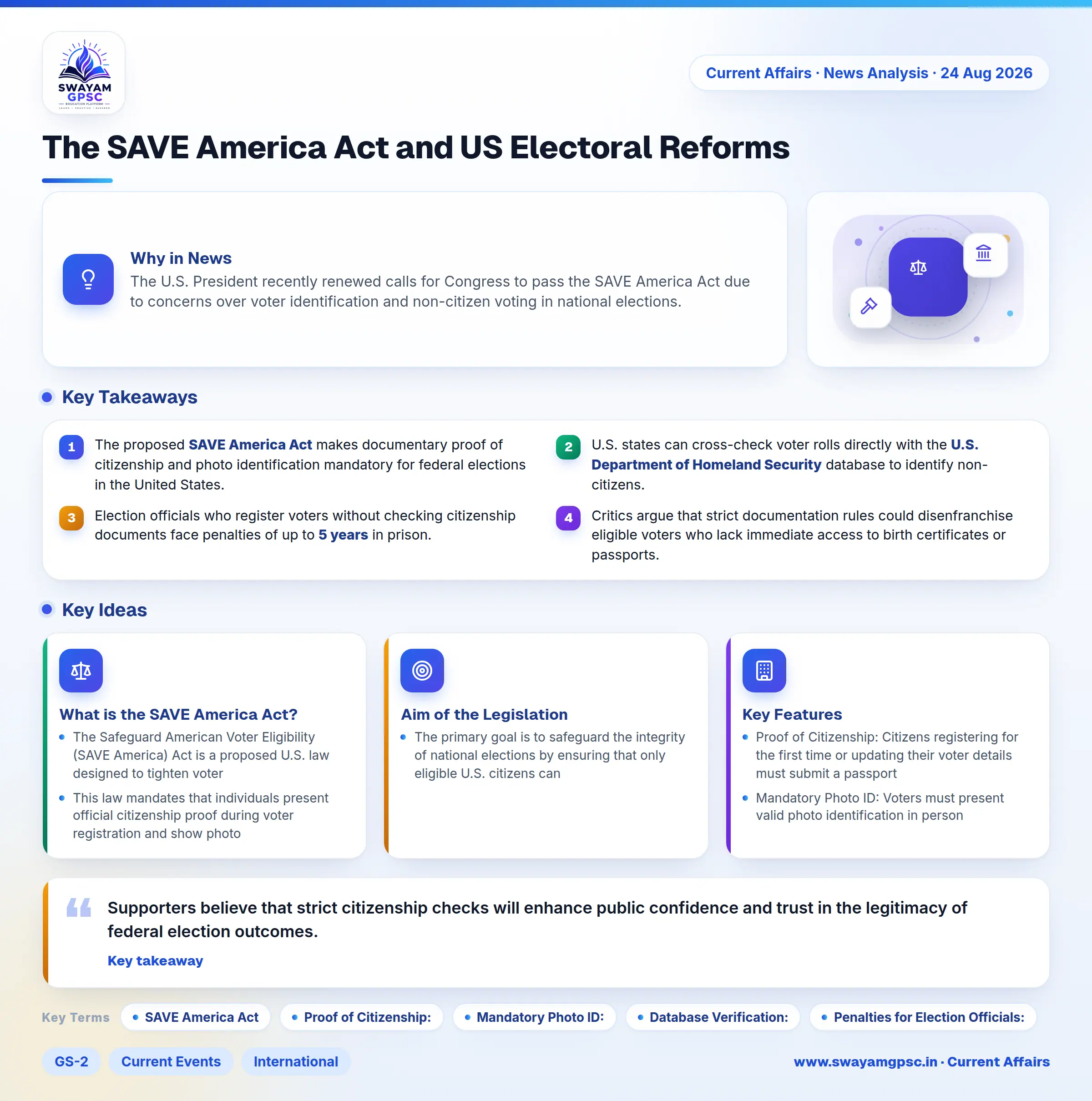
The SAVE America Act and US Electoral Reforms
#GS-2 #Current Events #International #Electoral Reforms #Polity
Key takeaways
- The proposed SAVE America Act makes documentary proof of citizenship and photo identification mandatory for federal elections in the United States.
- U.S. states can cross-check voter rolls directly with the U.S. Department of Homeland Security database to identify non-citizens.
- Election officials who register voters without checking citizenship documents face penalties of up to 5 years in prison.
- Critics argue that strict documentation rules could disenfranchise eligible voters who lack immediate access to birth certificates or passports.
Why in News
- The U.S. President recently renewed calls for Congress to pass the SAVE America Act due to concerns over voter identification and non-citizen voting in national elections.
What is the SAVE America Act?
- The Safeguard American Voter Eligibility (SAVE America) Act is a proposed U.S. law designed to tighten voter registration and identity requirements for federal elections.
- This law mandates that individuals present official citizenship proof during voter registration and show photo identification when voting, including through mail-in ballots.
Aim of the Legislation
- The primary goal is to safeguard the integrity of national elections by ensuring that only eligible U.S. citizens can vote while removing ineligible non-citizens from voter lists.
Key Features
- Proof of Citizenship: Citizens registering for the first time or updating their voter details must submit a passport, birth certificate, or naturalization paperwork alongside photo identification.
- Mandatory Photo ID: Voters must present valid photo identification in person, while mail-in voters must enclose a physical copy of their photo ID.
- Database Verification: U.S. states can cross-check their voting rolls with records from the U.S. Department of Homeland Security to identify potential non-citizens.
- Penalties for Election Officials: Any election official who registers individuals without verifying citizenship documentation faces up to 5 years of imprisonment.
Significance
- Supporters believe that strict citizenship checks will enhance public confidence and trust in the legitimacy of federal election outcomes.
Challenges
- Critics warn that strict documentation rules might prevent eligible citizens from voting, especially those who lack quick access to passports or birth certificates.