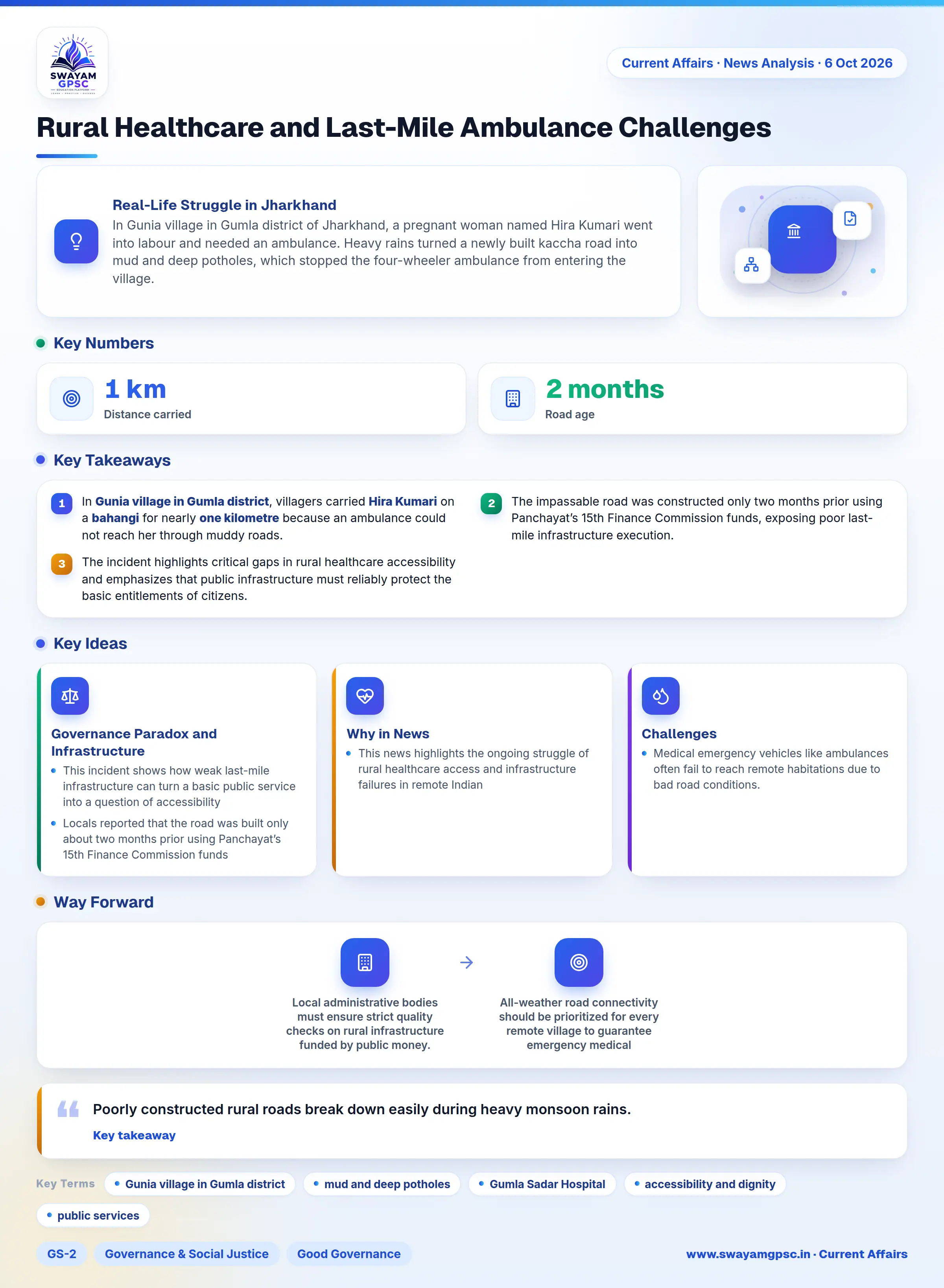
Rural Healthcare and Last-Mile Ambulance Challenges
#GS-2 #Governance & Social Justice #Good Governance #Health #Infrastructure #Poverty #Rural Development #Current Events #National
Key takeaways
- In Gunia village in Gumla district, villagers carried Hira Kumari on a bahangi for nearly one kilometre because an ambulance could not reach her through muddy roads.
- The impassable road was constructed only two months prior using Panchayat’s 15th Finance Commission funds, exposing poor last-mile infrastructure execution.
- The incident highlights critical gaps in rural healthcare accessibility and emphasizes that public infrastructure must reliably protect the basic entitlements of citizens.
Real-Life Struggle in Jharkhand
- In Gunia village in Gumla district of Jharkhand, a pregnant woman named Hira Kumari went into labour and needed an ambulance.
- Heavy rains turned a newly built kaccha road into mud and deep potholes, which stopped the four-wheeler ambulance from entering the village.
- Villagers put her on a ‘bahangi’ - a makeshift sling carrier - and two men carried her for nearly one kilometre to the main road.
- She was finally shifted to a waiting ambulance and taken to Gumla Sadar Hospital for her medical care.
Governance Paradox and Infrastructure Flaws
- This incident shows how weak last-mile infrastructure can turn a basic public service into a question of accessibility and dignity.
- Locals reported that the road was built only about two months prior using Panchayat’s 15th Finance Commission funds but broke down quickly due to poor construction.
- For pregnant women, senior citizens, and seriously ill patients, bad roads act as a barrier between timely treatment and preventable suffering.
- This case highlights a major governance issue where public services may exist on paper, but their value depends on whether citizens can actually reach them.
- True development means ensuring that infrastructure protects the life, dignity and basic entitlements of the last citizen.
Why in News
- This news highlights the ongoing struggle of rural healthcare access and infrastructure failures in remote Indian villages.
Challenges
- Poorly constructed rural roads break down easily during heavy monsoon rains.
- Medical emergency vehicles like ambulances often fail to reach remote habitations due to bad road conditions.
Way Forward
- Local administrative bodies must ensure strict quality checks on rural infrastructure funded by public money.
- All-weather road connectivity should be prioritized for every remote village to guarantee emergency medical access.