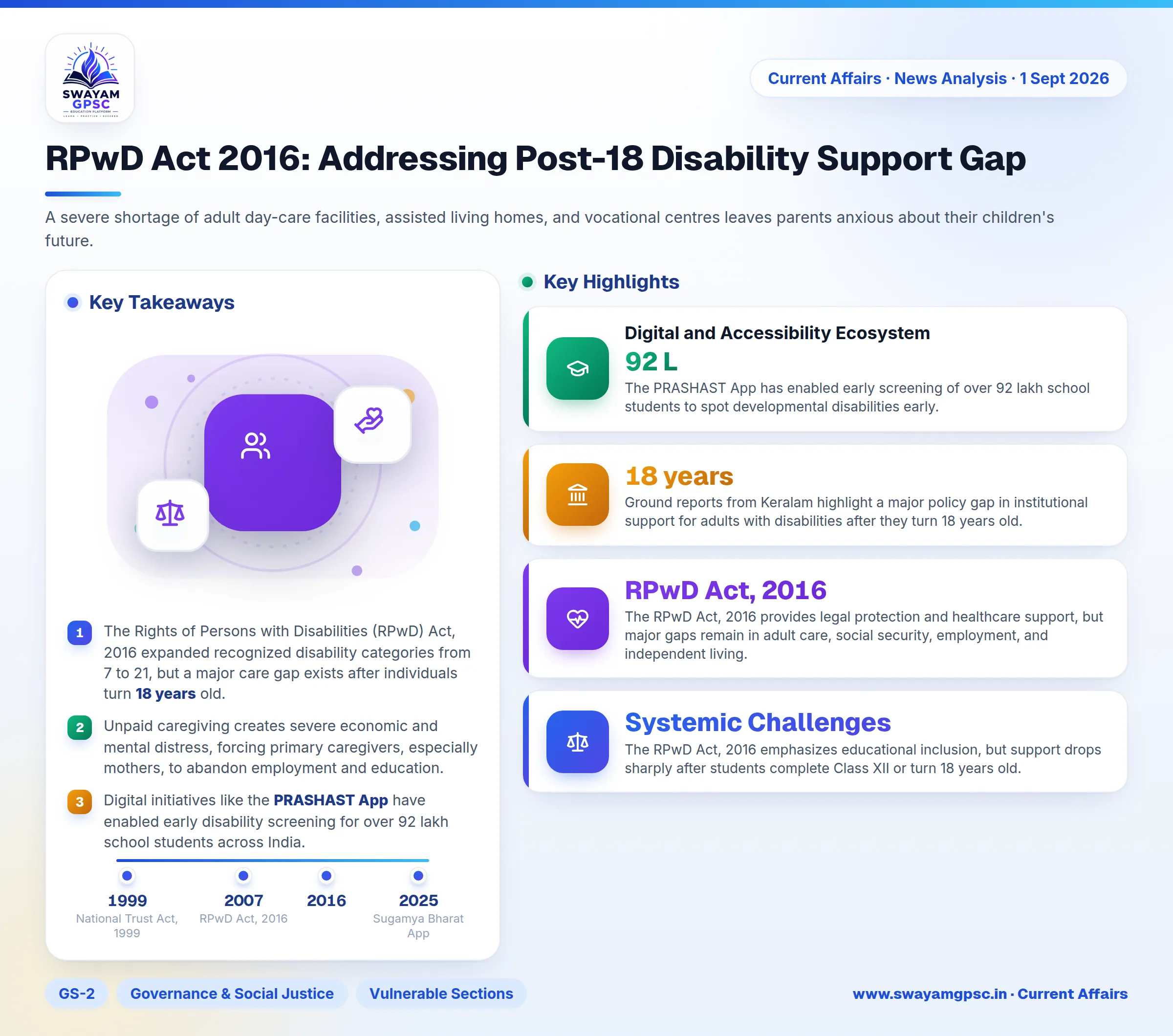
RPwD Act 2016: Addressing Post-18 Disability Support Gap
#GS-2 #Governance & Social Justice #Vulnerable Sections #Rights of Persons with Disabilities Act 2016 #Government Policies & Interventions #Welfare Schemes #Caregiver Burden #Accessibility
Key takeaways
- The Rights of Persons with Disabilities (RPwD) Act, 2016 expanded recognized disability categories from 7 to 21, but a major care gap exists after individuals turn 18 years old.
- Unpaid caregiving creates severe economic and mental distress, forcing primary caregivers, especially mothers, to abandon employment and education.
- Digital initiatives like the PRASHAST App have enabled early disability screening for over 92 lakh school students across India.
- Strengthening adult day-care centres, respite homes like Anpu Homes, and inflation-indexed pensions is essential to ensure long-term security for disabled citizens.
Why in News
- Nearly ten years after passing the Rights of Persons with Disabilities (RPwD) Act, 2016, discussions still focus mostly on primary education and basic physical accessibility.
- Ground reports from Keralam highlight a major policy gap in institutional support for adults with disabilities after they turn 18 years old.
- This lack of state support transfers a lifetime caregiving burden onto families, leading to deep financial and social distress.
Summary
- The RPwD Act, 2016 provides legal protection and healthcare support, but major gaps remain in adult care, social security, employment, and independent living.
- India needs to strengthen caregiver support, respite homes, early intervention, and departmental coordination to ensure long-term security for disabled individuals.
Systemic Challenges in Disability Rehabilitation
- The RPwD Act, 2016 emphasizes educational inclusion, but support drops sharply after students complete Class XII or turn 18 years old.
- A severe shortage of adult day-care facilities, assisted living homes, and vocational centres leaves parents anxious about their children's future.
- Most care systems rely heavily on parents, forcing mothers to quit their jobs and experience financial loss along with social isolation.
- Continuous caretaking leads to severe mental exhaustion, sleep deprivation, and high risk of depression among family caregivers.
- Poor awareness and weak last-mile delivery prevent many eligible families from receiving their government disability pensions.
- Lack of awareness about scientific treatments drives families toward fake miracle cures, resulting in heavy financial loss and delayed care.
- Poor coordination among the health, education, and social welfare departments breaks the delivery of rehabilitation services.
- Parents lack temporary institutional care facilities when they face personal medical emergencies or work commitments.
- Families caring for female disabled members face extra challenges regarding personal safety, bodily privacy, and hygiene management.
- A lack of community living centres and supported job programs stops individuals with intellectual disabilities from becoming self-reliant.
- Weak auditing and monitoring mean accessible infrastructure like wheelchair ramps on buses often remains broken or unused.
- Targeted awareness campaigns and behavioral changes are necessary so that public infrastructure is actually usable by disabled citizens.
India's Disability Policy Framework
- The RPwD Act, 2016 replaced the older 1995 law under Article 253 of the Constitution to meet UNCRPD standards ratified in 2007.
- The law expands recognized disability categories to 21, mandates job and education quotas, and prohibits discrimination.
- It mandates universal physical and digital accessibility across public infrastructure under the Sugamya Bharat Abhiyan.
- The law protects legal decision-making rights of disabled persons by replacing full guardianship with limited, supported decision-making.
- It establishes Special Courts and strict penalties to protect the dignity and legal rights of disabled individuals.
- The National Trust Act, 1999 provides legal guardianship and welfare support for autism, cerebral palsy, and multiple disabilities.
- The Rehabilitation Council of India (RCI) Act, 1992 standardizes training programs for special educators and rehabilitation professionals.
- The SIPDA scheme provides central financial and technical help to state governments for implementing disability rights.
Financial, Medical, and Institutional Support
- The ADIP scheme supplies free assistive devices and funds surgeries like cochlear implants to promote independent living.
- The National Divyangjan Finance and Development Corporation (NDFDC) gives low-interest loans for self-employment through schemes like Divyangjan Swavalamban Yojana.
- The ALIMCO public sector enterprise manufactures affordable limbs and assistive equipment on a national scale.
- The Deendayal Divyangjan Rehabilitation Scheme (DDRS) provides grant-in-aid support to non-governmental organizations running special schools.
Digital and Accessibility Ecosystem
- The Sugamya Bharat Abhiyan drives universal access across public buildings, transport networks, and digital platforms.
- The Sugamya Bharat App, updated in 2025 at Purple Fest, allows users to report accessibility barriers directly to authorities.
- The UDID Scheme creates a single national database that issues unique identity cards to streamline benefit delivery.
- The PM-DAKSH-DEPwD Portal connects disabled job seekers with skill training and private sector job opportunities.
- The PRASHAST App has enabled early screening of over 92 lakh school students to spot developmental disabilities early.
Way Forward: Strengthening Disability Support
- State governments should build assisted-living homes and adult day-care centres using subsidized land and viability gap funding.
- States should set up temporary respite-care centres, similar to Kerala's Anpu Homes, in every district to support caregivers.
- The government should offer caregiver allowances, monthly pensions, and mental health counseling through District Disability Rehabilitation Centres (DDRCs).
- Health authorities must expand District Early Intervention Centres (DEICs) to detect developmental delays during early childhood.
- Medical bodies must set standard treatment rules to protect families from fake cure claims and high medical bills.
- Companies should adopt clear disability diversity goals, supported by tax incentives and preferential government procurement policies.
- Disability pension amounts must link to inflation rates and cover the real costs of special care and assistive devices.
- Key ministries including Social Justice, Health, Education, and Skill Development must coordinate closely to deliver unified services.
- Authorities should link the UDID card directly to education, health, job training, and monthly pension benefits.
- The government must expand the Sugamya Bharat Abhiyan to cover rural public transport and digital platforms.
- Schools and local panchayats should introduce disability awareness programs to reduce social stigma and promote community inclusion.
Conclusion
- India must transition from family-based care to an institutional life-cycle support model for persons with disabilities.
- Better execution of the RPwD Act, 2016, along with respite care and job linkages, will secure dignity and independence for disabled citizens.