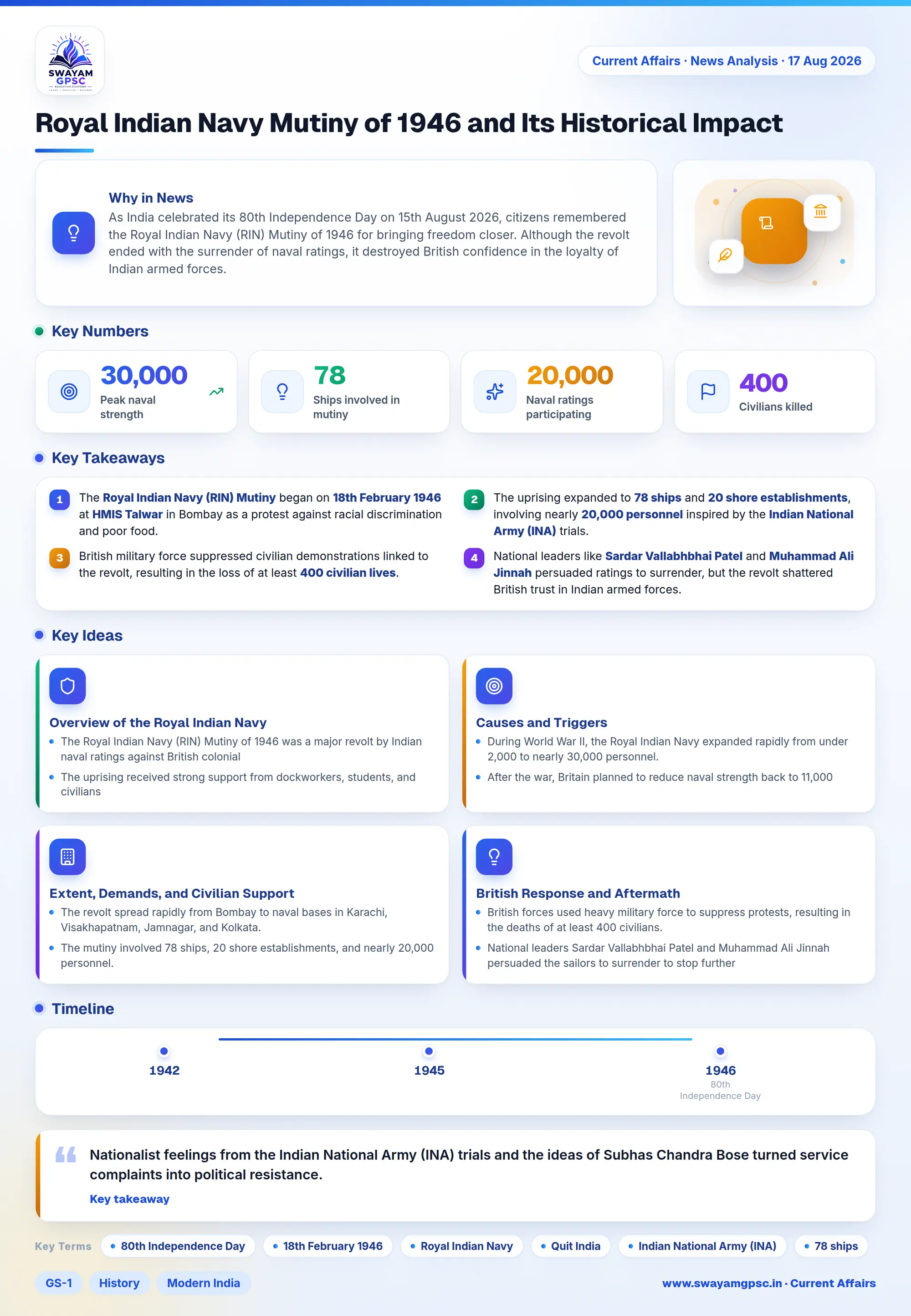
Royal Indian Navy Mutiny of 1946 and Its Historical Impact
#GS-1 #History #Modern India #Freedom Struggle #GS-2 #Current Events #National #Royal Indian Navy Mutiny #1946 Mutiny
Key takeaways
- The Royal Indian Navy (RIN) Mutiny began on 18th February 1946 at HMIS Talwar in Bombay as a protest against racial discrimination and poor food.
- The uprising expanded to 78 ships and 20 shore establishments, involving nearly 20,000 personnel inspired by the Indian National Army (INA) trials.
- British military force suppressed civilian demonstrations linked to the revolt, resulting in the loss of at least 400 civilian lives.
- National leaders like Sardar Vallabhbhai Patel and Muhammad Ali Jinnah persuaded ratings to surrender, but the revolt shattered British trust in Indian armed forces.
Why in News
- As India celebrated its 80th Independence Day on 15th August 2026, citizens remembered the Royal Indian Navy (RIN) Mutiny of 1946 for bringing freedom closer.
- Although the revolt ended with the surrender of naval ratings, it destroyed British confidence in the loyalty of Indian armed forces.
Overview of the Royal Indian Navy Mutiny
- The Royal Indian Navy (RIN) Mutiny of 1946 was a major revolt by Indian naval ratings against British colonial authority.
- The uprising received strong support from dockworkers, students, and civilians, while inspiring sympathy across other military branches.
- Starting as a strike on 18th February 1946 in Bombay, the revolt quickly turned into a nationwide anti-imperialist movement.
Causes and Triggers
- During World War II, the Royal Indian Navy expanded rapidly from under 2,000 to nearly 30,000 personnel.
- After the war, Britain planned to reduce naval strength back to 11,000, causing severe job insecurity among Indian sailors.
- Indian ratings faced racial discrimination, unhygienic living conditions, and bad food compared to British personnel.
- Between 1942 and 1945, nine smaller mutinies had already occurred over poor living conditions and bad management.
- Ratings painted anti-British slogans like Quit India and Down with the British on HMIS Talwar in late 1945 and early February 1946.
- The main strike began on 18th February 1946 after Commander Arthur Frederick King hurled racial abuse and ignored grievances.
- Nationalist feelings from the Indian National Army (INA) trials and the ideas of Subhas Chandra Bose turned service complaints into political resistance.
Extent, Demands, and Civilian Support
- The revolt spread rapidly from Bombay to naval bases in Karachi, Visakhapatnam, Jamnagar, and Kolkata.
- The mutiny involved 78 ships, 20 shore establishments, and nearly 20,000 personnel.
- Mutineers formed a Naval Strike Committee, called themselves the Indian National Navy, and hoisted Congress and Muslim League flags.
- Dock workers, mill workers, railway employees, and students joined protests, halting commercial activity and public transport in Bombay.
- Ratings demanded better food, pay parity with the Royal Navy, job protection after demobilization, and access to NAAFI stores.
- Political demands included the release of INA detainees, withdrawal of Indian troops from Indonesia, and an end to imperial expansion.
British Response and Aftermath
- British forces used heavy military force to suppress protests, resulting in the deaths of at least 400 civilians.
- National leaders Sardar Vallabhbhai Patel and Muhammad Ali Jinnah persuaded the sailors to surrender to stop further bloodshed.
- The sailors surrendered on political advice, limiting the immediate political results of the uprising.
- Unlike the INA movement, this mutiny lacked a single prominent leader to serve as a lasting national symbol.
- Often called the last war of independence, the revolt showed that Britain could no longer rely on Indian soldiers to maintain colonial rule.