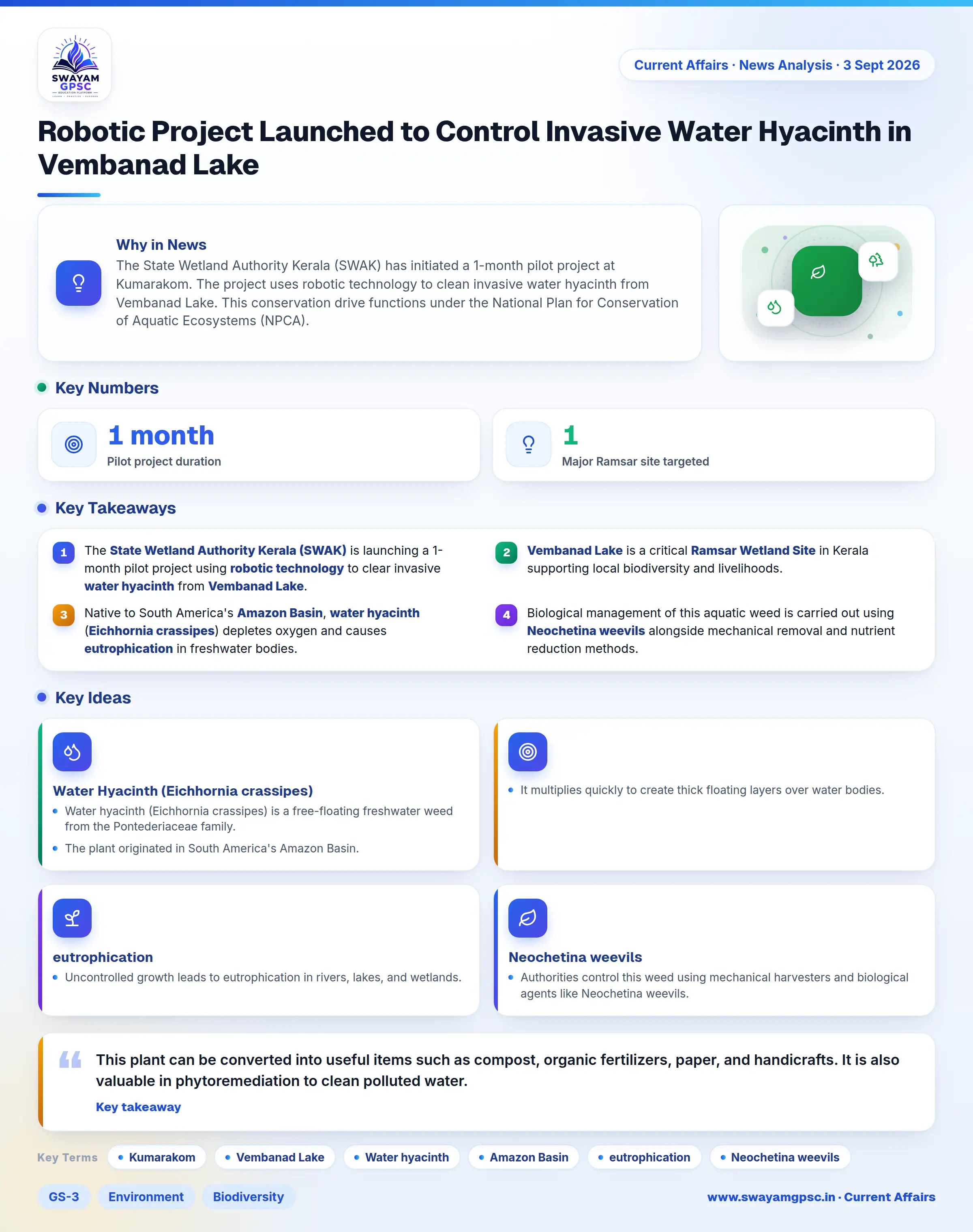
Robotic Project Launched to Control Invasive Water Hyacinth in Vembanad Lake
#GS-3 #Environment #Biodiversity #Science & Technology #Current Events #National
Key takeaways
- The State Wetland Authority Kerala (SWAK) is launching a 1-month pilot project using robotic technology to clear invasive water hyacinth from Vembanad Lake.
- Vembanad Lake is a critical Ramsar Wetland Site in Kerala supporting local biodiversity and livelihoods.
- Native to South America's Amazon Basin, water hyacinth (*Eichhornia crassipes*) depletes oxygen and causes eutrophication in freshwater bodies.
- Biological management of this aquatic weed is carried out using Neochetina weevils alongside mechanical removal and nutrient reduction methods.
Why in News
- The State Wetland Authority Kerala (SWAK) has initiated a 1-month pilot project at Kumarakom. The project uses robotic technology to clean invasive water hyacinth from Vembanad Lake.
- This conservation drive functions under the National Plan for Conservation of Aquatic Ecosystems (NPCA). It operates under the Ministry of Environment, Forest and Climate Change (MoEFCC).
- Vembanad Lake is a key Ramsar Wetland Site in Kerala. It sustains rich aquatic biodiversity, local fishing industries, tourism, and community livelihoods.
Water Hyacinth (Eichhornia crassipes)
- Water hyacinth (*Eichhornia crassipes*) is a free-floating freshwater weed from the Pontederiaceae family. It is recognized globally as an invasive alien species.
- The plant originated in South America's Amazon Basin. People introduced it to India and other countries as a decorative plant because of its purple flowers.
- It multiplies quickly to create thick floating layers over water bodies. These layers block sunlight from reaching underwater plants and drastically reduce dissolved oxygen levels.
- Uncontrolled growth leads to eutrophication in rivers, lakes, and wetlands. This chokes water channels, hurting fish farming, boat navigation, crop irrigation, and tourism activities.
- Authorities control this weed using mechanical harvesters and biological agents like Neochetina weevils. Stopping sewage run-off and nutrient pollution also prevents its rapid growth.
- This plant can be converted into useful items such as compost, organic fertilizers, paper, and handicrafts. It is also valuable in phytoremediation to clean polluted water.