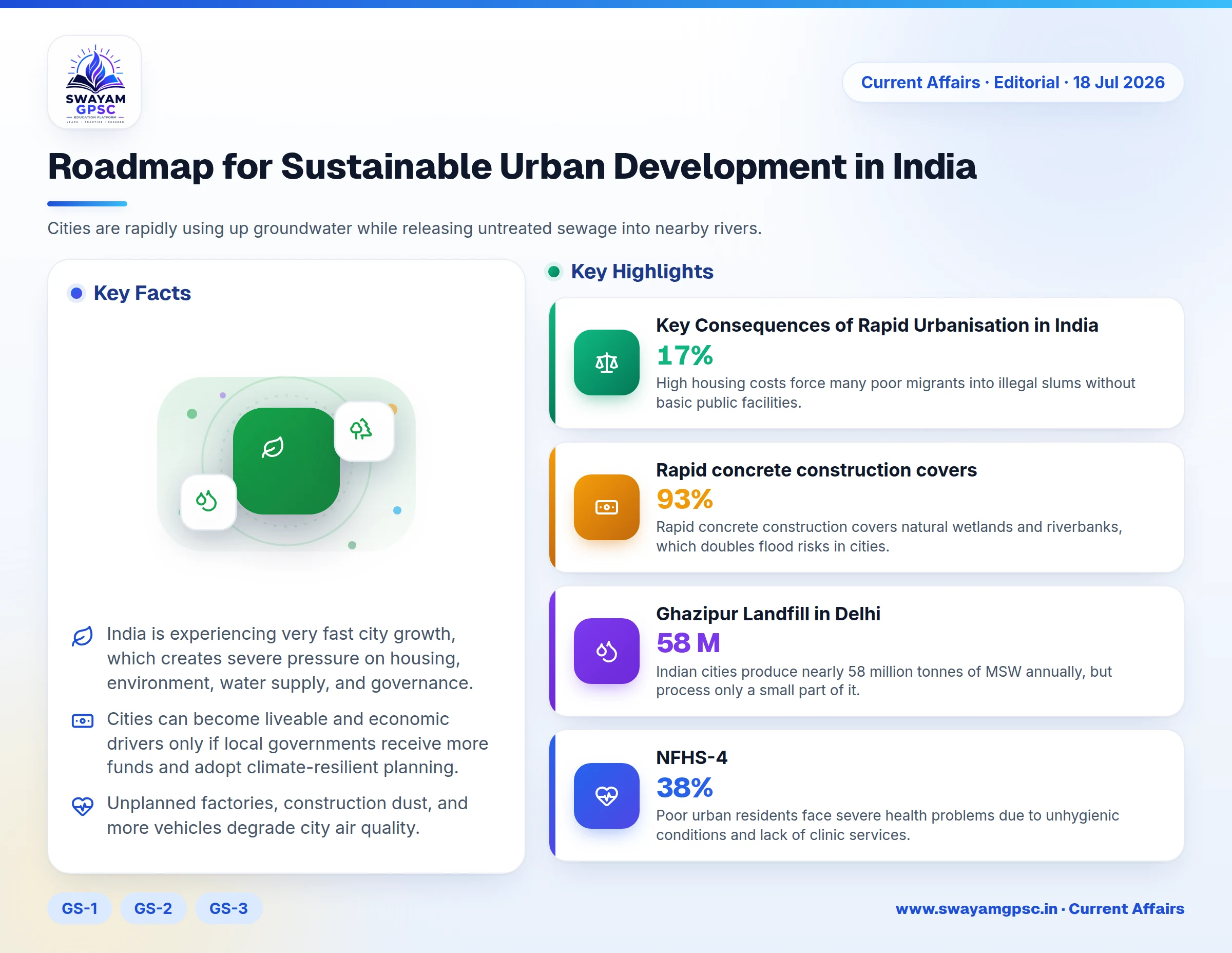
Roadmap for Sustainable Urban Development in India
#GS-1 #GS-2 #GS-3 #Geography #Population #Indian Polity & Constitution #Local Government #Governance & Social Justice #Economy #Infrastructure #Environment #Climate Change #Sustainable Development #Urbanization
Why in News
- India is experiencing very fast city growth, which creates severe pressure on housing, environment, water supply, and governance.
- Cities can become liveable and economic drivers only if local governments receive more funds and adopt climate-resilient planning.
Key Consequences of Rapid Urbanisation in India
- High housing costs force many poor migrants into illegal slums without basic public facilities. Around 17% of India's total urban population lives in informal settlements, with Dharavi in Mumbai housing over 1 million people in just 2.1 square kilometres.
- Unplanned factories, construction dust, and more vehicles degrade city air quality. Major cities face serious smog every winter, raising fine particulate matter levels and causing widespread lung diseases.
- Rapid concrete construction covers natural wetlands and riverbanks, which doubles flood risks in cities. For instance, Bengaluru lost 93% of its lake and forest cover as construction grew by 1,000%, leading to frequent waterlogging.
- Cities are rapidly using up groundwater while releasing untreated sewage into nearby rivers. Chennai faced Day Zero in 2019 when its major reservoirs dried up completely, forcing people to buy water from costly private tankers.
- Indian cities produce nearly 58 million tonnes of MSW annually, but process only a small part of it. The Ghazipur Landfill in Delhi has crossed 60 meters in height, frequently catching fire and leaking dangerous heavy metals into groundwater.
- Transport systems fail to keep up with economic expansion, leading to daily traffic jams. Corporate areas like Electronic City in Bengaluru experience heavy delays because road networks are narrow and public transit expands slowly.
- Poor urban residents face severe health problems due to unhygienic conditions and lack of clinic services. According to NFHS-4, 38% of urban poor children suffer from stunted growth, while diseases like dengue spread easily in dense settlements.
- Local city authorities lack financial independence and administrative power to run cities effectively. State governments have not transferred powers mandated under the 74th Constitutional Amendment Act, 1992, leaving 65% of India's statutory urban settlements without any proper Master Plan.
Key Steps Required for Sustainable Urban Development
- Local bodies must create GIS-based Master Plans using satellite maps to direct city growth systematically. Cities should adopt Transit-Oriented Development so residents can easily walk within 500 to 800 meters to access public transport stops.
- Urban design must protect wetlands and build Blue-Green Infrastructure to store rainwater naturally. Following the "Sponge Cities" model with permeable pavements in public parks and parking lots allows groundwater to recharge quickly.
- Municipalities should mandate source segregation of waste and enforce Zero Liquid Discharge (ZLD) rules for large factories. Cities need to build automated Material Recovery Facilities (MRFs) to recycle solid waste and treat sewage water for industrial reuse.
- Authorities must combine metro networks, city buses, and safe cycling tracks into one seamless system. Cities should convert public buses to electric vehicles and offer single digital tickets through Common Mobility Cards for easy commuting.
- Building codes must enforce energy efficiency standards set under the Energy Conservation Building Code (ECBC). Regulations should promote passive cooling designs, high-albedo cool roofs, and compulsory rooftop rainwater harvesting in all construction.
- State governments must grant full administrative and financial rights to local bodies under the 74th Constitutional Amendment Act, 1992. Municipalities can improve tax collection through digital mapping and issue Municipal Bonds to gather capital for infrastructure projects.
- Governments should pursue in-situ slum upgradation and build affordable housing units through Public-Private Partnerships (PPPs). These new housing units must have reliable power supply, clean drinking water taps, and proper underground drain networks.
- Planning agencies should develop self-sustaining counter-magnet towns and Tier-2 or Tier-3 cities to spread out economic activities. Building high-speed express transit and relocating universities or factories will reduce population pressure on mega-cities.
Conclusion
- The challenges of urban growth in India stem primarily from weak local governance rather than a total lack of resources.
- Cities can become liveable and sustainable only through strong fiscal autonomy for local bodies, decentralized urban planning, and nature-based infrastructure solutions.
Frequently Asked Questions (FAQs)
- Transit-Oriented Development focuses on constructing high-density residential and commercial hubs within 500 to 800 meters of mass transit stations to encourage walking and reduce private car use.
- Urban penalties refer to the severe health and nutritional disadvantages faced by the urban poor compared to rural populations, such as 38% of slum children suffering from stunting under NFHS-4.
- The Sponge City model uses permeable paving materials and natural water features to absorb rainwater runoff, prevent localized flooding, and recharge underground aquifers naturally.