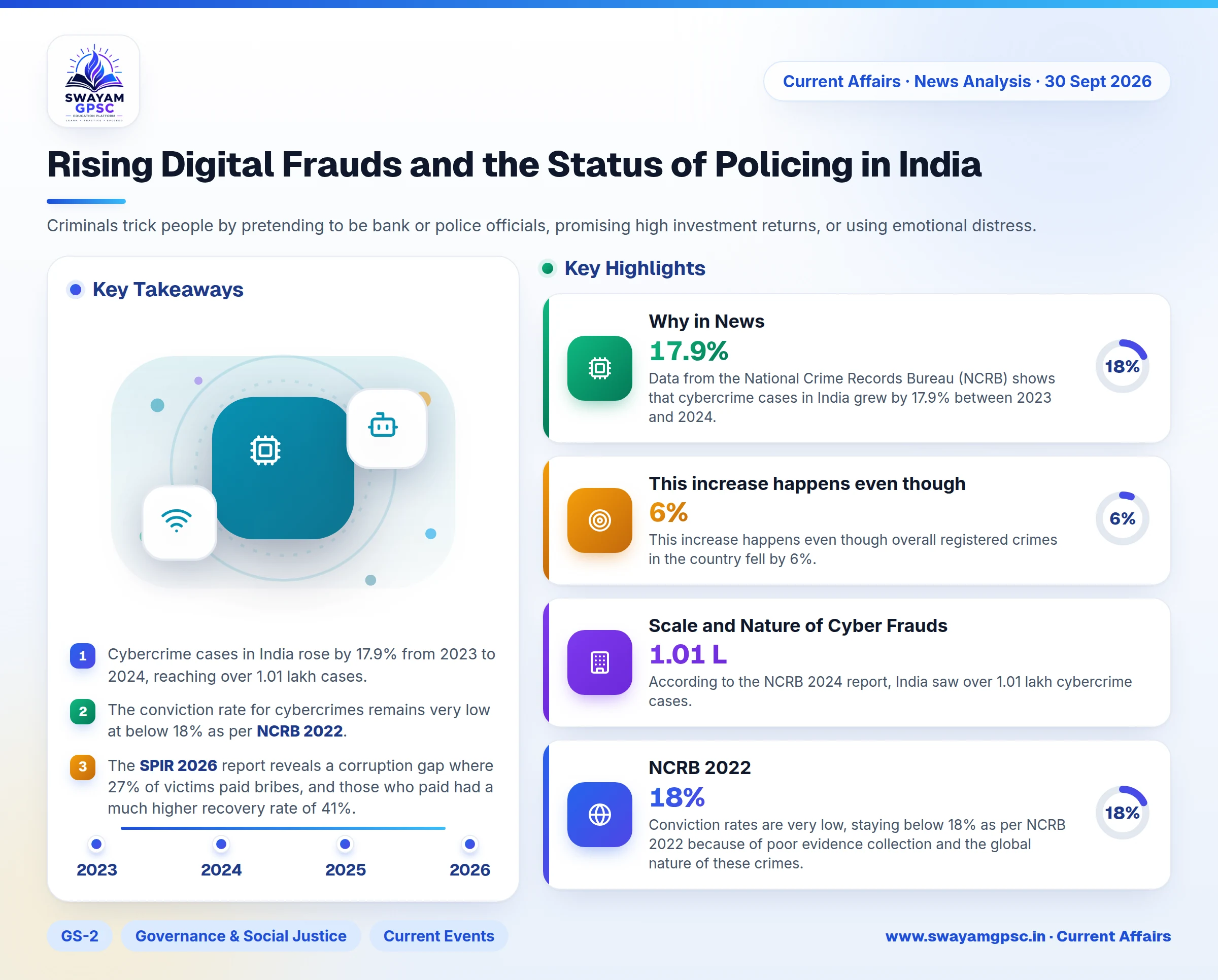
Rising Digital Frauds and the Status of Policing in India
#GS-2 #Governance & Social Justice #Current Events #National #GS-3 #Cyber Security #Cyber Warfare #Challenges to Internal Security Through Communication Networks #Money Laundering
Key takeaways
- Cybercrime cases in India rose by 17.9% from 2023 to 2024, reaching over 1.01 lakh cases.
- The conviction rate for cybercrimes remains very low at below 18% as per NCRB 2022.
- The SPIR 2026 report reveals a corruption gap where 27% of victims paid bribes, and those who paid had a much higher recovery rate of 41%.
- Modern frauds rely on social engineering and AI-enabled tools like deepfakes rather than technical hacking.
- Key institutional defenses include the I4C, CERT-In, and tools like the 1930 helpline for real-time fund freezing.
Why in News
- Data from the National Crime Records Bureau (NCRB) shows that cybercrime cases in India grew by 17.9% between 2023 and 2024.
- This increase happens even though overall registered crimes in the country fell by 6%.
- The Status of Policing in India Report (SPIR) 2026 warns that citizens are very vulnerable to cyber fraud and face huge hurdles in getting justice.
Scale and Nature of Cyber Frauds
- According to the NCRB 2024 report, India saw over 1.01 lakh cybercrime cases.
- The digital crime rate has reached 7.3 per lakh population, showing a shift from local physical crimes to borderless digital ones.
- Conviction rates are very low, staying below 18% as per NCRB 2022 because of poor evidence collection and the global nature of these crimes.
- Most frauds now use social engineering, which means psychological manipulation instead of technical hacking.
- Criminals trick people by pretending to be bank or police officials, promising high investment returns, or using emotional distress.
- Cybercrime is now a byproduct of deep digital integration, often called a tax on connectivity.
- Fraudsters track digital footprints to target wealthy and highly educated professionals.
- New scams include AI-enabled frauds, organized syndicates, and Digital Arrest scams using deepfakes and phishing.
- Criminals use Voice over Internet Protocol (VoIP) to hide their location and move money through mule accounts to avoid detection.
- The Unified Payments Interface (UPI) is a common target through compromised mobile numbers.
- Most crimes under the Information Technology Act, 2000 are for financial gain through forgery, cheating, and fraud.
- Over 80% of victims lost money, and 23% lost more than Rs 20,000.
India's Legal Framework
- The Information Technology Act, 2000 is the main law that punishes identity theft and protects critical infrastructure under Section 70A.
- The IT (Intermediary Guidelines and Digital Media Ethics Code) Rules, 2021 hold social media and digital markets accountable for removing illegal content.
- The Digital Personal Data Protection (DPDP) Act, 2023 requires data handlers to get clear user consent and keep data secure.
- The Promotion and Regulation of Online Gaming Act, 2025 supports e-sports but bans online money gaming and its promotion.
Institutional Defence Mechanisms
- The Indian Computer Emergency Response Team (CERT-In) tracks cyber threats and coordinates the response to incidents.
- The Indian Cybercrime Coordination Centre (I4C) helps different law enforcement agencies share information in real time.
- The National Critical Information Infrastructure Protection Centre (NCIIPC) protects vital sectors like banking, power, and telecom.
Challenges in Securing Justice
- Many victims never report crimes or quit the process because of complex paperwork and lack of trust in the police.
- Marginalized groups, including the poor and women, often have to pay bribes or use personal connections to get police help.
- The golden hour is often missed because stolen money is moved through mule accounts before banks can freeze them.
- Police are limited by territorial borders, while criminals use VoIP and VPNs to operate across states and countries.
- Local police stations lack the digital forensic tools and blockchain skills needed to secure convictions under the Bharatiya Sakshya Adhiniyam (BSA), 2023.
Way Forward
- Registering First Information Reports (FIRs) for cyber fraud must be mandatory and time bound to stop police bias.
- The Financial Fraud Risk Indicator (FRI) should be expanded to block suspicious numbers before the fraud happens.
- The I4C, Reserve Bank of India (RBI), and banks need a real time system to freeze funds in the golden hour without manual delays.
- Capacity must be increased for the 1930 Cybercrime Helpline and the National Cyber Crime Reporting Portal.
- Digital literacy should focus on teaching people how to spot psychological tricks rather than just generic warnings.
- The Sahyog Portal should be scaled up to remove phishing links and fake apps quickly.
- Cyber cells need internal audits to stop corruption and ensure fair treatment for all citizens.
Prelims in Focus: SPIR 2026 Report
- The Status of Policing in India Report (SPIR) 2026 was published by Lokniti-CSDS and Common Cause based on a survey of 8,306 citizens across 16 states.
- The report found that 33% of people got calls about unordered deliveries and 31% faced investment scams.
- High internet usage increases risk, with 46% of heavy users reporting scams compared to 19% of non-users.
- About 13% of surveyed citizens were cybercrime victims in the last 2 to 3 years.
- Wealthy people (57%) and college graduates (59%) are targeted more often than the poor or illiterate.
- Only 49% of victims filed a formal police complaint.
- Corruption is a major issue, with 27% of complainants paying bribes; those who paid bribes had a 41% recovery rate compared to 12% for those who did not.
- Poor victims are more likely to pay bribes (51%) than affluent ones (12%).
- The Sanchar Saathi Portal by the Department of Telecommunications (DoT) helps block stolen phones via CEIR and fake SIMs via ASTR.