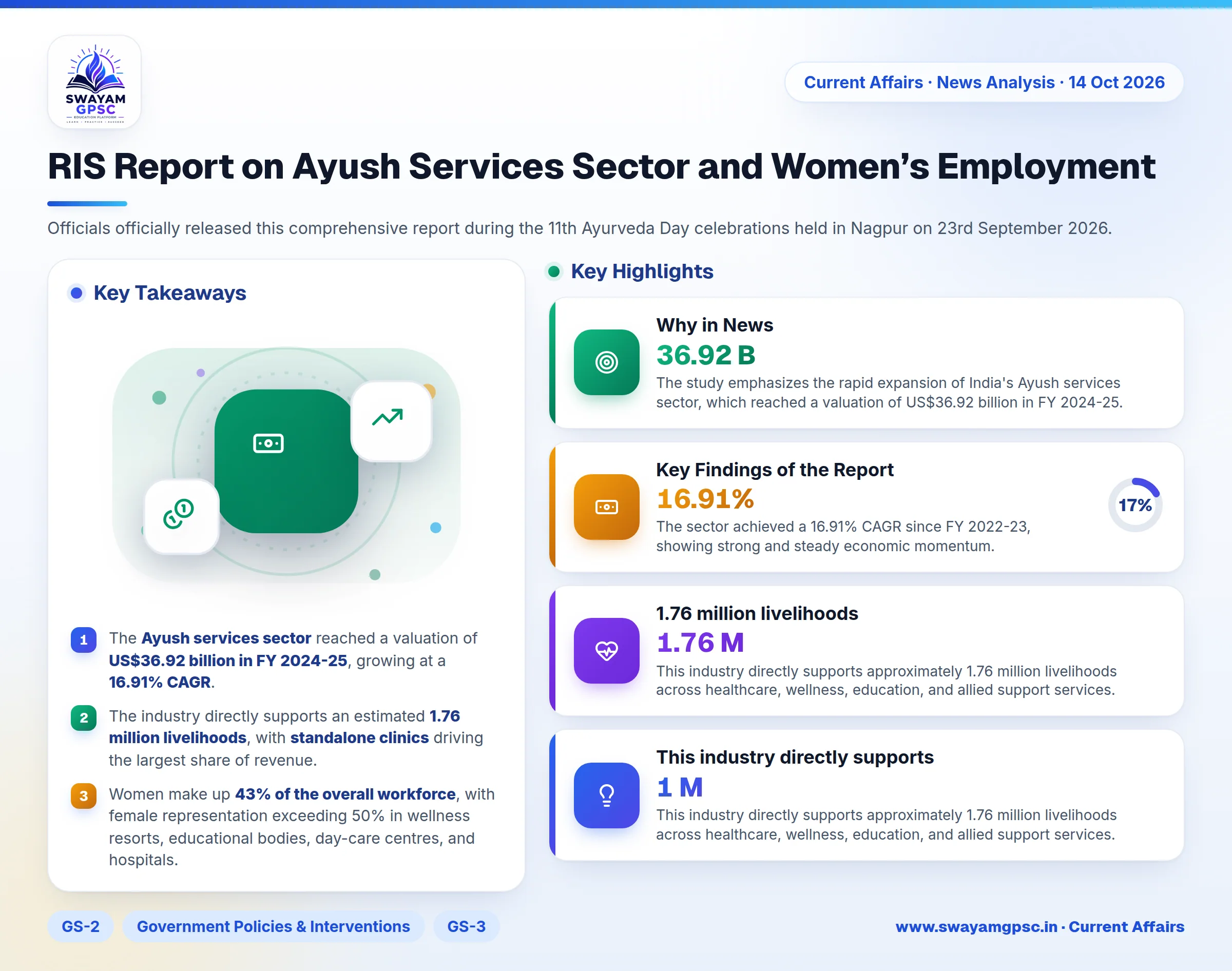
RIS Report on Ayush Services Sector and Women’s Employment
#GS-2 #Government Policies & Interventions #GS-3 #Inclusive Growth #Economy #Health #Employment
Key takeaways
- The Ayush services sector reached a valuation of US$36.92 billion in FY 2024-25, growing at a 16.91% CAGR.
- The industry directly supports an estimated 1.76 million livelihoods, with standalone clinics driving the largest share of revenue.
- Women make up 43% of the overall workforce, with female representation exceeding 50% in wellness resorts, educational bodies, day-care centres, and hospitals.
- Ayurveda dominates the market with US$17.73 billion, while Medical Value Travel contributed US$1.77 billion in FY 2024-25.
Why in News
- The Ministry of Ayush published a new study conducted by the Research and Information System for Developing Countries (RIS).
- The study emphasizes the rapid expansion of India's Ayush services sector, which reached a valuation of US$36.92 billion in FY 2024-25.
- It highlights the sector's major contributions to job creation, female workforce participation, and overall economic development.
- The findings came from a detailed survey covering 15,914 establishments across six different traditional medicine systems.
- Officials officially released this comprehensive report during the 11th Ayurveda Day celebrations held in Nagpur on 23rd September 2026.
Key Findings of the Report
- The broader Ayush services sector includes Ayurveda, Yoga and Naturopathy, Unani, Siddha, Sowa-Rigpa, and Homoeopathy.
- The sector achieved a 16.91% CAGR since FY 2022-23, showing strong and steady economic momentum.
- This industry directly supports approximately 1.76 million livelihoods across healthcare, wellness, education, and allied support services.
- More than one million livelihoods are concentrated specifically within local and standalone neighborhood clinics.
- Women account for 43% of the overall Ayush services workforce, proving its strong role in gender inclusivity.
- Female representation surpasses 50% in several organized segments, including spas and wellness resorts, educational institutes, day-care centres, and hospitals.
- Specifically, female participation reaches over 60% in spas and wellness resorts, 58% in educational institutes, 57% in day-care centres, and 53% in hospitals.
- Standalone clinics act as the primary revenue generator at US$16.21 billion, which represents 43.9% of the total sector revenue.
- Day-care centres follow closely as the second largest segment, generating US$10.13 billion.
- Together, standalone clinics and day-care centres contribute more than 70% of the entire industry revenue.
- Ayurveda remains the dominant traditional system, producing an estimated US$17.73 billion or roughly 48% of total Ayush services revenue.
- The wellness segment expanded rapidly with a 21.29% CAGR, while specialized Yoga centres grew by nearly 75% over two years.
- Medical Value Travel contributed an estimated US$1.77 billion to the sector during FY 2024-25.
- International patients make up about 5% of total patient volumes, yet they drive 15 to 25% of hospital-segment revenue.
- Experts project that the Ayush economy will surge to US$216-318 billion by 2047, supporting the national Viksit Bharat@2047 vision.
Conclusion
- The swift expansion of traditional healthcare services demonstrates their immense capacity to create jobs and empower women economically.
- Improving quality controls, digital infrastructure, skill training, and global market outreach will maximize the sector's contribution to the national economy and the Viksit Bharat @2047 vision.