Right to Vote in India: The Fundamental Rights Debate
#GS-2 #Indian Polity & Constitution #Constitution #Constitutional Bodies #Good Governance #Current Events #National #Elections #Right to Vote
Key takeaways
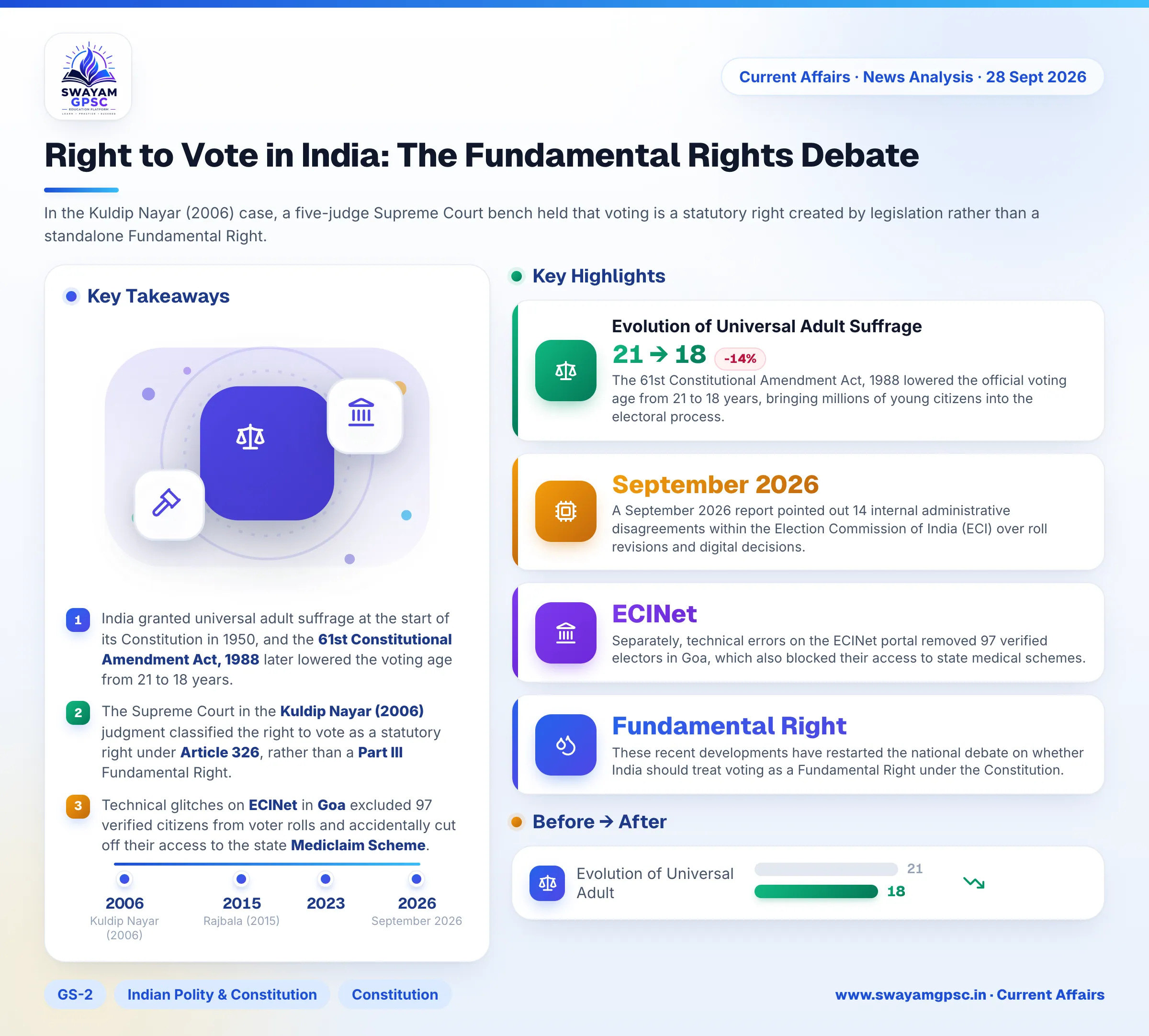
- India granted universal adult suffrage at the start of its Constitution in 1950, and the 61st Constitutional Amendment Act, 1988 later lowered the voting age from 21 to 18 years.
- The Supreme Court in the Kuldip Nayar (2006) judgment classified the right to vote as a statutory right under Article 326, rather than a Part III Fundamental Right.
- Technical glitches on ECINet in Goa excluded 97 verified citizens from voter rolls and accidentally cut off their access to the state Mediclaim Scheme.
- Recent reports highlighted 14 internal administrative disagreements over IT governance and decisions within the Election Commission of India (ECI).
Why in News
- A September 2026 report pointed out 14 internal administrative disagreements within the Election Commission of India (ECI) over roll revisions and digital decisions.
- Separately, technical errors on the ECINet portal removed 97 verified electors in Goa, which also blocked their access to state medical schemes.
- These recent developments have restarted the national debate on whether India should treat voting as a Fundamental Right under the Constitution.
Evolution of Universal Adult Suffrage
- Western democracies introduced voting rights step by step across centuries. In contrast, India granted universal adult suffrage immediately upon the adoption of its Constitution in 1950 without property or literacy limits.
- The 61st Constitutional Amendment Act, 1988 lowered the official voting age from 21 to 18 years, bringing millions of young citizens into the electoral process.
- Starting with the landmark Kesavananda Bharati (1973) ruling, the Supreme Court established that free and fair elections form a core part of the Basic Structure doctrine.
Legal and Constitutional Status of Voting
- The Constituent Assembly placed adult suffrage under Article 326 rather than inside Part III, which left electoral rules and conditions to parliamentary laws.
- In the Kuldip Nayar (2006) case, a five-judge Supreme Court bench held that voting is a statutory right created by legislation rather than a standalone Fundamental Right.
- Later, the Supreme Court in the Rajbala (2015) case termed voting a constitutional right, sparking fresh discussions about how franchise connects to political expression and democratic governance.
The Goa ECINet Episode and Digital Exclusion
- During the Special Intensive Revision in Goa, the portal flagged 97 voters for minor clerical mismatches across names, age data, and past records.
- Field officers physically verified the eligibility of these voters, yet the ECINet software reportedly blocked local officers from restoring their active status on the roll.
- This software deletion prevented these citizens from using the Goa Mediclaim Scheme, showing how tying welfare eligibility to electoral databases can cause serious harm.
- Unlike single human errors, centralized automated failures can disenfranchise large groups of genuine voters at once without clear correction pathways.
Institutional Governance within the Election Commission
- Sections 17 and 18 of the Chief Election Commissioner and other Election Commissioners Act, 2023 mandate that the Commission should aim for unanimous decisions or decide by majority vote.
- Recent draft reports revealed 14 internal objections over IT management and roll procedures, raising concerns about whether all major technological decisions received full collective approval.
Arguments for Making Voting a Fundamental Right
- Granting voting the status of a Fundamental Right would allow courts to strictly review arbitrary name deletions and excessive documentation demands.
- A formal constitutional status would protect citizens against automated digital exclusions by creating legally enforceable software safeguards.
- It would protect citizens from losing critical welfare services and healthcare when state agencies link program benefits to voter lists.
- This constitutional upgrade would align India with international democratic standards, including Article 25 of the International Covenant on Civil and Political Rights (ICCPR).
Concerns Regarding Fundamental Right Recognition
- Constitutionalizing the right to vote could cause a flood of writ petitions over routine list corrections, increasing pressure on courts during fast-paced elections.
- Strict procedural barriers might make it harder for election staff to remove deceased, permanently relocated, or ineligible individuals in a timely manner.
- Granting direct writ remedies could clash with Article 329(b) of the Constitution, which restricts court interference during ongoing polls and requires disputes to go through election petitions.
Way Forward
- A larger Supreme Court bench should clarify the legal boundaries of voting, linking political franchise directly with democratic free expression.
- Election authorities must introduce mandatory prior notices, personal hearings, and clear written reasons before removing any citizen from the electoral roll.
- The digital platforms ECINet and ERONet should grant Electoral Registration Officers the technical power to correct errors directly, supported by transparent audit trails.
- State governments should delink essential welfare programs from voter rolls and accept other standard identity proofs for medical and social security benefits.
- The Election Commission should make all major procedural shifts and digital roll changes through documented, collective meetings under the 2023 Act.
Conclusion
- When software glitches cut citizens off from both democratic participation and essential public welfare, the real-world costs become very high.
- India must protect its democracy by strengthening collective Commission governance, fixing automated software tools, and placing the right to vote on a firm constitutional footing.