Need to Revisit India's Nuclear Doctrine
#GS-2 #GS-3 #Indian Polity & Constitution #Economy #Science & Technology #Current Events #National #International #Government Policies & Interventions #Defence #Nuclear Technology
Key takeaways
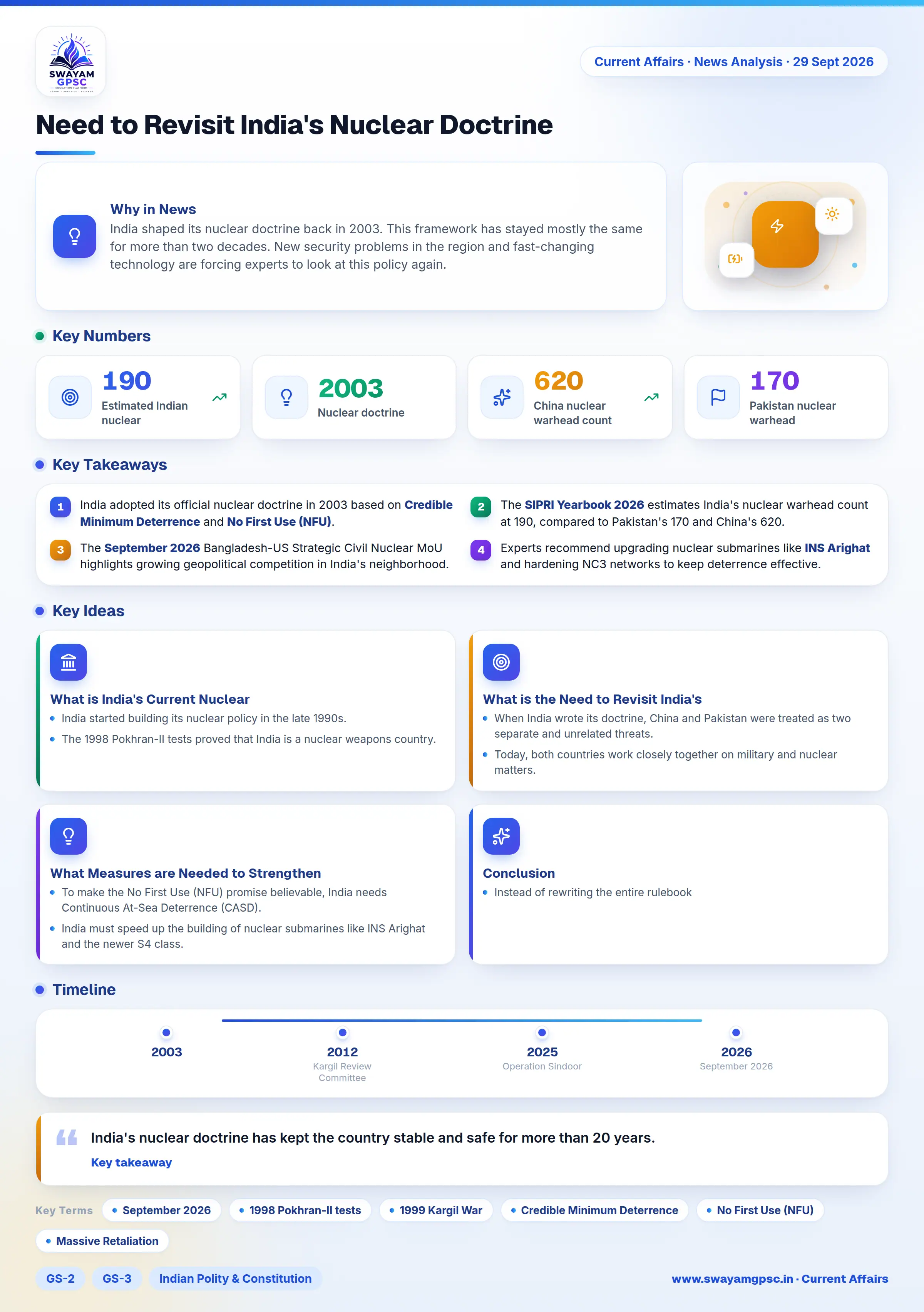
- India adopted its official nuclear doctrine in 2003 based on Credible Minimum Deterrence and No First Use (NFU).
- The SIPRI Yearbook 2026 estimates India's nuclear warhead count at 190, compared to Pakistan's 170 and China's 620.
- The September 2026 Bangladesh-US Strategic Civil Nuclear MoU highlights growing geopolitical competition in India's neighborhood.
- Experts recommend upgrading nuclear submarines like *INS Arighat* and hardening NC3 networks to keep deterrence effective.
Why in News
- India shaped its nuclear doctrine back in 2003. This framework has stayed mostly the same for more than two decades.
- New security problems in the region and fast-changing technology are forcing experts to look at this policy again.
- For example, the Bangladesh-US Memorandum of Understanding (MoU) on strategic civil nuclear cooperation signed in September 2026 shows how regional friendships are shifting.
- This changing environment sparks debate on whether India should update its nuclear rules without throwing away the whole system.
What is India's Current Nuclear Doctrine
- India started building its nuclear policy in the late 1990s.
- The 1998 Pokhran-II tests proved that India is a nuclear weapons country.
- Shortly after, the 1999 Kargil War showed that having nuclear weapons does not stop conventional border fights from happening.
- The Cabinet Committee on Security (CCS) officially launched the doctrine in 2003 based on earlier drafts.
- The entire policy rests on two main ideas: Credible Minimum Deterrence and No First Use (NFU).
- Credible Minimum Deterrence means keeping just enough weapons to make enemies think twice because the damage will be too high.
- No First Use (NFU) means India promises to launch nuclear weapons only if an enemy uses them first against Indian soil or troops.
- Massive Retaliation means any counterattack by India will be huge and devastating, which supports the idea of Mutually Assured Destruction (MAD).
- Strict political control keeps the power to launch weapons in civilian hands through the Nuclear Command Authority (NCA).
- The Political Council, led by the Prime Minister, is the only group with the power to approve a nuclear strike.
- The Executive Council, led by the National Security Advisor, gives expert advice and carries out orders.
- India promises not to use nuclear weapons against countries that do not have them, with one major exception.
- India keeps the right to hit back with nuclear weapons if a country attacks it with chemical or biological weapons first.
- India supports global nuclear disarmament and keeps a self-imposed ban on testing new nuclear bombs.
- According to the SIPRI Yearbook 2026, India now owns roughly 190 warheads, where 12 are deployed and 178 stay in reserve.
- This puts India slightly ahead of Pakistan with 170 warheads, but far behind China which has 620 warheads.
- During Operation Sindoor in May 2025, India and Pakistan used cyber warfare during a military faceoff for the very first time in history.
What is the Need to Revisit India's Nuclear Doctrine
- When India wrote its doctrine, China and Pakistan were treated as two separate and unrelated threats.
- Today, both countries work closely together on military and nuclear matters.
- China is growing its nuclear stockpile and building military facilities along the Line of Actual Control (LAC).
- Pakistan uses its nuclear weapons to make up for the fact that India has a much stronger conventional army.
- Pakistan built small battlefield weapons called Tactical Nuclear Weapons (TNWs), such as the Nasr missile.
- These small weapons create a big problem for India because the Massive Retaliation policy promises a massive response even to small attacks.
- Experts argue whether India should keep Credible Minimum Deterrence (CMD) and No First Use (NFU) while building smarter and more flexible response choices.
- New tech like Artificial Intelligence (AI), cyber weapons, anti-satellite tools, and Hypersonic Glide Vehicles (HGVs) leaves very little time to make critical decisions.
- India must upgrade its Nuclear Command, Control, and Communications (NC3) networks to survive cyber attacks.
- The Bangladesh-US Strategic Civil Nuclear MoU signed in September 2026 shows how major global powers are competing for influence in South Asia.
- Russia has historically led civil nuclear work in Bangladesh through the Rooppur Nuclear Power Plant, where India helps by supplying non-critical parts and training.
- Now that the United States and China are also trying to enter that space, India must protect its strategic safety right at its own border.
What Measures are Needed to Strengthen India's Nuclear Doctrine
- To make the No First Use (NFU) promise believable, India needs Continuous At-Sea Deterrence (CASD).
- India must speed up the building of nuclear submarines like *INS Arighat* and the newer S4 class.
- India successfully tested Multiple Independently Targetable Reentry Vehicles (MIRV) during the Agni-V Divyastra test to break through enemy Ballistic Missile Defence (BMD) shields.
- Protecting the Nuclear Command, Control, and Communications (NC3) network against cyber attacks and AI tampering is extremely urgent.
- Good space technology and satellites will give the Nuclear Command Authority (NCA) clear information during a crisis.
- India should use the advice from the Naresh Chandra Task Force on National Security (2012) and the Kargil Review Committee (1999) to improve military leadership.
- Bringing the Chief of Defence Staff (CDS) into the nuclear decision loop will connect civilian leaders with the Strategic Forces Command (SFC) smoothly.
- India can maintain smart strategic ambiguity without changing the words of the No First Use (NFU) rule, leaving enemies guessing about exact responses.
Conclusion
- India's nuclear doctrine has kept the country stable and safe for more than 20 years.
- Instead of rewriting the entire rulebook, regular checkups and better tech will keep India safe against new global threats.