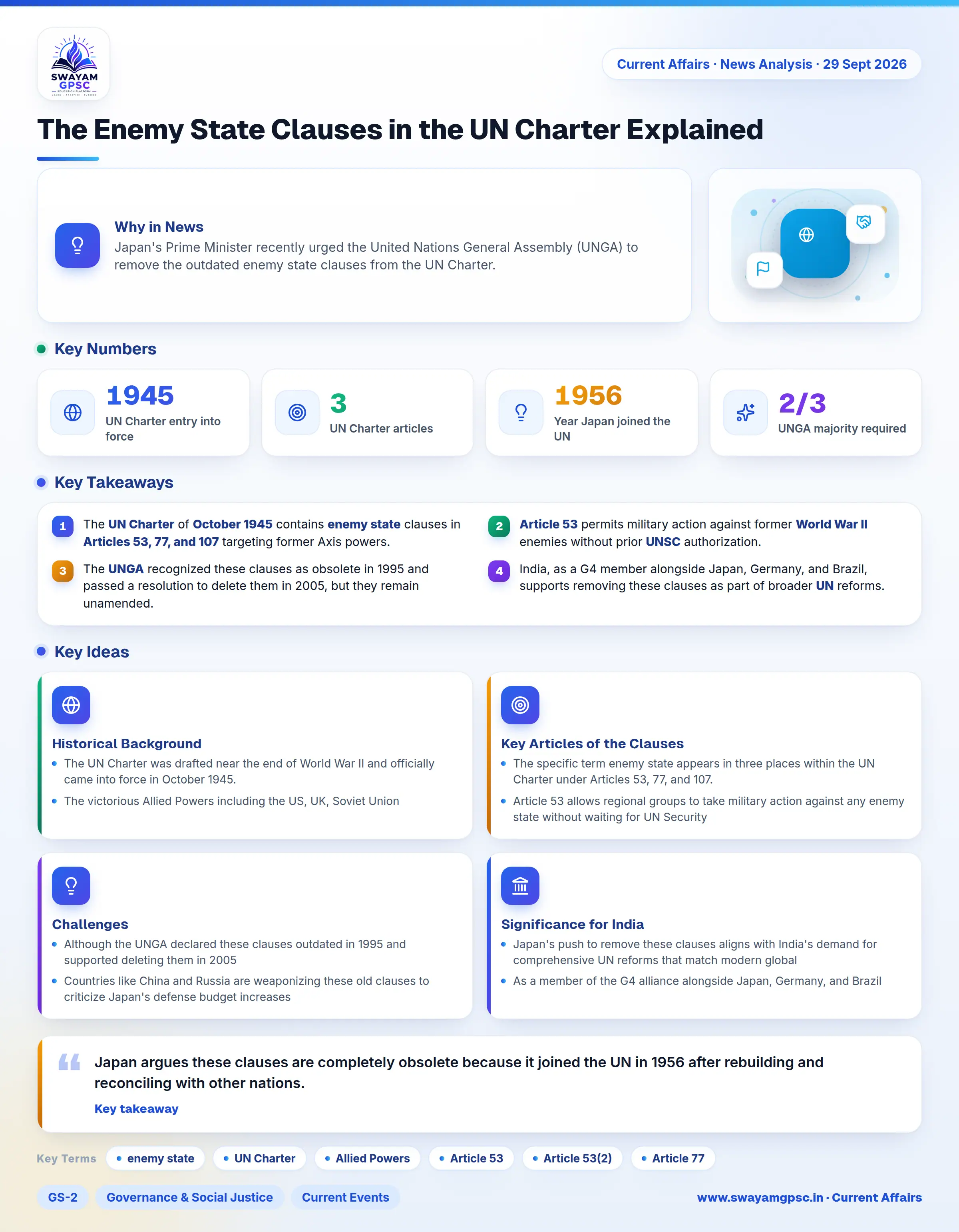
The Enemy State Clauses in the UN Charter Explained
#GS-2 #Governance & Social Justice #Current Events #International #Important International Institutions #UN Reform
Key takeaways
- The UN Charter of October 1945 contains enemy state clauses in Articles 53, 77, and 107 targeting former Axis powers.
- Article 53 permits military action against former World War II enemies without prior UNSC authorization.
- The UNGA recognized these clauses as obsolete in 1995 and passed a resolution to delete them in 2005, but they remain unamended.
- India, as a G4 member alongside Japan, Germany, and Brazil, supports removing these clauses as part of broader UN reforms.
Why in News
- Japan's Prime Minister recently urged the United Nations General Assembly (UNGA) to remove the outdated enemy state clauses from the UN Charter.
Historical Background
- The UN Charter was drafted near the end of World War II and officially came into force in October 1945.
- The victorious Allied Powers including the US, UK, Soviet Union, and China inserted these clauses to stop the defeated Axis Powers like Japan, Germany, and Italy from returning to militarism.
- These clauses act as a special exception to Article 2(4) of the UN Charter which otherwise bans the threat or use of force against any country.
Key Articles of the Clauses
- The specific term enemy state appears in three places within the UN Charter under Articles 53, 77, and 107.
- Article 53 allows regional groups to take military action against any enemy state without waiting for UN Security Council (UNSC) approval.
- Article 53(2) defines an enemy state as any country that fought against a UN Charter signatory during World War II.
- Article 77 deals with the UN trusteeship system and mentions territories that were separated from enemy states after the war.
- Article 107 protects and legalizes any actions that Allied governments took against Axis powers during or immediately after the war.
Challenges
- Japan argues these clauses are completely obsolete because it joined the UN in 1956 after rebuilding and reconciling with other nations.
- Although the UNGA declared these clauses outdated in 1995 and supported deleting them in 2005, they still remain in the text.
- Countries like China and Russia are weaponizing these old clauses to criticize Japan's defense budget increases and to challenge its claims over the Kuril Islands.
- Amending the UN Charter is extremely difficult because it requires a two-thirds majority in the UNGA and ratification by two-thirds of member states.
- The five permanent UNSC members hold veto power and worry that changing the text will lead to larger demands for UNSC structural reforms.
Significance for India
- Japan's push to remove these clauses aligns with India's demand for comprehensive UN reforms that match modern global realities.
- As a member of the G4 alliance alongside Japan, Germany, and Brazil, India seeks to make the global multilateral system more representative and effective.