Pradhan Mantri Anusuchit Jaati Abhyuday Yojana
#GS-2 #Governance & Social Justice #Current Events #National #Welfare Schemes #Poverty
Key takeaways
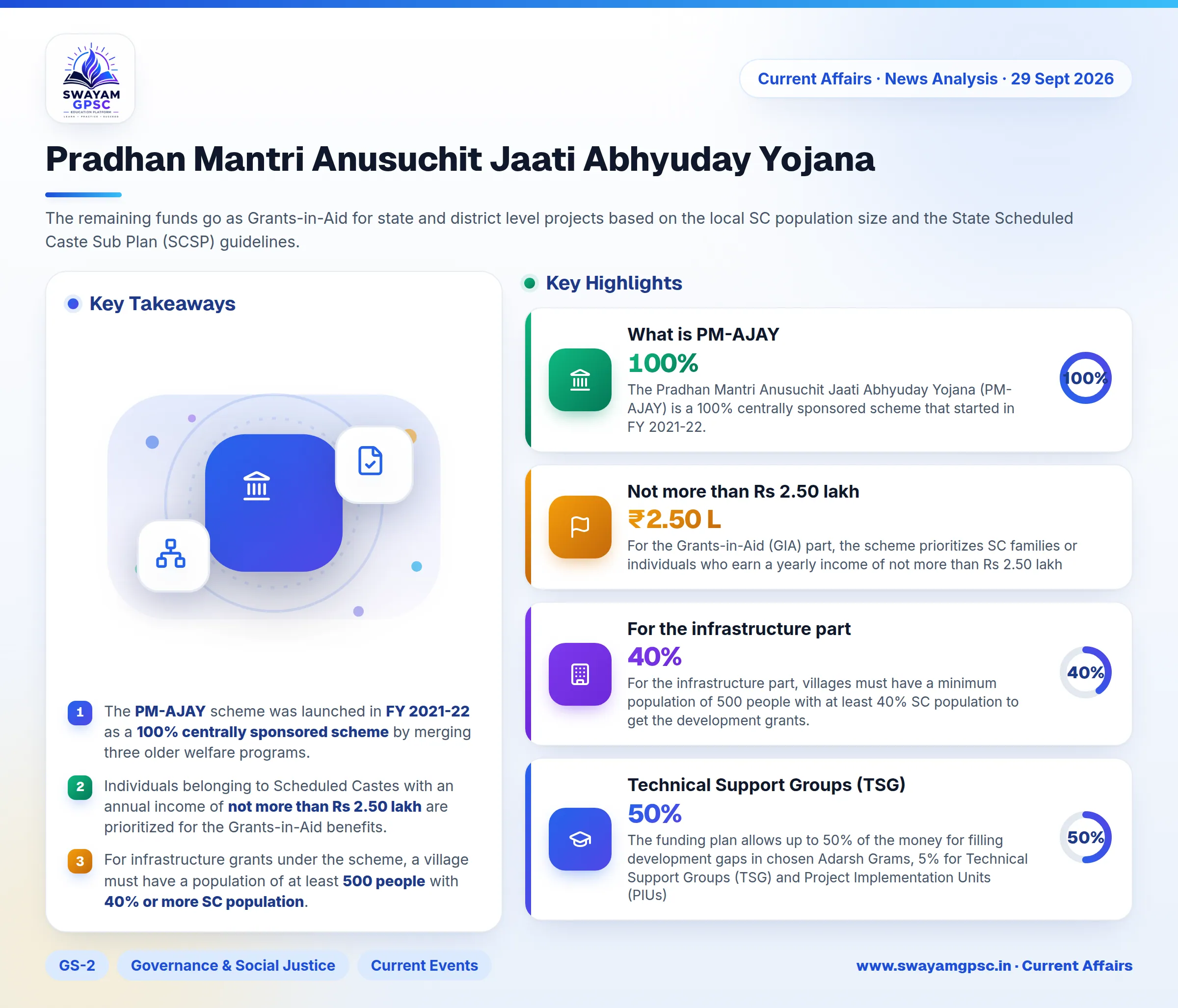
- The PM-AJAY scheme was launched in FY 2021-22 as a 100% centrally sponsored scheme by merging three older welfare programs.
- Individuals belonging to Scheduled Castes with an annual income of not more than Rs 2.50 lakh are prioritized for the Grants-in-Aid benefits.
- For infrastructure grants under the scheme, a village must have a population of at least 500 people with 40% or more SC population.
- Between FY 2021-22 and FY 2025-26, the government released over Rs 1,730 crore to support more than 2.5 lakh beneficiaries.
- By September 2026, a total of 785 student hostels were completed to support the education of SC students.
Why in News
- The Ministry of Social Justice & Empowerment recently shared the updates and progress of the Pradhan Mantri Anusuchit Jaati Abhyuday Yojana (PM-AJAY).
- The ministry also announced the launch of the PM-AJAY Mobile App and Portal to make the execution of this scheme faster, more transparent, and of better quality.
What is PM-AJAY
- The Pradhan Mantri Anusuchit Jaati Abhyuday Yojana (PM-AJAY) is a 100% centrally sponsored scheme that started in FY 2021-22.
- The main goal of this initiative is to bring social, economic, and educational upliftment to the Scheduled Caste (SC) communities through a unified development plan.
- The government created PM-AJAY by combining three older schemes: Pradhan Mantri Adarsh Gram Yojana (PMAGY), Special Central Assistance to Scheduled Castes Sub Plan (SCA to SCSP), and Babu Jagjivan Ram Chhatrawas Yojana (BJRCY).
- The Ministry of Social Justice & Empowerment runs this scheme with a focus on reducing poverty, building better infrastructure in SC-majority areas, and opening up educational avenues.
- For the Grants-in-Aid (GIA) part, the scheme prioritizes SC families or individuals who earn a yearly income of not more than Rs 2.50 lakh, though other SC members in SC-majority groups can also apply.
- For the infrastructure part, villages must have a minimum population of 500 people with at least 40% SC population to get the development grants.
- The funding plan allows up to 50% of the money for filling development gaps in chosen Adarsh Grams, 5% for Technical Support Groups (TSG) and Project Implementation Units (PIUs), and 2% for building or repairing student hostels.
- The remaining funds go as Grants-in-Aid for state and district level projects based on the local SC population size and the State Scheduled Caste Sub Plan (SCSP) guidelines.
- Once the infrastructure projects are finished, the respective state governments or the executing agencies take care of their upkeep.
Major Components of the Scheme
- The Adarsh Gram component aims to turn SC-dominated villages into model villages by setting up missing basic amenities and public services.
- An Adarsh Gram is a model village where residents have access to all basic facilities, the essential needs of every group are met, wealth gaps are minimized, and good infrastructure is present to help people live with dignity.
- The Grants-in-Aid component provides monetary help to states and districts to start livelihood projects, teach job skills, build infrastructure in SC-majority areas, and construct residential schools.
- The government released over Rs 1,730 crore to states from FY 2021-22 to FY 2025-26, which supported more than 2.5 lakh individual and group beneficiaries.
- Building and maintaining student hostels helps SC students from villages and remote corners get easy access to quality education.
- By September 2026, the government successfully completed the construction of 785 student hostels under this program.
- For FY 2026-27, the government set aside Rs 61.46 crore in central funds to build two hostel projects, which include one hostel for girls and one for boys, to house 264 students.
- The government introduced the PM-AJAY Mobile App and PM-AJAY Portal to move the entire administrative process from physical paperwork to a digital, real-time system.
- This digital shift is designed to bring better transparency, stronger accountability, and faster work speed by making data accessible and helping different departments collaborate easily.
Conclusion
- PM-AJAY offers a complete path to empower Scheduled Castes by linking livelihood assistance, infrastructure growth, and education.
- Using digital platforms and ensuring strong execution at the grass-roots level will help India achieve its dream of inclusive growth under Viksit Bharat @2047.