Delhi Air Quality Management Plan 2026-27 Details
#GS-2 #Governance & Social Justice #Health #Government Policies & Interventions #GS-3 #Environment #Environmental Pollution & Degradation #Current Events #National #Quick Facts For Prelims
Key takeaways
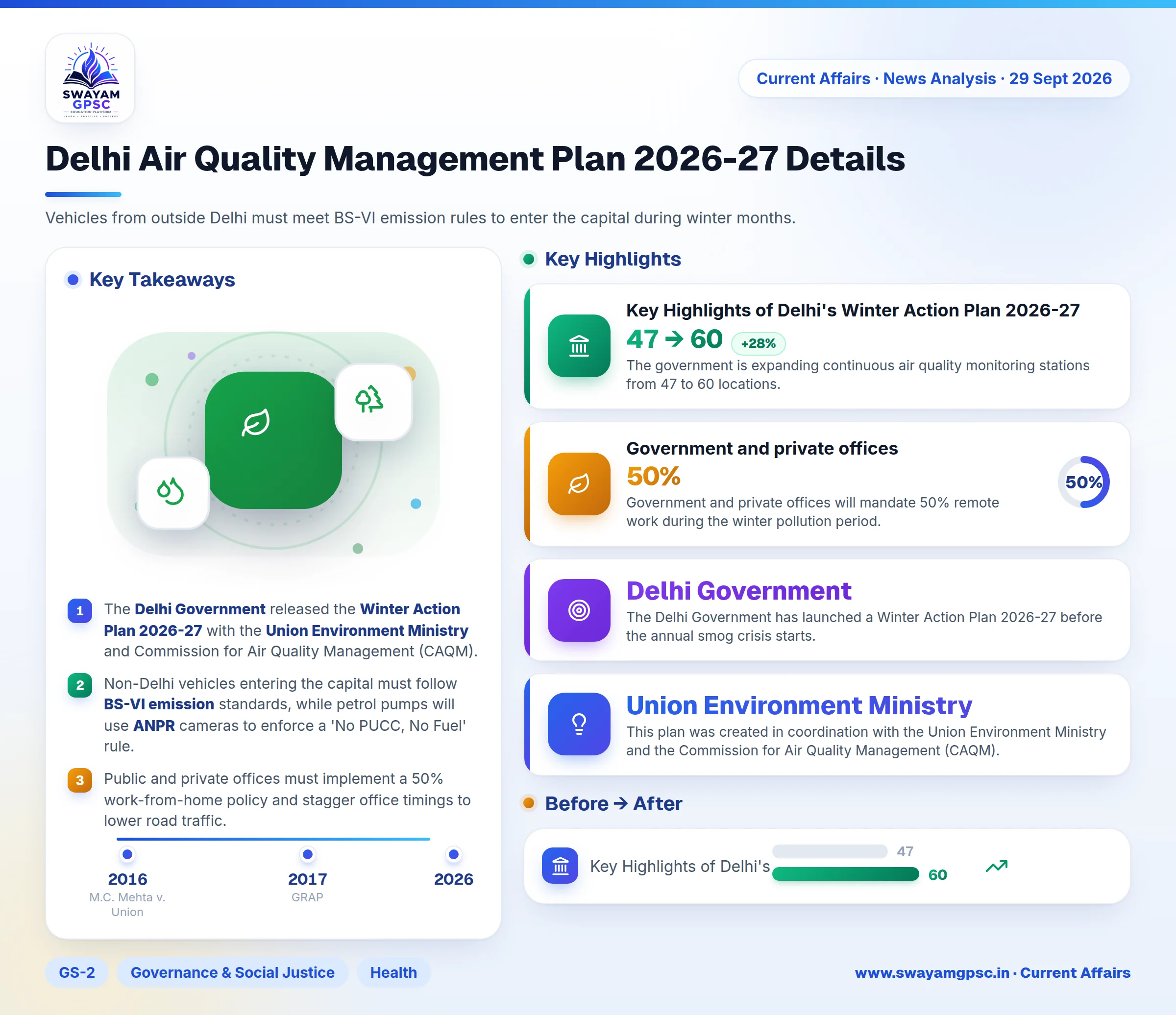
- The Delhi Government released the Winter Action Plan 2026-27 with the Union Environment Ministry and Commission for Air Quality Management (CAQM).
- Non-Delhi vehicles entering the capital must follow BS-VI emission standards, while petrol pumps will use ANPR cameras to enforce a 'No PUCC, No Fuel' rule.
- Public and private offices must implement a 50% work-from-home policy and stagger office timings to lower road traffic.
- Air monitoring stations across the region will increase from 47 to 60, backed by an AI-enabled Command and Control Centre starting 1st October 2026.
- The emergency GRAP system operates across four stages, banning non-essential construction and BS-III petrol or BS-IV diesel vehicles when AQI crosses critical levels.
Why in News
- The Delhi Government has launched a Winter Action Plan 2026-27 before the annual smog crisis starts.
- This plan was created in coordination with the Union Environment Ministry and the Commission for Air Quality Management (CAQM).
- The strategy shifts pollution control from a reactive model to a proactive, year-round preventive system.
- It uses airshed-based management that treats the entire Delhi-NCR as one combined air pollution zone.
- These new preventive measures will work together with the existing Graded Response Action Plan (GRAP) rules.
Key Highlights of Delhi's Winter Action Plan 2026-27
- Vehicles from outside Delhi must meet BS-VI emission rules to enter the capital during winter months.
- CNG vehicles, electric vehicles, and emergency services do not face these entry restrictions.
- Petrol pumps with Automatic Number Plate Recognition (ANPR) cameras will deny fuel to non-compliant vehicles.
- Vehicles lacking a valid Pollution Under Control Certificate (PUCC) or past their service life cannot buy fuel.
- Municipal parking fees across authorized public parking spots will double to discourage private car use.
- Government and private offices will mandate 50% remote work during the winter pollution period.
- Offices and municipal corporations will stagger working hours to prevent peak-hour traffic jams and idling emissions.
- The framework imposes phased bans on dust-generating construction during peak winter pollution periods.
- Authorities will increase the use of mechanical road sweepers and water sprinklers with chemical dust suppressants.
- An AI-enabled Command and Control Centre will start monitoring emissions from 1st October 2026.
- A total of 334 enforcement teams working in shifts will track industrial emissions and open burning.
- The government is expanding continuous air quality monitoring stations from 47 to 60 locations.
- Citizens can report local air pollution issues using the Green Delhi App or a new portal.
Graded Response Action Plan (GRAP)
- The GRAP is an emergency framework that triggers specific actions based on ambient air pollution levels.
- The Supreme Court directed the creation of this framework in the *M.C. Mehta v. Union of India* (2016) case.
- The government officially notified the GRAP framework in 2017.
- The Commission for Air Quality Management (CAQM) enforces this plan along with the Ministry of Environment, Forest and Climate Change (MoEFCC).
- The framework uses step-by-step responses based on the Air Quality Index (AQI) to control toxic pollution.
- Stage I applies when the AQI is Poor (201-300) and focuses on road dust control and PUC checks.
- Stage II applies when the AQI is Very Poor (301-400) and restricts diesel generator sets.
- Stage III applies when the AQI is Severe (401-450) and bans BS-III petrol and BS-IV diesel vehicles.
- Stage IV applies when the AQI is Severe+ (above 450) and stops heavy truck entry and non-essential industries.
Frequently Asked Questions
- GRAP is a stage-wise emergency framework that responds to changing AQI levels in Delhi-NCR.
- The Commission for Air Quality Management (CAQM) implements GRAP alongside MoEFCC and local state governments.
- The Winter Action Plan 2026-27 focuses on preventive actions before pollution spikes, while GRAP reacts after AQI deteriorates.
- Airshed management treats the whole Delhi-NCR as one air region because air pollutants move across state borders.
- Key tech measures include AI monitoring, ANPR cameras at fuel pumps, more air stations, and digital public reporting.