Drought Management in India: Understanding Challenges and Strategic Solutions
#GS-1 #Geography #Geographical Features & Location #GS-3 #Environment #Pollution & Degradation #Conservation #Agriculture #Water Scarcity #Drought Management
Key takeaways
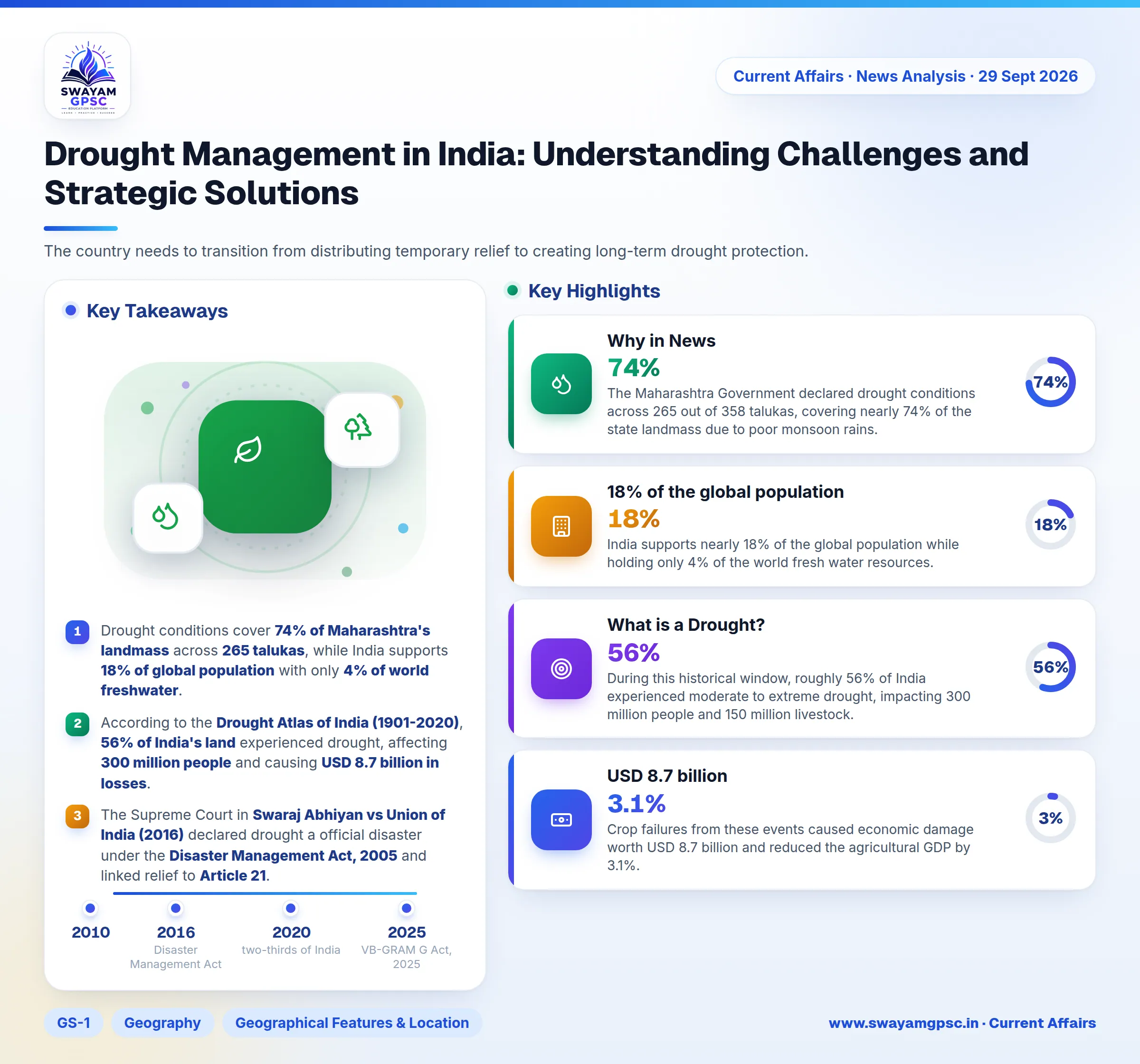
- Drought conditions cover 74% of Maharashtra's landmass across 265 talukas, while India supports 18% of global population with only 4% of world freshwater.
- According to the Drought Atlas of India (1901-2020), 56% of India's land experienced drought, affecting 300 million people and causing USD 8.7 billion in losses.
- The Supreme Court in Swaraj Abhiyan vs Union of India (2016) declared drought a official disaster under the Disaster Management Act, 2005 and linked relief to Article 21.
- To fix fragmented water management, the Mihir Shah Committee (2016) recommended merging surface and groundwater bodies into a single National Water Commission.
Why in News
- The Maharashtra Government declared drought conditions across 265 out of 358 talukas, covering nearly 74% of the state landmass due to poor monsoon rains.
- Similar water stress and drought-like situations are affecting Karnataka, Telangana, Andhra Pradesh, and parts of Rajasthan.
- India supports nearly 18% of the global population while holding only 4% of the world fresh water resources.
- This water deficit poses significant threats to agriculture, food security, rural livelihoods, and overall economic stability.
Summary of India's Drought Situation
- Drought in India is a complex problem linked to rainfall fluctuations, climate change, depleted groundwater, and unviable farming habits.
- The country needs to transition from distributing temporary relief to creating long-term drought protection.
- Long-term security requires early-warning tools, climate-hardy crops, micro-irrigation, unified water management, and local conservation efforts.
What is a Drought?
- A drought is a prolonged period of abnormally low rainfall that leads to severe water shortages for plants, animals, and human populations.
- According to the Drought Atlas of India (1901 to 2020), almost two-thirds of India remains vulnerable to drought conditions.
- During this historical window, roughly 56% of India experienced moderate to extreme drought, impacting 300 million people and 150 million livestock.
- Crop failures from these events caused economic damage worth USD 8.7 billion and reduced the agricultural GDP by 3.1%.
- Droughts no longer affect only dry regions; wet areas like Cherrapunji in Meghalaya now face water shortages for nine months every year, whereas parts of Jaisalmer in Rajasthan get around 9 cm of rainfall annually.
Classification of Droughts
- The 2009 Manual of Drought Management by the Ministry of Agriculture divides droughts into three distinct categories.
- Meteorological Drought happens when rainfall falls significantly below the long-term normal average for a region.
- A rainfall deficit between 26% and 50% marks a moderate meteorological drought, while a deficit over 50% creates a severe drought.
- Hydrological Drought occurs when surface water stores and underground aquifers fall below necessary operational levels.
- Hydrological droughts can occur even with normal rainfall if human water consumption exceeds natural recharge rates.
- Agricultural Drought takes place when soil moisture drops too low to support crop growth, directly harming crop yields.
- In India, agricultural drought means 4 straight weeks of severe rain deficit during the Kharif season, or 6 straight weeks during the rest of the year.
Drought Declaration Framework and Regulations
- District Collectors historically relied on post-harvest physical assessments like the annewari, paisewari, or girdawari systems to estimate losses.
- The Manual for Drought Management, 2009 introduced four modern scientific indicators to detect drought conditions earlier.
- Drought can be declared if overall rainfall from June to September stays below 75% of the average, or if June to July rainfall drops below 50%.
- Declarations can occur if the total crop sowing area falls below 50% of cultivable land by the end of July or August.
- Satellites monitor plant health using the Normalized Difference Vegetation Index (NDVI) under the NADAMS project, where a deviation score of 0.4 or lower indicates drought.
- The Moisture Adequacy Index (MAI) measures soil water supply, and an MAI score under 25 signals severe agricultural drought.
- The State Government holds the ultimate legal authority to declare a drought within its boundaries.
- The Manual for Drought Management, 2009 and the NDMA Guidelines for Management of Drought, 2010 offer reference standards, but both documents are non-binding on states.
Financial Relief Mechanism and Legal Aspects
- States initially distribute financial aid using money allocated in their State Disaster Response Fund (SDRF).
- When state funds run out, an Inter-Ministerial Central Team evaluates local damage, and extra relief comes from the National Disaster Response Fund (NDRF).
- While the Ministry of Home Affairs handles most natural disasters, the Ministry of Agriculture and Farmers Welfare acts as the central nodal agency for droughts.
- In the Swaraj Abhiyan vs Union of India (2016) case, the Supreme Court ruled that drought is officially a disaster under the Disaster Management Act, 2005.
- The Supreme Court tied drought relief directly to Article 21, stating that denying timely drought declarations deprives vulnerable citizens of their right to live with dignity.
Causes of Drought in India
- Irregularities in the South-West Monsoon, which supplies 70% to 80% of annual rainfall, lead to widespread rain deficits.
- The El Niño Southern Oscillation (ENSO) phenomenon warms equatorial Pacific waters, historical patterns show this leads directly to lower rainfall across India.
- Climate change causes unusual rain patterns where brief downpours are followed by long dry periods, reducing the Moisture Adequacy Index (MAI).
- Distorted Minimum Support Price (MSP) policies and free electricity encourage farmers to grow water-heavy crops like sugarcane in Marathwada and paddy in Punjab.
- India extracts more groundwater than any other country, deep tube wells empty underground reserves faster than rain can refill them.
- The destruction of forests, wetlands, and traditional water structures like Johads, Baolis, and Eris lowers the soil ability to hold rainwater.
Key Challenges in Drought Management
- National drought guidelines remain non-binding, leading to inconsistent standards and delayed declarations across different states.
- Many local governments still wait for post-harvest crop evaluations rather than using fast satellite indicators like NDVI, delaying SDRF payouts.
- Water management is divided between the Central Water Commission for rivers and the Central Ground Water Board for wells, stopping unified water planning.
- State agencies focus mostly on reactive crisis response like sending water tankers rather than investing in permanent drought-proofing.
- Drip and sprinkler irrigation adoption under PMKSY remains low in many regions because small farmers cannot afford high initial equipment costs.
Measures Needed to Strengthen Drought Management
- Governments must implement strict agro-climatic zoning so farmers only plant crops suitable for local water levels.
- States should encourage farmers to swap thirsty crops for millets under Shree Anna, pulses, and oilseeds using guaranteed MSP incentives.
- State governments must use satellite data from NADAMS to declare droughts automatically based on objective NDVI and MAI readings.
- The central government should rapidly scale up the Per Drop More Crop initiative under PMKSY.
- India should follow the Mihir Shah Committee (2016) recommendations to combine surface and groundwater management under one National Water Commission.
- Gram Panchayats should conduct local groundwater audits and regulate well drilling using models like the Atal Bhujal Yojana.
- Communities must restore local water structures by using funds from the VB-GRAM G Act, 2025 and the Jal Shakti Abhiyan.
Conclusion
- Drought in India is fundamentally a failure of water management and governance rather than a simple shortage of rain.
- The nation must move from emergency relief distribution to proactive, long-term drought protection.
- Combining early warning tools, resilient crops, efficient irrigation, and community conservation will secure India's food production and rural economy.