Right to Internet Access as a Fundamental Right for Children
#GS-2 #Indian Polity & Constitution #Constitution #Judiciary #Governance & Social Justice #Government Policies & Interventions #GS-3 #Science & Technology #ICT #IT & Computers
Key takeaways
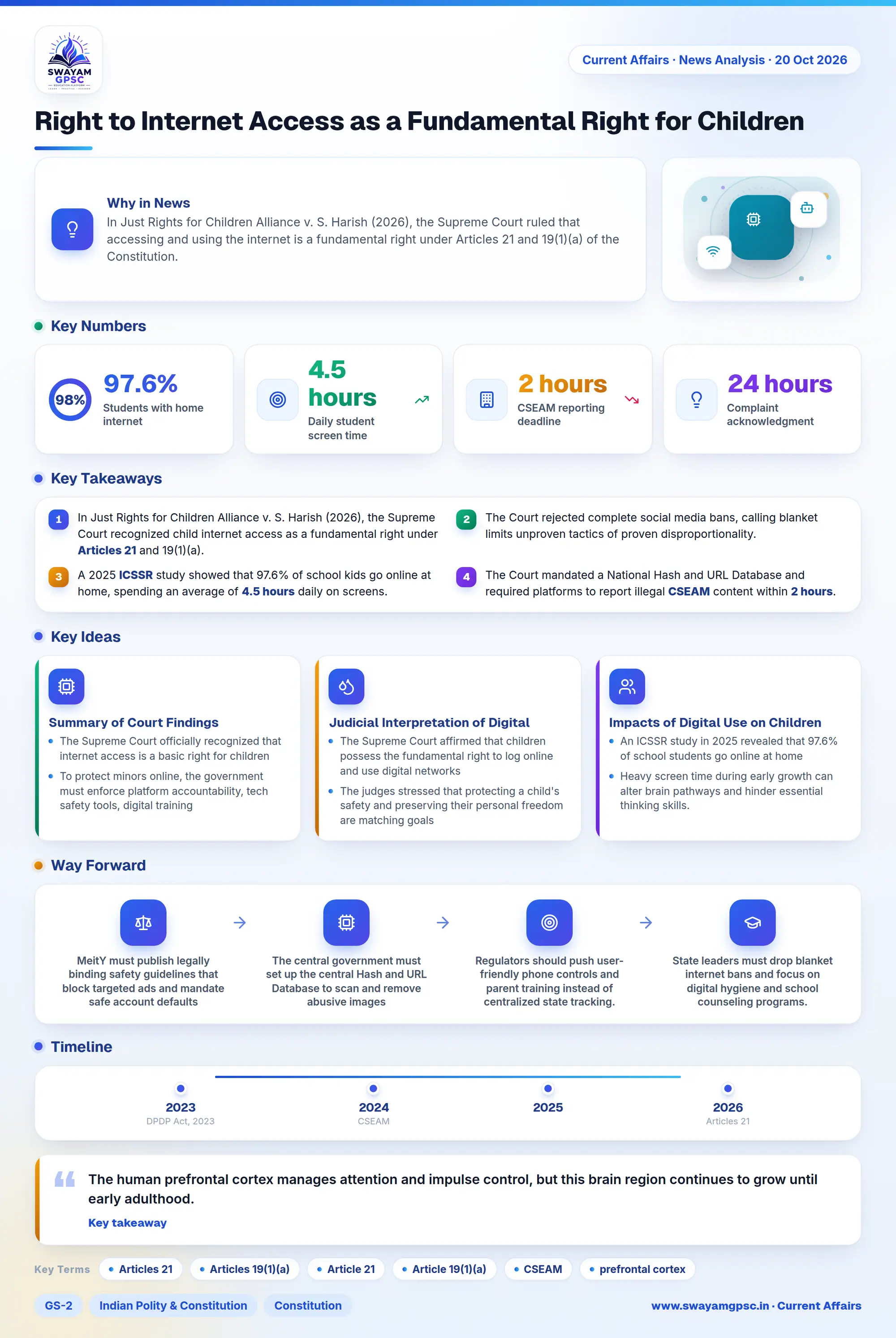
- In Just Rights for Children Alliance v. S. Harish (2026), the Supreme Court recognized child internet access as a fundamental right under Articles 21 and 19(1)(a).
- The Court rejected complete social media bans, calling blanket limits unproven tactics of proven disproportionality.
- A 2025 ICSSR study showed that 97.6% of school kids go online at home, spending an average of 4.5 hours daily on screens.
- The Court mandated a National Hash and URL Database and required platforms to report illegal CSEAM content within 2 hours.
- Intermediaries face direct monetary fines under Section 79 of the IT Act, 2000 if they fail to remove dangerous material quickly.
Why in News
- In Just Rights for Children Alliance v. S. Harish (2026), the Supreme Court ruled that accessing and using the internet is a fundamental right under Articles 21 and 19(1)(a) of the Constitution.
- The Supreme Court declared that this digital fundamental right belongs to all children, regardless of how old they are.
- The Supreme Court previously asked the central government and the National Commission for Protection of Child Rights to build safety rules for minors on social media.
- A 2025 study backed by the Indian Council of Social Science Research (ICSSR) showed that India must protect children's mental and emotional health while supporting digital growth.
Summary of Court Findings
- The Supreme Court officially recognized that internet access is a basic right for children, turning down total usage bans in favor of fair, balanced limits.
- To protect minors online, the government must enforce platform accountability, tech safety tools, digital training, and strong defenses against exploitation.
Judicial Interpretation of Digital Rights
- The Supreme Court affirmed that children possess the fundamental right to log online and use digital networks across all age groups.
- The judges stressed that protecting a child's safety and preserving their personal freedom are matching goals that work together.
- The Court rejected complete social media bans for minors, calling blanket restrictions unproven tactics that create heavy, unfair burdens.
- The justices pointed out that blocking internet access treats child victims like criminal offenders and forces them onto dangerous, unmonitored websites.
- In Anuradha Bhasin v Union of India (2020), the Supreme Court protected online speech, expression, and business under Articles 19(1)(a) and 19(1)(g).
- In Pragya Prasun v Union of India (2025), the Court decided that digital access forms an essential part of the right to life under Article 21.
- In the Cricket Association of Bengal (1995) case, the judiciary confirmed that Article 19(1)(a) guarantees the right to receive and share knowledge.
- The Court ruled that state restrictions on digital access require passed laws, a valid public goal, and strict measures that match the purpose.
- The Court ordered law enforcement to attack harm directly by targeting Child Sexual Exploitation and Abuse Material (CSEAM) and creators instead of blocking young users.
- In 2024, the Supreme Court overturned a regional court ruling by deciding that viewing or keeping CSEAM breaks the law under the POCSO Act and IT Act.
Impacts of Digital Use on Children
- The human prefrontal cortex manages attention and impulse control, but this brain region continues to grow until early adulthood.
- An ICSSR study in 2025 revealed that 97.6% of school students go online at home, mostly using smartphones for about 4.5 hours daily.
- Heavy screen time during early growth can alter brain pathways and hinder essential thinking skills.
- Platforms use quick reward signals like likes to form habit loops that shorten attention spans on regular offline tasks.
- Using Artificial Intelligence (AI) tools for basic schoolwork replaces the healthy practice of independent critical thinking.
- App features like auto-play and endless scrolling remove natural rest breaks and pressure kids into continuous phone use.
- Constant digital noise gets rid of empty downtime, taking away the mental quiet needed for deep personal creativity.
- Excessive phone time increases anxiety, hurts sleep, causes body dissatisfaction, and triggers irritability when screens are removed.
Regulation Precedents and Initiatives
- In December 2025, Australia set a minimum age limit of 16 for social media platforms, while Norway tested rules for kids under 16.
- In March 2026, Karnataka introduced plans for an under-16 social media limit, while Andhra Pradesh suggested restrictions for kids under 13.
- State educational boards are adding online safety and cyber awareness classes directly into school books.
- Community efforts like Mission Shakti train young women to spot online grooming, defend personal privacy, and stop cyberbullying.
- The NCERT created a Safe Online Learning guidebook and set up school Cyber Clubs to teach digital safety habits.
Challenges in Regulating Children's Internet Use
- The DPDP Act, 2023 and DPDP Rules, 2025 require parent permission for child data, but verifying ages through personal IDs raises privacy risks under K.S. Puttaswamy v. Union of India (2017).
- Many parents lack the technical skills to set up complex account filters or control screen algorithms effectively.
- Rule 4(2) of the IT Rules, 2021 requires messaging apps to trace original senders of illegal content, which threatens end-to-end encryption for all users.
- Under Section 79 of the IT Act, 2000, platforms get legal immunity for user posts, but modern algorithms promote content actively and blur these boundaries.
- The Supreme Court found that tech platforms often fail to report local CSEAM instances directly to police officers or juvenile units as required by the POCSO Act, 2012.
- Strict access bans often fail because children move to dark, unmonitored websites where reporting abusers becomes much harder.
- Regulatory enforcement targets young victims through access blocks instead of shutting down illegal groups and original creators.
- Arbitrary web bans disconnect poor kids and rural students from remote education resources and online learning tools.
- State efforts like screen limits create legal friction with central laws and fail to offer uniform technical standards across borders.
- Small software startups face heavy financial costs when setting up 24/7 human review teams to satisfy strict cleanup rules.
Measures to Protect Minors Online
- The Supreme Court suggested a mandatory child mode for youth accounts that turns on high privacy settings automatically.
- The Ministry of Electronics and Information Technology (MeitY) must write clear rules under the IT Act to stop behavioral ad profiling against kids.
- The Supreme Court called for a national Hash and URL database to catch illegal images, verified by three human reviewers.
- Platforms must file reports on untraced illegal content within 2 hours and confirm user complaints within 24 hours.
- The Supreme Court recommended large monetary fines and revenue losses for platforms that refuse to take down harmful material.
- Operating systems should offer localized parent controls so families do not rely on central government tracking.
- Schools must teach digital safety alongside age-appropriate health classes covering personal consent and abuse reporting.
Pros and Cons of the Ruling
- The ruling protects web learning for students living in far villages where digital tools provide the main access to classes.
- The decision protects young citizens from aggressive state identification checks and biometric data tracking.
- The directive targets actual cyber criminals and illegal content networks instead of taking away student access.
- The ruling builds digital literacy so children can browse safely without facing enforced tech ignorance.
- Past digital rights guidelines like Anuradha Bhasin suffered from uneven enforcement during local web shutdowns.
- Open web access without strong system safety exposes kids to predatory algorithms and screen dependency.
Way Forward
- MeitY must publish legally binding safety guidelines that block targeted ads and mandate safe account defaults for kids.
- The central government must set up the central Hash and URL Database to scan and remove abusive images automatically.
- Regulators should push user-friendly phone controls and parent training instead of centralized state tracking.
- State leaders must drop blanket internet bans and focus on digital hygiene and school counseling programs.
Conclusion
- The Supreme Court confirmed that protecting children does not require taking away their fundamental rights under the Constitution.
- Going after bad actors instead of web tools turns safe digital access into an essential part of growing up.
- The true success of this ruling depends on building child safety systems without creating mass digital surveillance.