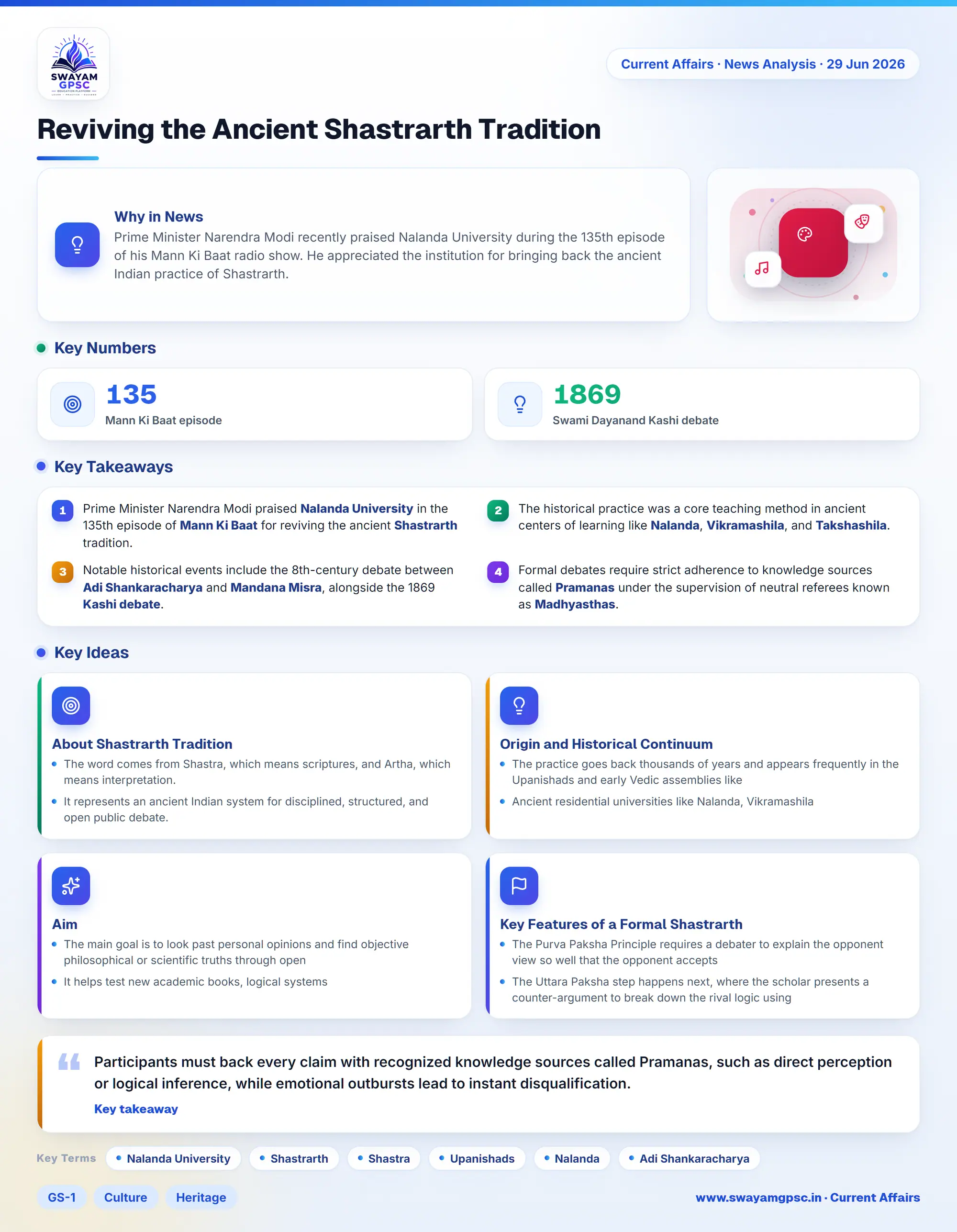
Reviving the Ancient Shastrarth Tradition
#GS-1 #Culture #Heritage #Ancient India #Education
Key takeaways
- Prime Minister Narendra Modi praised Nalanda University in the 135th episode of Mann Ki Baat for reviving the ancient Shastrarth tradition.
- The historical practice was a core teaching method in ancient centers of learning like Nalanda, Vikramashila, and Takshashila.
- Notable historical events include the 8th-century debate between Adi Shankaracharya and Mandana Misra, alongside the 1869 Kashi debate.
- Formal debates require strict adherence to knowledge sources called Pramanas under the supervision of neutral referees known as Madhyasthas.
Why in News
- Prime Minister Narendra Modi recently praised Nalanda University during the 135th episode of his Mann Ki Baat radio show.
- He appreciated the institution for bringing back the ancient Indian practice of Shastrarth.
About Shastrarth Tradition
- The word comes from Shastra, which means scriptures, and Artha, which means interpretation.
- It represents an ancient Indian system for disciplined, structured, and open public debate.
- This is not a casual argument, but a formal intellectual discussion where scholars test their ideas against opposing views.
Origin and Historical Continuum
- The practice goes back thousands of years and appears frequently in the Upanishads and early Vedic assemblies like Sabhas and Samitis.
- Ancient residential universities like Nalanda, Vikramashila, and Takshashila used this debate style as their main teaching method for international scholars.
- Famous debates include the 8th-century discussion between Adi Shankaracharya and Mandana Misra, and Swami Dayanand Saraswati participating in the 1869 Kashi debate.
Aim
- The main goal is to look past personal opinions and find objective philosophical or scientific truths through open peer review.
- It helps test new academic books, logical systems, and commentaries before society accepts them into mainstream learning.
Key Features of a Formal Shastrarth
- The Purva Paksha Principle requires a debater to explain the opponent view so well that the opponent accepts the description as completely fair.
- The Uttara Paksha step happens next, where the scholar presents a counter-argument to break down the rival logic using facts and valid reasoning.
- Participants must back every claim with recognized knowledge sources called Pramanas, such as direct perception or logical inference, while emotional outbursts lead to instant disqualification.
- Neutral referees known as Madhyasthas monitor the entire proceedings and give the final academic verdict.
- Historically held in Sanskrit, the tradition now works across multiple languages while demanding high verbal precision and clear expression.