India's Green Jobs Revolution: Driving Livelihoods and Inclusive Growth
#GS-3 #Economy #Employment #Environment #Sustainable Development #Green Jobs in India #India Green Jobs Moment iFOREST Report #Green Employment and Sustainable Economic Growth #Green Jobs Creation Potential by 2035 #Renewable Energy and Electric Vehicle Employment #Green Skills Development
Key takeaways
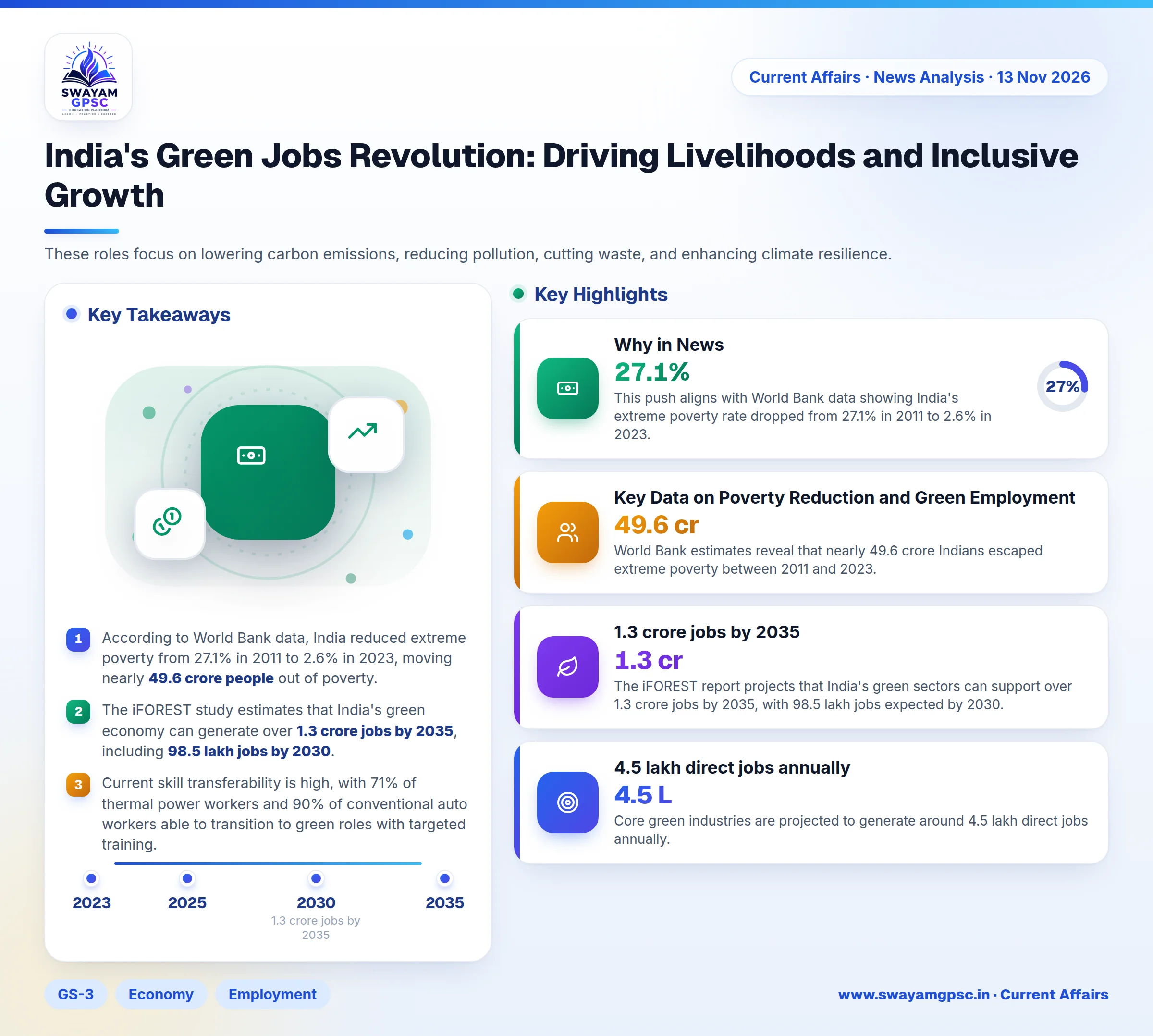
- According to World Bank data, India reduced extreme poverty from 27.1% in 2011 to 2.6% in 2023, moving nearly 49.6 crore people out of poverty.
- The iFOREST study estimates that India's green economy can generate over 1.3 crore jobs by 2035, including 98.5 lakh jobs by 2030.
- Current skill transferability is high, with 71% of thermal power workers and 90% of conventional auto workers able to transition to green roles with targeted training.
- Despite having a 27% youth population, only 5.3% have technical education and dedicated green training programs have covered just 81,000 people.
- To address the skilling gap, the government launched PM-SETU with a budget of Rs 60,000 crore to upgrade 1,000 government ITIs across the country.
Why in News
- A recent study titled India's Green Jobs Moment by iFOREST highlights the vital role of green employment.
- The report shows how green jobs can drive inclusive growth as India works toward Viksit Bharat 2047.
- This push aligns with World Bank data showing India's extreme poverty rate dropped from 27.1% in 2011 to 2.6% in 2023.
Understanding Green Jobs
- Green jobs refer to decent employment opportunities across various sectors that actively protect or restore environmental health.
- These roles focus on lowering carbon emissions, reducing pollution, cutting waste, and enhancing climate resilience.
- The key growth areas include renewable energy like solar and wind, green hydrogen, electric vehicles, circular economy initiatives, and nature-based rural projects.
- Unlike traditional heavy industries concentrated in specific regions, green jobs like rooftop solar setups and EV servicing naturally spread across small towns and villages.
Key Data on Poverty Reduction and Green Employment
- World Bank estimates reveal that nearly 49.6 crore Indians escaped extreme poverty between 2011 and 2023.
- The iFOREST report projects that India's green sectors can support over 1.3 crore jobs by 2035, with 98.5 lakh jobs expected by 2030.
- Core green industries are projected to generate around 4.5 lakh direct jobs annually.
- The transition requires minimal retraining, as 71% of thermal power roles can easily adapt to renewable energy and green hydrogen jobs.
- Similarly, about 90% of traditional auto sector roles can convert to electric vehicle servicing through targeted bridge training.
- India holds a strong demographic edge, with youth aged 15 to 29 making up over 27% of the total population.
- In 2025, roughly 17.3% of Indian youth held college degrees, with young women at 17.9% slightly outstripping young men at 16.7%.
- However, a significant skilling deficit exists because only 5.3% of youth possess technical credentials and just 5% have formal vocational training.
- Dedicated green training initiatives have managed to upskill only about 81,000 individuals so far.
Government Initiatives to Build Green Skills
- The government introduced PM-SETU with an outlay of Rs 60,000 crore to upgrade 1,000 government ITIs using industry-led Special Purpose Vehicles.
- The Skill Council for Green Jobs (SCGJ) operates under the Ministry of Skill Development and Entrepreneurship to design national standards and certify trainers in clean tech sectors.
- The Ministry of Skill Development and Entrepreneurship is updating the National Policy for Skill Development and Entrepreneurship (2015) to integrate climate-resilient skilling.
- Programs like PM Surya Ghar combine rooftop solar expansion with specialized technician drives to build a local installation workforce.
Challenges in Scaling India's Green Workforce
- Over 90% of Indian youth lack formal technical or vocational training, creating a shortage of skilled shop-floor talent for green projects.
- Clean energy and EV companies face severe shortages of certified high-voltage technicians and battery maintenance experts.
- The system relies heavily on short training programs, with 43% of certified workers taking courses shorter than six months.
- These brief courses fail to prepare trainees for specialized roles like operating green hydrogen electrolyzers or diagnosing complex battery storage systems.
- Many of India's 15,000 ITIs rely on obsolete machinery and lack modern green laboratories or trained faculty.
- Traditional ITI courses still train students on internal combustion engines rather than electric vehicle powertrains.
- Weak links between schools, training institutes, and employers result in high dropout rates and poor job placement tracking.
- Trained rural youth find it hard to secure formal apprenticeships or credit to launch local solar repair or recycling enterprises.
Way Forward
- India should establish a dedicated National Green Jobs and Skilling Mission to align training standards, apprenticeships, and prior learning recognition.
- Institutions need to offer longer, high-value diploma programs co-designed with green industry leaders alongside short reskilling courses.
- Authorities must use PM-SETU hubs and National Skill Training Institutes to set up dedicated green labs and train vocational instructors.
- Policy frameworks must connect school education under NEP 2020 with paid apprenticeships and digital placement tracking.
Conclusion
- India's sharp reduction in extreme poverty creates a great opportunity to offer secure and sustainable green jobs to its large youth population.
- Unlocking this massive economic potential requires modernizing vocational centers and creating a smooth pipeline from school classrooms to green workplaces.