Agrivoltaics: Integrating Agriculture with Solar Energy in India
#GS-2 #GS-3 #Governance & Social Justice #Economy #Environment #Government Policies & Interventions #Infrastructure #Conservation #Climate Change #Agriculture #Energy
Key takeaways
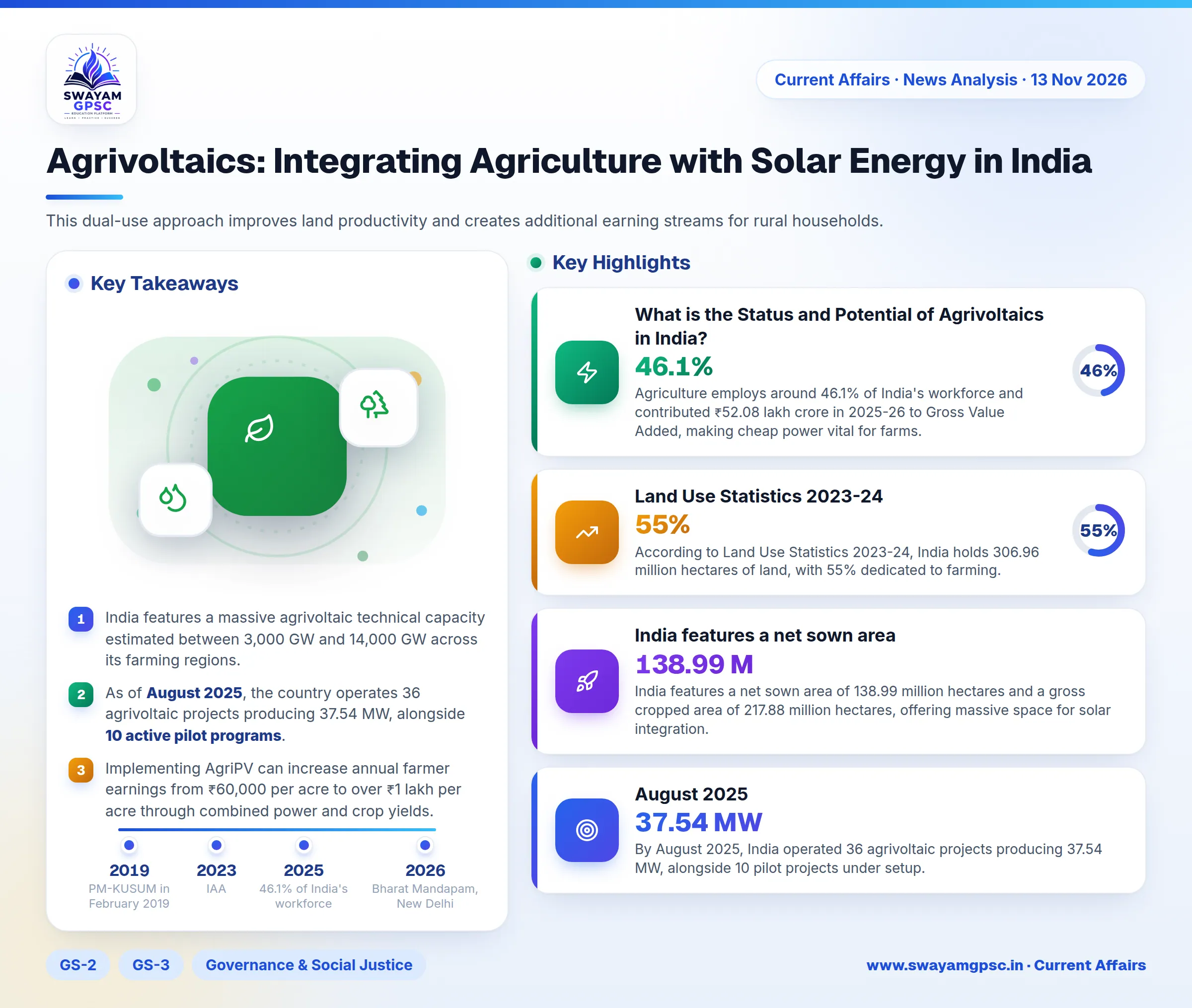
- India features a massive agrivoltaic technical capacity estimated between 3,000 GW and 14,000 GW across its farming regions.
- As of August 2025, the country operates 36 agrivoltaic projects producing 37.54 MW, alongside 10 active pilot programs.
- Implementing AgriPV can increase annual farmer earnings from ₹60,000 per acre to over ₹1 lakh per acre through combined power and crop yields.
- The central government backed PM-KUSUM with ₹34,422 crore to push solar pumps and rural clean energy systems.
- Six states including Maharashtra, Rajasthan, Andhra Pradesh, Madhya Pradesh, Karnataka, and Uttar Pradesh contain nearly 50% of India's AgriPV capacity.
Why in News
- The Bharat Renewable Energy Summit & Expo 2026 took place at Bharat Mandapam, New Delhi, bringing key sector leaders together.
- The event focused on speeding up renewable energy expansion, building investment channels, and introducing new clean technologies.
- Agrivoltaics (AgriPV) emerged as a key solution to combine farming with solar energy on the same plot of land.
- This dual-use approach improves land productivity and creates additional earning streams for rural households.
What are the Key Facts About Agrivoltaics?
- Agrivoltaics allows farmers to grow crops or raise livestock while generating solar electricity right above the same land.
- The system mounts solar panels high above crop rows so farming operations continue underneath without interruption.
- Engineers build elevated solar structures with optimal spacing to permit sunlight, rainfall, workers, and field machinery to pass easily.
- The partial shading from elevated panels lowers heat stress on crops and reduces soil water loss in hot regions.
- This dual land productivity model generates both agricultural harvests and green power, driving up total land yield.
- Farmers can use the generated power directly for irrigation pumps, cold storage units, and farm tools, while selling extra electricity to the power grid.
- Shade-tolerant options such as fruits, vegetables, spices, and medicinal plants thrive well under agrivoltaic systems.
- Unlike standard solar farms that clear out vegetation, agrivoltaics keeps farming active alongside power production.
What is the Status and Potential of Agrivoltaics in India?
- Agriculture employs around 46.1% of India's workforce and contributed ₹52.08 lakh crore in 2025-26 to Gross Value Added, making cheap power vital for farms.
- According to Land Use Statistics 2023-24, India holds 306.96 million hectares of land, with 55% dedicated to farming.
- India features a net sown area of 138.99 million hectares and a gross cropped area of 217.88 million hectares, offering massive space for solar integration.
- By August 2025, India operated 36 agrivoltaic projects producing 37.54 MW, alongside 10 pilot projects under setup.
- Different climate zones use tailored designs, such as elevated solar structures, interspace layouts, and tracking systems.
- Technical studies estimate India's total agrivoltaic generation capacity between 3,000 GW and nearly 14,000 GW.
- Adding solar systems can raise farm income from ₹60,000 per acre to over ₹1 lakh per acre annually under good conditions.
- National GIS mapping shows 47.35 million hectares of restricted cropland suitable for AgriPV after applying environmental and farm filters.
- Six major states including Maharashtra, Rajasthan, Andhra Pradesh, Madhya Pradesh, Karnataka, and Uttar Pradesh hold nearly 50% of India's total AgriPV potential.
- States such as Odisha, Tamil Nadu, Kerala, Telangana, Bihar, and West Bengal also show strong setup possibilities.
- Southern, western, and central regions gain from high solar light levels and extensive fruit and vegetable cultivation.
Pradhan Mantri Kisan Urja Suraksha evam Utthaan Mahabhiyan (PM-KUSUM)
- The government started PM-KUSUM in February 2019 to promote farm solar energy, cut diesel use, and boost rural earnings.
- The central government earmarked financial backing of ₹34,422 crore to drive the program.
- Component A supports building small, grid-connected solar power stations on farm properties.
- Component B helps farmers install standalone solar pumps in areas off the main power grid.
- Component C focuses on solarising existing grid-tied pumps at both individual farm and power-feeder levels.
- These elements build the basic infrastructure required to expand agrivoltaic setups across farm belts.
Centre of Excellence on Agrivoltaics
- The National Institute of Solar Energy (NISE) joined hands with ICAR-IARI to create this research hub.
- The institution runs field research, builds sample units, trains technicians, and tests crop health under panel shading.
- It manages a 100-kW agrivoltaic setup at the Indian Agricultural Research Institute campus for practical testing.
India Agrivoltaics Alliance (IAA)
- Formed in 2023, the IAA functions under the National Solar Energy Federation of India (NSEFI) with more than 40 member groups.
- The platform coordinates policy discussions, shared research, field tests, and industry knowledge exchange.
- It focuses on creating practical business models that balance crop output with renewable power profits.
Major State-Level Initiatives Supporting Solar Energy in Agriculture
- Maharashtra runs Mukhyamantri Saur Krushi Vahini Yojana 2.0 targeting 16,000 MW of solar builds across government and private plots.
- This program delivers daytime electricity to farmers, opening the door for expanded agrivoltaics adoption.
- Gujarat operates Kisan Suryoday Yojana to provide reliable daytime power to farmers between 5 AM and 9 PM, cutting late-night field work risks.
- Karnataka introduced Surya Raitha Scheme to help farmers set up solar pumps and earn money by feeding extra power to the grid.
Conclusion
- Agrivoltaics presents a smart dual path to secure both food crops and clean energy while raising rural household income.
- Scaling up requires tailored designs, cheap bank loans, field testing, clear standards, and strong participation from local farming communities.