WHO Global TB Report 2026: India's Progress and Challenges
#GS-2 #Governance & Social Justice #Health #Current Events #International #WHO Global Tuberculosis Report 2026 #Tuberculosis Burden in India 2025 #WHO End TB Strategy #National Tuberculosis Elimination Programme #Ni-kshay Poshan Yojana #TB Surveillance
Key takeaways
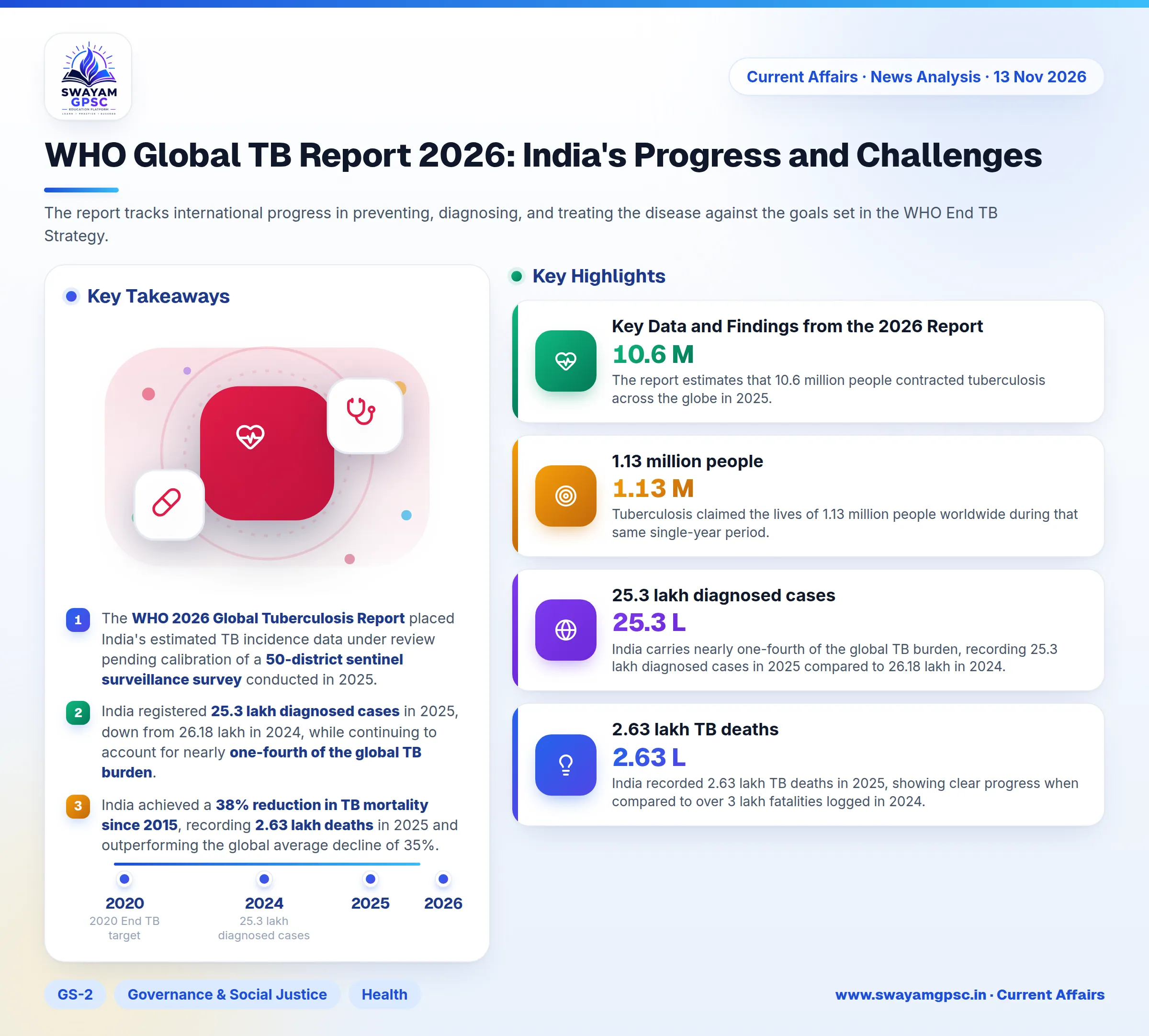
- The WHO 2026 Global Tuberculosis Report placed India's estimated TB incidence data under review pending calibration of a 50-district sentinel surveillance survey conducted in 2025.
- India registered 25.3 lakh diagnosed cases in 2025, down from 26.18 lakh in 2024, while continuing to account for nearly one-fourth of the global TB burden.
- India achieved a 38% reduction in TB mortality since 2015, recording 2.63 lakh deaths in 2025 and outperforming the global average decline of 35%.
- Domestic funding covers 96% of India's national TB programme, supporting key tools like the Ni-kshay tracking portal and CBNAAT molecular diagnostic tests.
Why in News
- The World Health Organization published its 2026 Global Tuberculosis Report but placed India's estimated TB incidence numbers under official review.
- This data remains under review while experts finalize results from a 50-district sentinel surveillance survey conducted across India in 2025.
About the WHO Global TB Report
- The World Health Organization releases this flagship publication every year to deliver a complete assessment of the global tuberculosis epidemic.
- The report tracks international progress in preventing, diagnosing, and treating the disease against the goals set in the WHO End TB Strategy.
Importance of Estimated Incidence
- Health agencies compare a country's estimated incidence against its actual notified cases to find total uncounted infections.
- This numerical gap highlights the exact pool of undiagnosed patients who unknowingly spread the infection across their local communities.
Shift in Surveillance Methodology
- Nationwide prevalence surveys like those run in 1955-58 and 2020-21 demand massive financial and logistical resources.
- To fix this, India launched a repeatable population-level sentinel survey across 50 representative districts in 2025.
- Statisticians at the WHO are currently calibrating these new survey results against the baseline established during the 2020-21 national study.
Key Data and Findings from the 2026 Report
- The report estimates that 10.6 million people contracted tuberculosis across the globe in 2025.
- Tuberculosis claimed the lives of 1.13 million people worldwide during that same single-year period.
- India carries nearly one-fourth of the global TB burden, recording 25.3 lakh diagnosed cases in 2025 compared to 26.18 lakh in 2024.
- India recorded 2.63 lakh TB deaths in 2025, showing clear progress when compared to over 3 lakh fatalities logged in 2024.
- The country achieved a 38% reduction in mortality since 2015, which beats the global average drop of 35% over the same timeframe.
- This 38% drop allowed India to cross the WHO interim 2020 End TB target of a 35% reduction, though it missed the original deadline by five years and fell short of the 75% target for 2025.
- Domestic budgetary resources supply roughly 96% of India's national TB programme funding, demonstrating strong national financial independence.
Key Initiatives Taken So Far
- The National TB Elimination Programme (NTEP) shifted national strategy from basic control to total elimination, using mandatory private sector reporting and real-time tracking on the Ni-kshay portal.
- The government introduced the Ni-kshay Poshan Yojana (NPY) to give monthly Direct Benefit Transfer cash support for patient nutrition, alongside community food kits provided under the Pradhan Mantri TB Mukt Bharat Abhiyaan.
- Health authorities expanded rapid molecular testing via CBNAAT and Truenat machines nationwide while deploying handheld, AI-powered portable X-ray tools for faster screening.
- Medical teams rolled out shorter, injection-free drug combinations like BPaL and BPaLM for Multidrug-Resistant TB to help patients finish their full treatment courses.
Challenges Associated with TB Elimination
- The government has delayed releasing its annual domestic TB report, which leaves public health researchers without updated state-level data on case notifications and drug resistance.
- Many patients with mild or hidden symptoms in rural areas and urban slums face long delays before getting a molecular test, allowing the infection to spread unchecked.
- A large portion of patients visit unmonitored private clinics first, where they face incomplete treatment courses, missed drug-resistance tests, and high out-of-pocket costs.
- Dangerous drug-resistant strains like MDR-TB continue to spread while social stigma causes vulnerable individuals to hide their symptoms out of fear.
Way Forward
- The government should finish calibrating the 50-district survey with the WHO and resume publishing the annual India TB Report to maintain full policy transparency.
- Health departments must place portable AI chest X-ray units and rapid molecular test kits inside local Ayushman Arogya Mandirs while setting up strong sample transport systems.
- Authorities should connect private clinics and pharmacies into the NTEP through Patient Provider Support Agencies (PPSAs) to supply free medicines and track patient progress.
- Local health officials must perform medical audits on every TB death to identify care failures while offering household contact screening and TB Preventive Therapy (TPT).
Conclusion
- India's 38% drop in TB deaths since 2015 proves that diagnostic expansion, nutritional aid, and domestic funding work well together.
- However, missing incidence figures highlight the urgent need for fast and open data collection.
- To reach full elimination, India must look beyond main notification numbers to catch hidden cases early, partner with private doctors, and support every patient through their complete treatment.