NITI Aayog Mid-Course Evaluation of PLI Schemes
#GS-3 #Economy #Industrial Growth #Growth #Infrastructure #Mobilization of Resources #Industrial Policy
Key takeaways
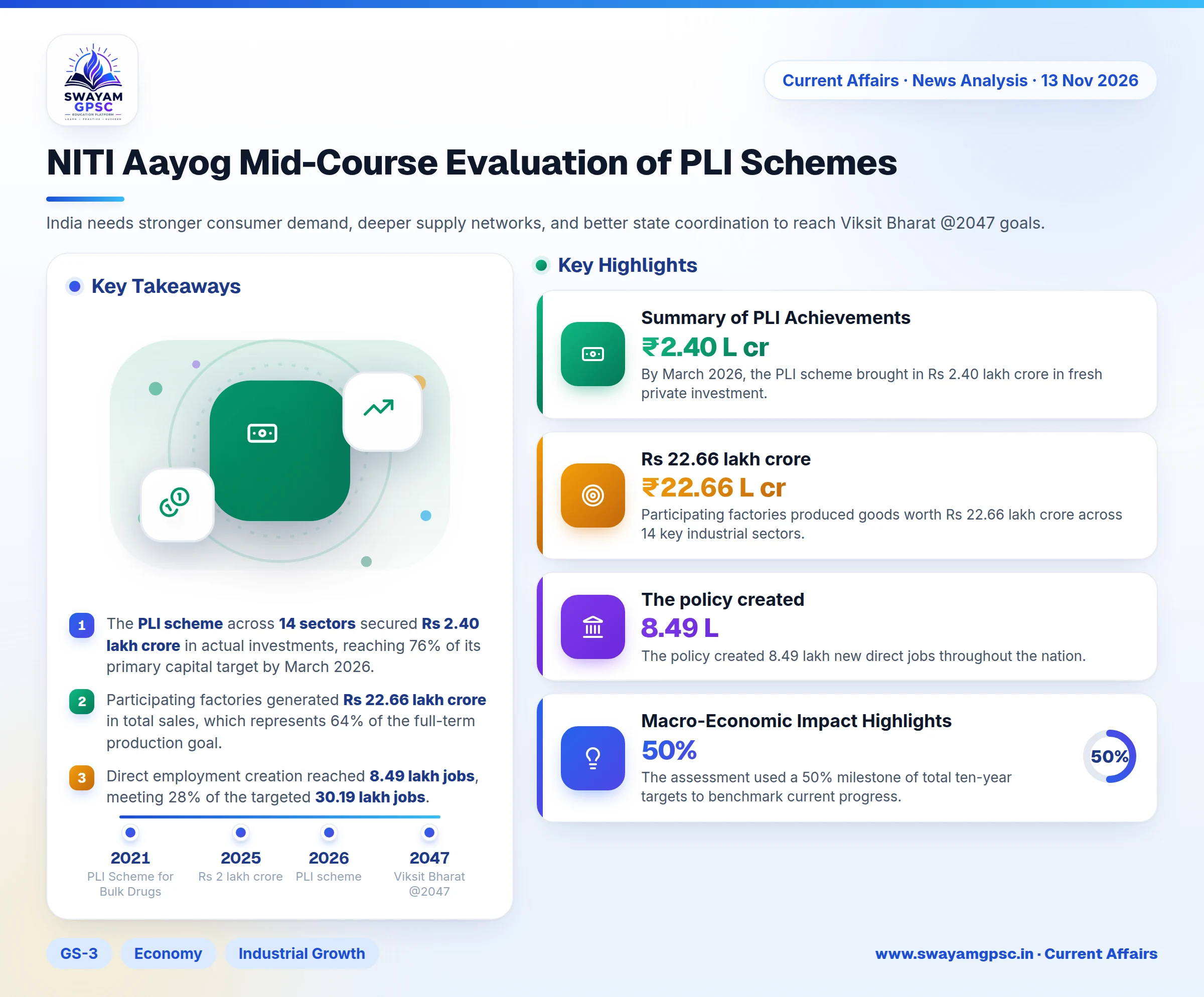
- The PLI scheme across 14 sectors secured Rs 2.40 lakh crore in actual investments, reaching 76% of its primary capital target by March 2026.
- Participating factories generated Rs 22.66 lakh crore in total sales, which represents 64% of the full-term production goal.
- Direct employment creation reached 8.49 lakh jobs, meeting 28% of the targeted 30.19 lakh jobs.
- Mobile phone exports jumped nearly nine-fold to Rs 2 lakh crore in FY2025, while mobile imports fell by 77% under the electronics package.
- The central government distributed Rs 35,354 crore in financial rewards, equal to 18.51% of the overall Rs 1.91 lakh crore budget.
Why in News
- NITI Aayog worked with IIM Ahmedabad to publish a review titled Impact Assessment of PLI Schemes.
- This mid-course report tests all 14 Production Linked Incentive (PLI) programs against key targets like investments, output, jobs, and exports.
Summary of PLI Achievements
- By March 2026, the PLI scheme brought in Rs 2.40 lakh crore in fresh private investment.
- Participating factories produced goods worth Rs 22.66 lakh crore across 14 key industrial sectors.
- The policy created 8.49 lakh new direct jobs throughout the nation.
- Major hurdles like weak local hiring, low local component sourcing, and unequal sector growth still exist.
- India needs stronger consumer demand, deeper supply networks, and better state coordination to reach Viksit Bharat @2047 goals.
Macro-Economic Impact Highlights
- The assessment used a 50% milestone of total ten-year targets to benchmark current progress.
- Total investments hit 76% of the total ten-year target of Rs 3.15 lakh crore.
- Factory output reached 64% of the full-term goal set at Rs 35.37 lakh crore.
- Job creation stands at 28% of the total ten-year target of 30.19 lakh jobs.
- The schemes completed 58% of their planned timeline, leaving 42% of the run time active.
- The government released Rs 35,354 crore in incentives, which equals 18.51% of the total Rs 1.91 lakh crore budget.
- Incentive payments follow verified sales and investment figures rather than upfront grants.
- Job numbers lag behind because setting up new factories and scaling production takes time.
Sector-Wise Performance of PLI Schemes
- Nearly 70% of target industrial segments are meeting their scheduled progress markers.
- The Large Scale Electronics Manufacturing (LSEM) PLI increased mobile phone exports to Rs 2 lakh crore in FY2025 while cutting mobile imports by 77%.
- New policies like the Electronics Component Manufacturing Scheme build on LSEM success to increase local parts production.
- The PLI Scheme for Bulk Drugs created 55,000 MT of capacity across 26 critical APIs, shifting India from a Rs 1,930 crore trade deficit in FY2021-22 to a Rs 2,280 crore trade surplus in FY2024-25.
- The PLI Scheme for Medical Devices started local production of MRI machines, CT scanners, LINACs, and cardiac implants.
- The PLI Scheme for Pharmaceuticals brought in over Rs 45,000 crore in investments across 55 approved applicants, starting local production of 191 pharmaceutical products for the first time.
- Pharma exports grew 32.7% from USD 19.46 billion in 2021 to USD 25.82 billion in 2025.
- Big drug companies produced 61% of all pharma goods under the scheme, while small businesses showed slower progress.
- The PLI Scheme for IT Hardware 2.0 raised average incentives to 5% after version 1.0 struggled with lower rates of 1-4%.
- The Telecom PLI Scheme lowered equipment imports by an average of 18.5% per year and added a 1% extra reward for local designs.
- The PLI Scheme for Automobiles and Auto Components boosted vehicle exports by 33.2% to USD 25.16 billion in 2025 while requiring 50% Domestic Value Addition.
- The PLI Scheme for ACC Batteries faces setup delays due to high local sourcing rules and missing raw materials.
- The Drone PLI Scheme increased sector revenues seven-fold and spent 77.5% of its assigned funds.
- The PLI Scheme for Technical Textiles cut imports by 49.4%, but used only 3.61% of its fund allocation because rules were too strict.
- The PLI Scheme for White Goods grew local air conditioner compressor capacity ten-fold to 10 million units, but actual payout numbers stay low.
- The PLI Scheme for High-Efficiency Solar PV Modules directly built 21% of current domestic solar capacity, though international price swings cause challenges.
- The PLI Scheme for Food Processing pushed sales to Rs 1.09 lakh crore in FY2025-26 and generated 3.29 lakh jobs.
- The PLI Scheme for Specialty Steel covers 67 applicants across 21 sub-categories, but policy updates delayed setup times.
Understanding the Production Linked Incentive Scheme
- The central government launched the PLI scheme in 2020 under the Atmanirbhar Bharat plan with an initial budget of Rs 1.97 lakh crore.
- The policy rewards manufacturers with direct money payments based on sales increases over a fixed base year.
- India created these incentives to lower reliance on foreign suppliers after Covid-19 broke global shipping lines.
- The program encourages multinational firms to move factories to India under the China+1 supply strategy.
- Total planned spending across all 14 sectors stands at Rs 1.91 lakh crore as of late 2026.
- The initiative aims to build big factories, connect local companies to global supply chains, cut import reliance on items like APIs, and create new jobs.
- The scheme divides industries into labor-heavy sectors like textiles, value-chain sectors like electronics, and futuristic sunrise sectors like battery storage.
NITI Aayog Recommendations
- Design customized rules for each industry instead of using one common setup for every sector.
- Add market demand incentives like guaranteed government purchases to match the current supply-side push.
- Set up standard data tracking to monitor real investment, hiring, sales, and export numbers.
- Improve weekly coordination between federal authorities, state governments, and factory leaders.
- Give complex manufacturing sectors longer timelines to achieve goals without early cutoffs.
- Focus on getting foreign technology transfers to increase local part sourcing and global sales.
Conclusion
- The PLI scheme successfully changed Indian industrial policy by linking government support to clear output goals.
- Fixing slow job growth and building reliable local parts suppliers will decide if India reaches its Viksit Bharat @2047 goals.