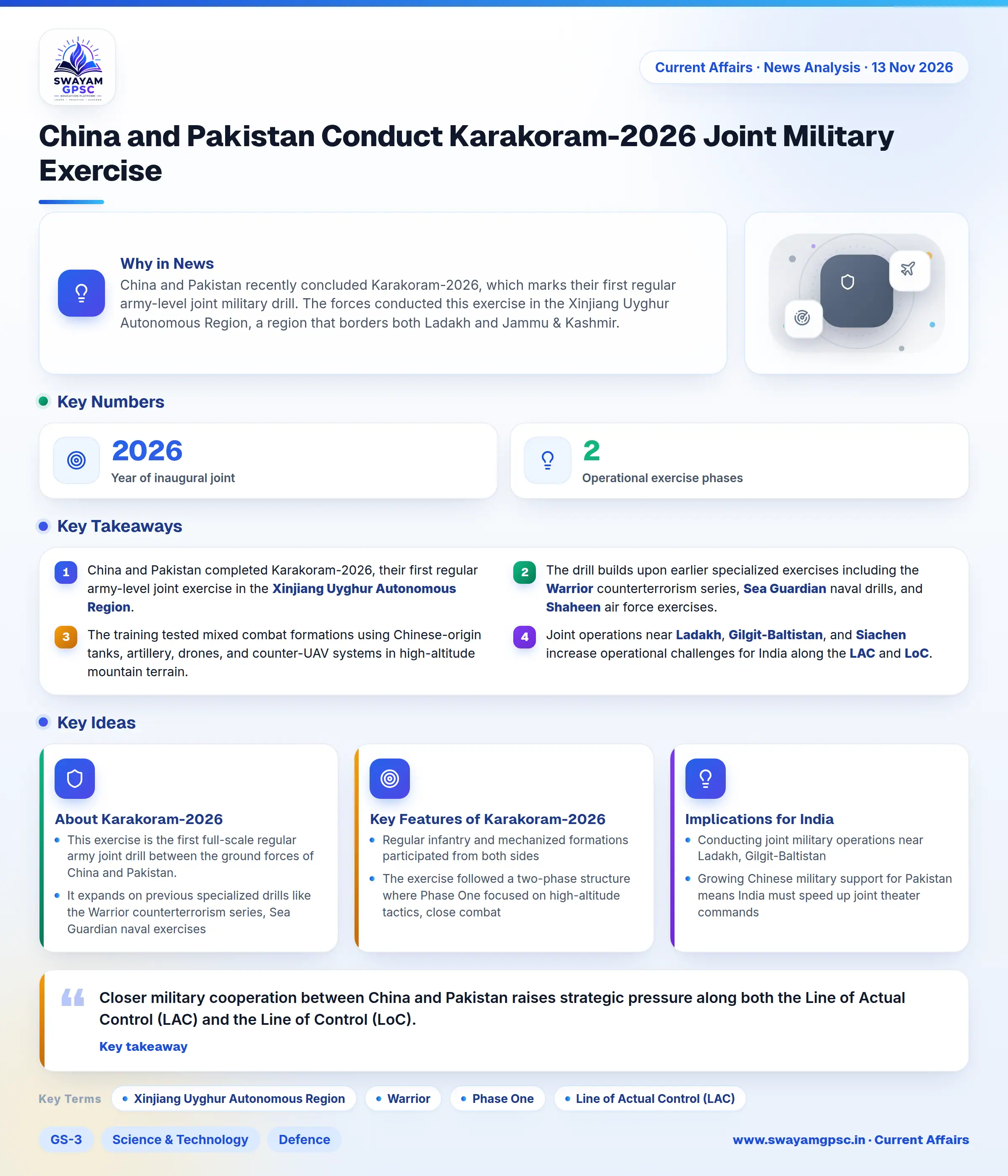
China and Pakistan Conduct Karakoram-2026 Joint Military Exercise
#GS-3 #Science & Technology #Defence #International Relations #Joint Military Exercises #China-Pakistan Relations #Karakoram-2026
Key takeaways
- China and Pakistan completed Karakoram-2026, their first regular army-level joint exercise in the Xinjiang Uyghur Autonomous Region.
- The drill builds upon earlier specialized exercises including the Warrior counterterrorism series, Sea Guardian naval drills, and Shaheen air force exercises.
- The training tested mixed combat formations using Chinese-origin tanks, artillery, drones, and counter-UAV systems in high-altitude mountain terrain.
- Joint operations near Ladakh, Gilgit-Baltistan, and Siachen increase operational challenges for India along the LAC and LoC.
Why in News
- China and Pakistan recently concluded Karakoram-2026, which marks their first regular army-level joint military drill.
- The forces conducted this exercise in the Xinjiang Uyghur Autonomous Region, a region that borders both Ladakh and Jammu & Kashmir.
About Karakoram-2026
- This exercise is the first full-scale regular army joint drill between the ground forces of China and Pakistan.
- It expands on previous specialized drills like the Warrior counterterrorism series, Sea Guardian naval exercises, and Shaheen air force drills.
- China hosted the exercise in its Xinjiang Uyghur Autonomous Region.
- The exercise directly involved the ground forces of the People's Republic of China and the Islamic Republic of Pakistan.
- The exercise aimed to boost tactical coordination, joint command, operational standardization, and battlefield interoperability in tough high-altitude areas.
Key Features of Karakoram-2026
- Regular infantry and mechanized formations participated from both sides, moving beyond past special forces drills to expand conventional military ties.
- The exercise followed a two-phase structure where Phase One focused on high-altitude tactics, close combat, and UAV operations, while Phase Two tested joint maneuvers and live-fire drills.
- Troops standardized their operations around Chinese hardware, using Chinese weapons, armored vehicles, artillery, drones, and counter-drone systems.
- Both armies created mixed combat units and joint command structures to test unified battlefield choices and operational coordination.
- The operational training focused heavily on high-altitude mountain warfare logistics, drone swarms, electronic warfare, and counter-UAV defense in the Himalayan and Karakoram terrain.
Implications for India
- Closer military cooperation between China and Pakistan raises strategic pressure along both the Line of Actual Control (LAC) and the Line of Control (LoC).
- Conducting joint military operations near Ladakh, Gilgit-Baltistan, and Siachen creates direct security concerns for India.
- Growing Chinese military support for Pakistan means India must speed up joint theater commands, boost local defense production, and build multi-domain deterrence.