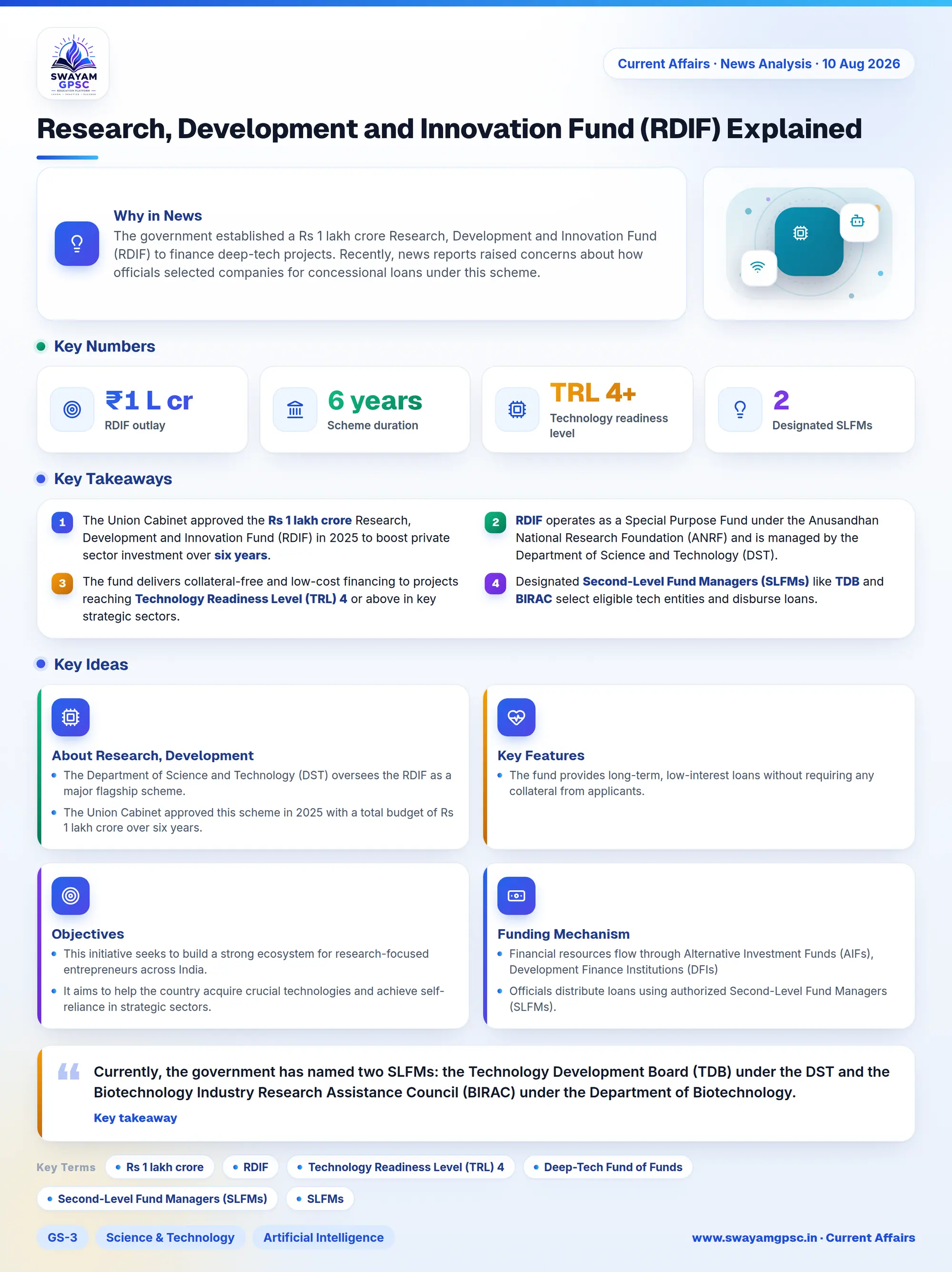
Research, Development and Innovation Fund (RDIF) Explained
#GS-3 #Science & Technology #Artificial Intelligence #Biotechnology #Defence #Space #GS-2 #Current Events #National #Government Policies
Key takeaways
- The Union Cabinet approved the Rs 1 lakh crore Research, Development and Innovation Fund (RDIF) in 2025 to boost private sector investment over six years.
- RDIF operates as a Special Purpose Fund under the Anusandhan National Research Foundation (ANRF) and is managed by the Department of Science and Technology (DST).
- The fund delivers collateral-free and low-cost financing to projects reaching Technology Readiness Level (TRL) 4 or above in key strategic sectors.
- Designated Second-Level Fund Managers (SLFMs) like TDB and BIRAC select eligible tech entities and disburse loans.
Why in News
- The government established a Rs 1 lakh crore Research, Development and Innovation Fund (RDIF) to finance deep-tech projects. Recently, news reports raised concerns about how officials selected companies for concessional loans under this scheme.
About Research, Development and Innovation Fund
- The Department of Science and Technology (DST) oversees the RDIF as a major flagship scheme. It functions as a Special Purpose Fund under the Anusandhan National Research Foundation (ANRF).
- The Union Cabinet approved this scheme in 2025 with a total budget of Rs 1 lakh crore over six years. Its primary goal is to encourage private companies to invest more money in research and development.
Key Features
- The fund provides long-term, low-interest loans without requiring any collateral from applicants. It focuses on high-risk and high-impact projects that reach Technology Readiness Level (TRL) 4 or higher in critical and emerging fields like AI, quantum technology, semiconductors, space, defence, robotics, clean energy, and digital healthcare.
Objectives
- This initiative seeks to build a strong ecosystem for research-focused entrepreneurs across India.
- It aims to help the country acquire crucial technologies and achieve self-reliance in strategic sectors.
- The government wants to create a dedicated Deep-Tech Fund of Funds to secure long-term economic growth and national autonomy.
Funding Mechanism
- Financial resources flow through Alternative Investment Funds (AIFs), Development Finance Institutions (DFIs), Non-Banking Financial Companies (NBFCs), and Focused Research Organisations (FROs). These institutions invest directly in Indian firms and startups working on tech-heavy innovations.
- Officials distribute loans using authorized Second-Level Fund Managers (SLFMs). These fund managers evaluate applications and select Eligible Technology Entities (ETEs) for financial support.
- Currently, the government has named two SLFMs: the Technology Development Board (TDB) under the DST and the Biotechnology Industry Research Assistance Council (BIRAC) under the Department of Biotechnology.