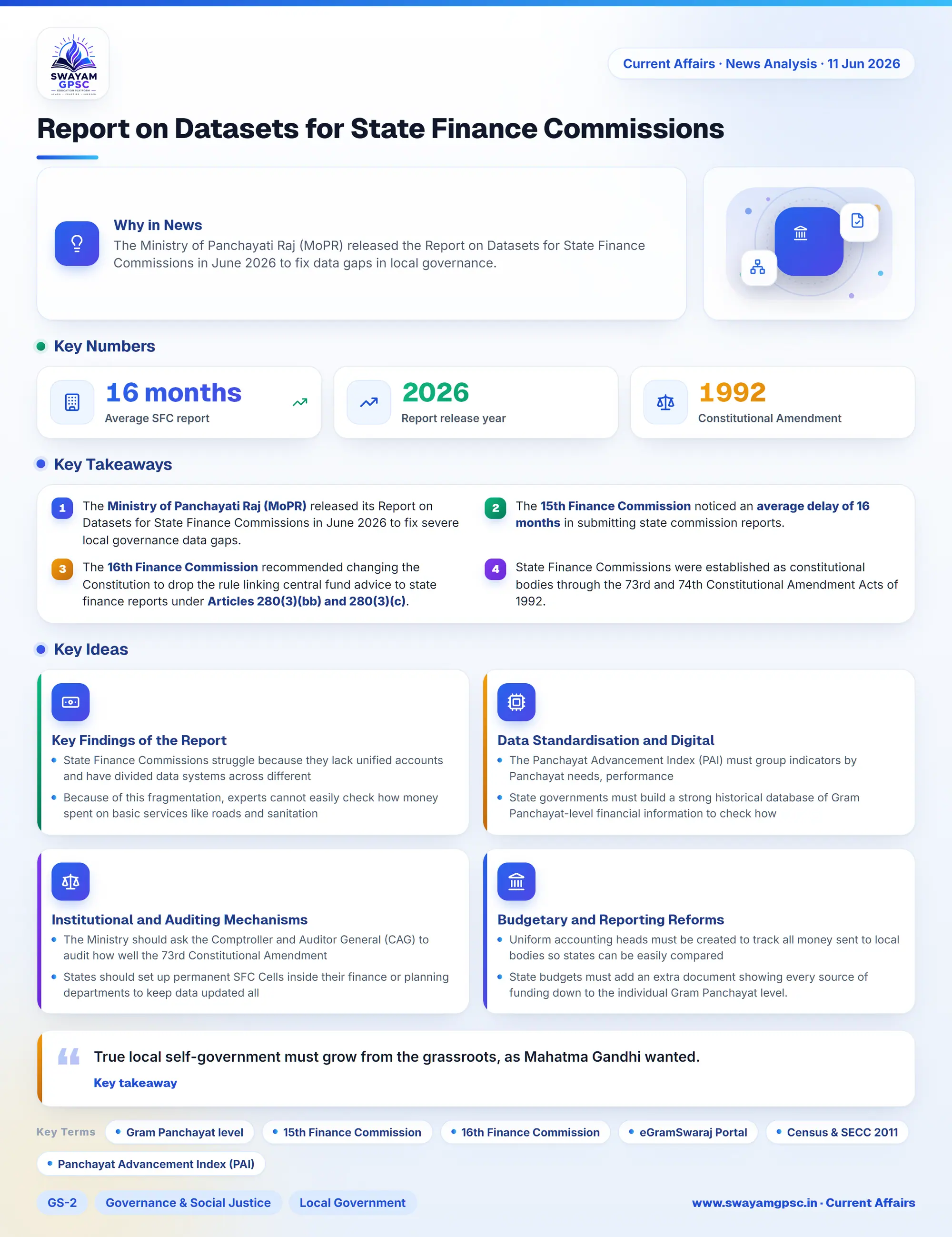
Report on Datasets for State Finance Commissions
#GS-2 #Governance & Social Justice #Local Government #Economy #Local Self Governance #Government Policies & Interventions
Key takeaways
- The Ministry of Panchayati Raj (MoPR) released its Report on Datasets for State Finance Commissions in June 2026 to fix severe local governance data gaps.
- The 15th Finance Commission noticed an average delay of 16 months in submitting state commission reports.
- The 16th Finance Commission recommended changing the Constitution to drop the rule linking central fund advice to state finance reports under Articles 280(3)(bb) and 280(3)(c).
- State Finance Commissions were established as constitutional bodies through the 73rd and 74th Constitutional Amendment Acts of 1992.
Why in News
- The Ministry of Panchayati Raj (MoPR) released the Report on Datasets for State Finance Commissions in June 2026 to fix data gaps in local governance.
- The report highlights major data issues that limit State Finance Commissions (SFCs) and suggests a new plan to build a stronger local government data system.
Key Findings of the Report
- State Finance Commissions struggle because they lack unified accounts and have divided data systems across different departments.
- Because of this fragmentation, experts cannot easily check how money spent on basic services like roads and sanitation actually improves public life.
- A severe shortage of trained accountants at the Gram Panchayat level leads to incomplete and messy financial records.
- The 15th Finance Commission noticed an average delay of 16 months in submitting State Finance Commission reports, which forces states to use old financial advice.
- The methodology and data quality of State Finance Commission reports vary widely across different states.
- As a result, the 16th Finance Commission found these reports too poor to use for making central fund sharing recommendations.
- Because of these ongoing problems, the 16th Finance Commission recommended amending the Constitution to drop the requirement under Articles 280(3)(bb) and 280(3)(c).
- The eGramSwaraj Portal suffers from uneven data entry across states, which hurts its reliability and integration.
- The Panchayat Advancement Index (PAI 2.0) helps compare performance, but it does not yet group indicators by needs, performance, or backwardness for money sharing.
- Data from the Census & SECC 2011 is too old, making it unhelpful for checking modern local financial needs.
- CAG Audit Reports & AuditOnline give reliable audit numbers, but they lack detail at the Gram Panchayat level, which limits local budget planning.
Data Standardisation and Digital Infrastructure
- The Panchayat Advancement Index (PAI) must group indicators by Panchayat needs, performance, and backwardness to help State Finance Commissions do better analysis with state-wise data.
- State governments must build a strong historical database of Gram Panchayat-level financial information to check how much revenue they can raise.
- National datasets often track revenue villages instead of Panchayats, so the Ministry of Panchayati Raj must work with MoSPI to capture Gram Panchayat data using the Local Government (LG) Directory.
Institutional and Auditing Mechanisms
- The Ministry should ask the Comptroller and Auditor General (CAG) to audit how well the 73rd Constitutional Amendment Act, 1992 is working in practice.
- States should set up permanent SFC Cells inside their finance or planning departments to keep data updated all the time.
- A regular meeting forum should be created so current and former State Finance Commissions can share lessons and learn from each other.
Budgetary and Reporting Reforms
- Uniform accounting heads must be created to track all money sent to local bodies so states can be easily compared with help from the CAG.
- State budgets must add an extra document showing every source of funding down to the individual Gram Panchayat level.
- State Finance Commissions should use the common reporting template first suggested by the 13th Finance Commission (2010-15).
Capacity Building and Inter-Ministerial Synergy
- The National Institute of Rural Development and Panchayati Raj (NIRDPR) should run training programs and restart publishing Panchayat statistics.
- The National Institute of Public Finance and Policy (NIPFP) should write a detailed manual to guide future commissions.
- An expert group made of MoPR, MoSPI, MoUD, and NITI Aayog should restart the local statistics initiative of the Government of India.
State Finance Commission Overview
- The State Finance Commission (SFC) is a constitutional body created to share financial power fairly in India.
- SFCs were created as the financial base of local self-government through the landmark 73rd and 74th Constitutional Amendment Acts of 1992.
- Their main job is to review the money situation of Panchayati Raj Institutions (PRIs) and Urban Local Bodies (ULBs) and suggest rules for sharing state funds.
- Article 243-I says the Governor of a State must form a Finance Commission within one year of the 73rd Amendment Act and every five years after that.
- Article 243-Y allows the Finance Commission formed under Article 243-I to also check the money situation of municipalities.
- Article 280 tells the Central Finance Commission (CFC) to recommend ways to grow state funds to support local bodies based on State Finance Commission reports.
- State legislatures decide the rules for who joins the State Finance Commission and how they are chosen.
- The Governor must present every State Finance Commission report and an action taken note to the State Legislature.
- State Finance Commissions decide how to share taxes, tolls, and fees between the state and local bodies.
- They also decide which taxes local bodies can collect and use on their own.
- They recommend grants from the Consolidated Fund of the State to help local bodies.
- They suggest any other steps needed to make local government finances stronger.
Conclusion
- True local self-government must grow from the grassroots, as Mahatma Gandhi wanted.
- Strong fiscal federalism needs clear data to match fund sharing with real local needs.
- Applying the Ministry's data suggestions will help improve governance and reach the Sustainable Development Goals (SDGs) faster.