Remittances Anchoring India’s External Balances
#GS-2 #GS-3 #Economy #Infrastructure #Current Events #National #International #Banking #Growth
Key takeaways
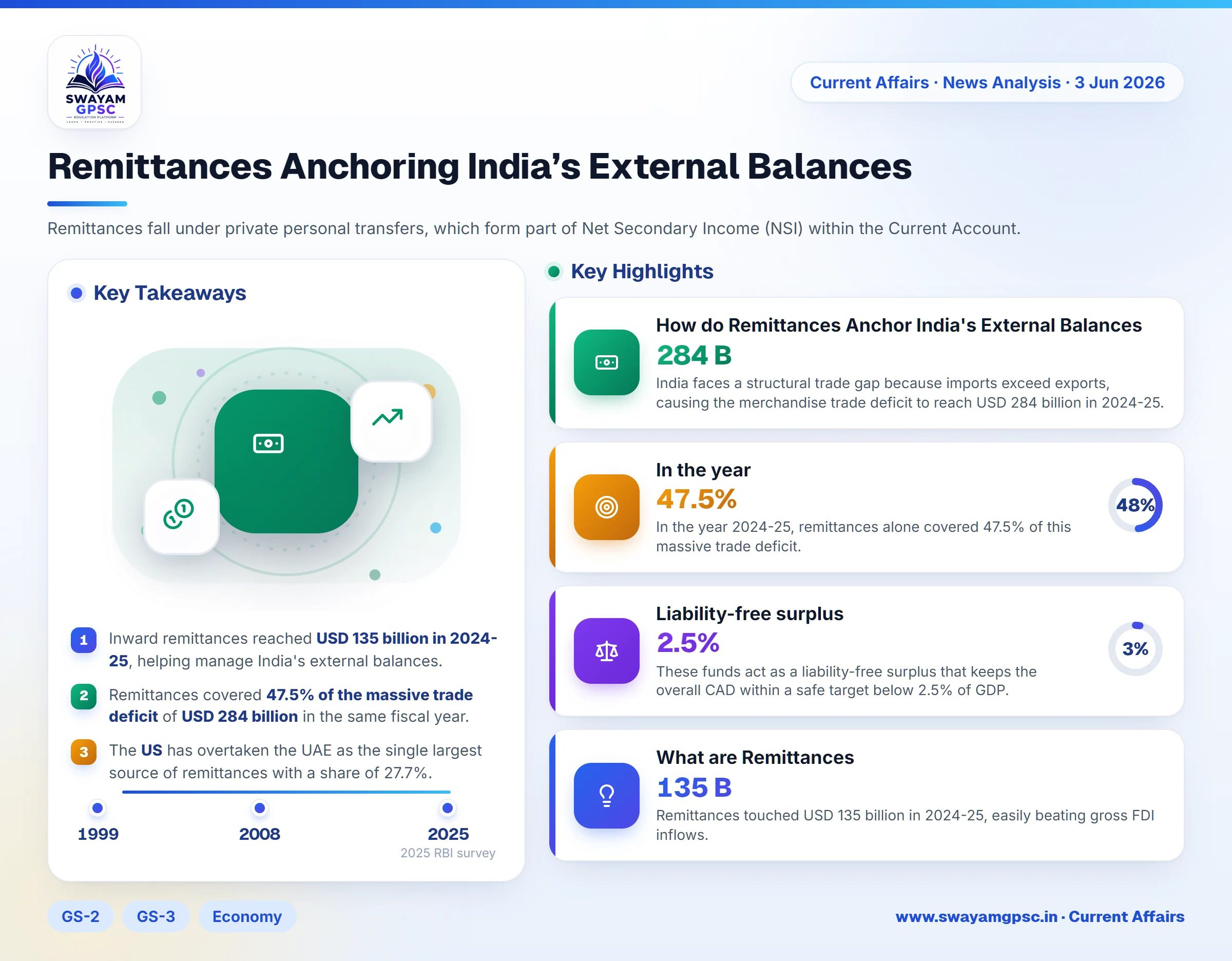
- Inward remittances reached USD 135 billion in 2024-25, helping manage India's external balances.
- Remittances covered 47.5% of the massive trade deficit of USD 284 billion in the same fiscal year.
- The US has overtaken the UAE as the single largest source of remittances with a share of 27.7%.
- Under the Liberalized Remittance Scheme (LRS), residents can remit up to USD 250,000 per year for permitted purposes.
Why in News
- Economists highlight that inward remittances play a vital part in managing India’s external balances.
- Amid global economic challenges and volatile Foreign Portfolio Investments (FPIs), remittances have emerged as the unsung hero of India’s macroeconomic stability.
How do Remittances Anchor India's External Balances
- The BoP is split into two parts: the Current Account and the Capital Account.
- Remittances fall under private personal transfers, which form part of Net Secondary Income (NSI) within the Current Account.
- India faces a structural trade gap because imports exceed exports, causing the merchandise trade deficit to reach USD 284 billion in 2024-25.
- In the year 2024-25, remittances alone covered 47.5% of this massive trade deficit.
- These funds act as a liability-free surplus that keeps the overall CAD within a safe target below 2.5% of GDP.
- Since mid-2013, remittance inflows have often financed more than the total volume of India's merchandise trade deficit.
- Unlike hot money like FPIs that can leave quickly during global shocks, remittances provide a stable and continuous supply of foreign currency.
- When families convert foreign currencies like US Dollars, Euros, and UAE Dirhams into INR, it creates a steady demand for the Rupee.
- This steady demand protects the domestic currency from sharp drops caused by sudden foreign investor sell-offs.
Significance for the Indian Economy
- Unlike External Commercial Borrowings (ECBs) or Foreign Direct Investment (FDI) that need future repayments, remittances are private, non-returnable transfers.
- They reduce the burden on the Reserve Bank of India (RBI) to manage the forex market and help build robust forex reserves.
- At the local level, these funds boost domestic consumption, improve health and education, and drive regional growth in states like Kerala, Maharashtra, Karnataka, and Tamil Nadu.
What are Remittances
- Remittances are cross-border money transfers sent by migrant workers and Non-Resident Indians (NRIs) back home to support their families.
- These flows happen due to altruistic motives rather than pure investment, making them highly stable against global financial shocks.
- The Foreign Exchange Management Act (FEMA), 1999 regulates all foreign exchange transactions in India.
- Under the Liberalized Remittance Scheme (LRS), residents can send up to USD 250,000 per year for personal and investment needs.
- The LRS strictly bans sending money for gambling, speculative trading, and terrorist financing.
- Money can be sent to India using NRE, NRO, and FCNR accounts.
- India has remained the world’s largest recipient of remittances since 2008.
- Remittances touched USD 135 billion in 2024-25, easily beating gross FDI inflows.
- A 2025 RBI survey shows that advanced nations now account for over 50% of total remittance inflows.
- The US has overtaken the UAE as the top single source, with its share rising to 27.7%.
- The combined share of Gulf countries has dropped to 38%, and the UAE share fell to 19.2%.
- High-wage professionals in OECD countries now send more money than blue-collar workers in the Gulf.
- However, high reliance on advanced economies makes India vulnerable to strict visa rules.
- Also, AI-driven automation in Western nations threatens white-collar tech jobs that drive recent remittance growth.
- Political friction in the GCC region also risks displacing many blue-collar workers.
- Any drop in these inflows combined with negative FDI trends will widen the current account deficit and weaken the rupee.