Relevance and Challenges of Regional Parties in Indian Politics
#GS-2 #Indian Polity & Constitution #Governance & Social Justice #Constitution #Current Events #National #Representation of People's Act
Key takeaways
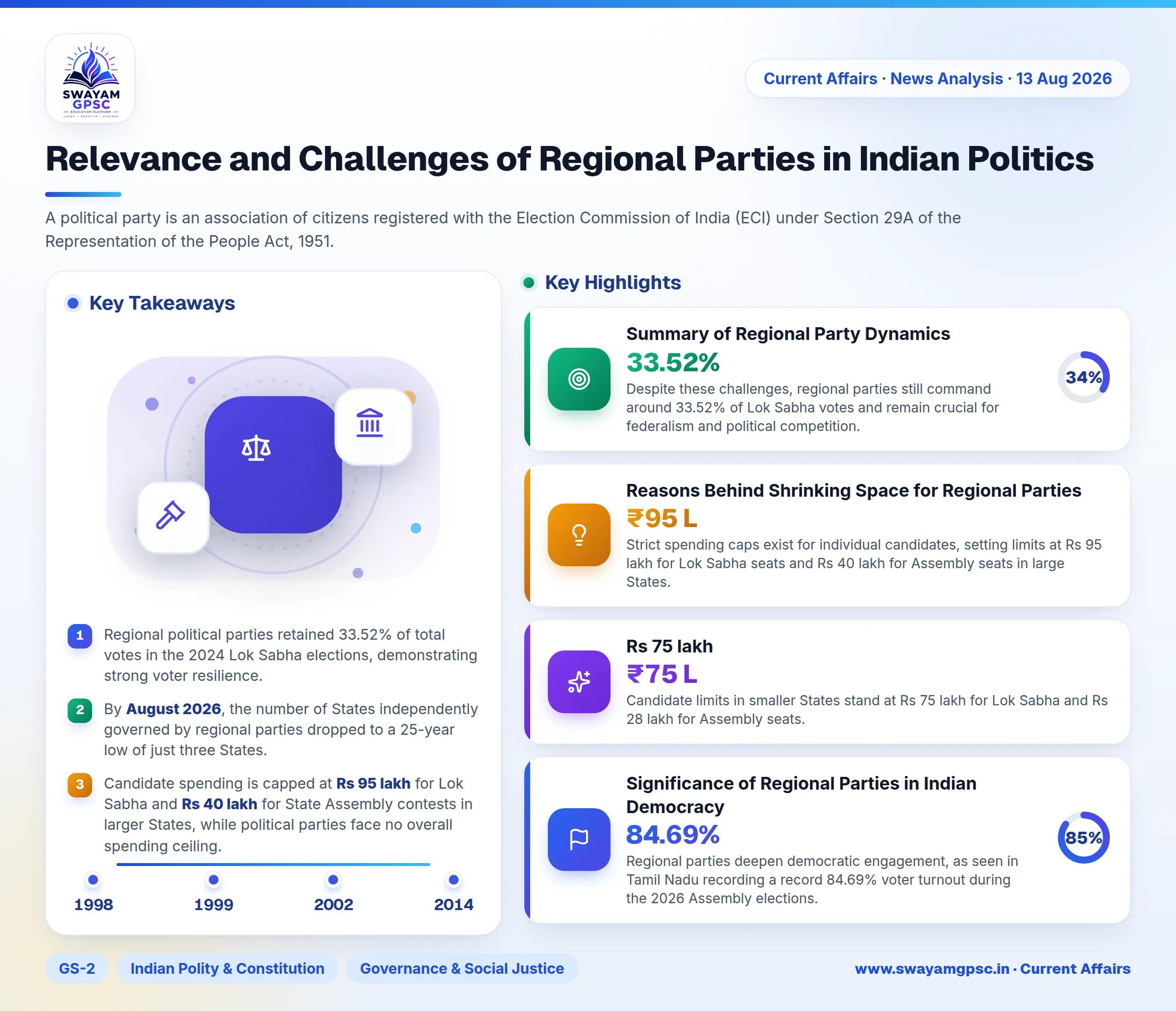
- Regional political parties retained 33.52% of total votes in the 2024 Lok Sabha elections, demonstrating strong voter resilience.
- By August 2026, the number of States independently governed by regional parties dropped to a 25-year low of just three States.
- Candidate spending is capped at Rs 95 lakh for Lok Sabha and Rs 40 lakh for State Assembly contests in larger States, while political parties face no overall spending ceiling.
- Reforming the Tenth Schedule and enacting state election funding based on the Indrajit Gupta Committee (1998) recommendations can protect regional parties from resource disparities.
Why in News
- Recent electoral setbacks and widespread defections across regional political parties have sparked intense debates about their future relevance.
- Proposals surrounding the One Nation, One Election framework raise further questions on whether regional parties can maintain their political footprint.
Summary of Regional Party Dynamics
- Regional parties face severe electoral and organizational struggles, including stronger national competition, defections, leadership crises, and financial constraints.
- Despite these challenges, regional parties still command around 33.52% of Lok Sabha votes and remain crucial for federalism and political competition.
Classification of Party System in India
- A political party is an association of citizens registered with the Election Commission of India (ECI) under Section 29A of the Representation of the People Act, 1951.
- India follows a multi-party political system where regional and national forces compete at both Union and State levels.
- The ECI formally classifies registered parties into recognized national parties, state parties, and unrecognized parties under the Election Symbols (Reservation and Allotment) Order, 1968.
- State parties are widely known as regional parties because their influence remains concentrated within specific State boundaries.
- The original text of the Constitution of India did not mention the term political party until the 52nd Constitutional Amendment Act, 1985 introduced the Tenth Schedule.
Reasons Behind Shrinking Space for Regional Parties
- The rapid organizational and electoral expansion of dominant national parties has significantly squeezed the political space available to regional outfits.
- By August 2026, regional parties independently led governments in only three States and one Union Territory, marking a 25-year low.
- India's political system evolved through three main phases: one-party dominance from 1952 to 1967, regional aspirations from 1967 to 1989, and coalition politics from 1989 to 2014.
- Under the First-Past-the-Post electoral system, even a minor drop in vote share can result in a massive loss of seats for regional parties.
- Many regional parties suffer from weak internal democracy and dynastic leadership, leading to severe factionalism and succession crises.
- Emerging political leaders often leave regional parties due to restricted growth opportunities and move toward well-structured national parties.
- Strict spending caps exist for individual candidates, setting limits at Rs 95 lakh for Lok Sabha seats and Rs 40 lakh for Assembly seats in large States.
- Candidate limits in smaller States stand at Rs 75 lakh for Lok Sabha and Rs 28 lakh for Assembly seats.
- Political parties themselves face no total campaign expenditure limits, giving wealthy national parties a massive financial advantage over regional rivals.
- Misuse of the anti-defection provisions under the Tenth Schedule creates frequent party splits and destabilizes regional political organizations.
- Central investigative agencies, corruption charges, and financial pressures place extra operational strain on regional party leadership.
- Financial autonomy of States is shrinking due to discretionary powers of Governors, delayed state bills, tied grants under Centrally Sponsored Schemes, and rising central cesses under Article 271.
- Simultaneous elections under One Nation, One Election risk sweeping regional welfare issues aside in favor of national security or macroeconomic agendas.
- Voters increasingly prefer candidates focused on broader economic development and national aspirations over purely regional identity issues.
Evidence of Resilience
- Regional parties maintained a stable voter base by securing 33.52% of total votes during the 2024 Lok Sabha elections.
- Voters consistently demonstrate a strong preference for regional parties during State Assembly elections.
- Regional parties remain vital coalition allies, governing in States like Andhra Pradesh, Meghalaya, Nagaland, and Puducherry, while participating in many others.
Significance of Regional Parties in Indian Democracy
- Regional parties prevent excessive centralization of power by pushing the national government toward greater administrative and financial devolution.
- Coalition governments between 1989 and 2014 forced central leaders to address State demands through bodies like the Inter-State Council and NITI Aayog.
- Regional leaders pioneer innovative welfare policies, such as Tamil Nadu's Midday Meal Scheme, which later transformed into nationwide government initiatives.
- Regional parties deepen democratic engagement, as seen in Tamil Nadu recording a record 84.69% voter turnout during the 2026 Assembly elections.
- Regional parties ensure that local linguistic, cultural, and geographic concerns receive adequate attention in Parliament and national policy discussions.
Measures to Strengthen Regional Parties
- Introducing partial state funding of elections, as advised by the Indrajit Gupta Committee (1998), can help balance campaign resources.
- Reforming the Tenth Schedule to eliminate loopholes regarding party mergers will curb engineered defections against regional parties.
- The Dinesh Goswami Committee (1990) suggested transferring disqualification powers from the Speaker to the President or Governor acting on ECI advice.
- The Law Commission's 170th Report (1999) and the 2002 Constitution Review Commission recommended handing anti-defection decisions to an independent tribunal.
- Building structured internal democracy and nurturing second-tier leadership will prevent destructive splits during party leadership transitions.
- Implementing simultaneous elections requires strong constitutional safeguards so national topics do not overshadow State-specific developmental narratives.
- Future parliamentary delimitation must protect Southern States with strong regional parties from losing representation due to population growth in northern belts.
- Regional parties must transition toward developmental regionalism by delivering strong governance models in health, infrastructure, and fiscal policy.
Conclusion
- Regional parties are facing severe organizational tests rather than total extinction in Indian politics.
- Sustaining India's democratic health requires vibrant regional voices to reflect true federal diversity at national and State levels.