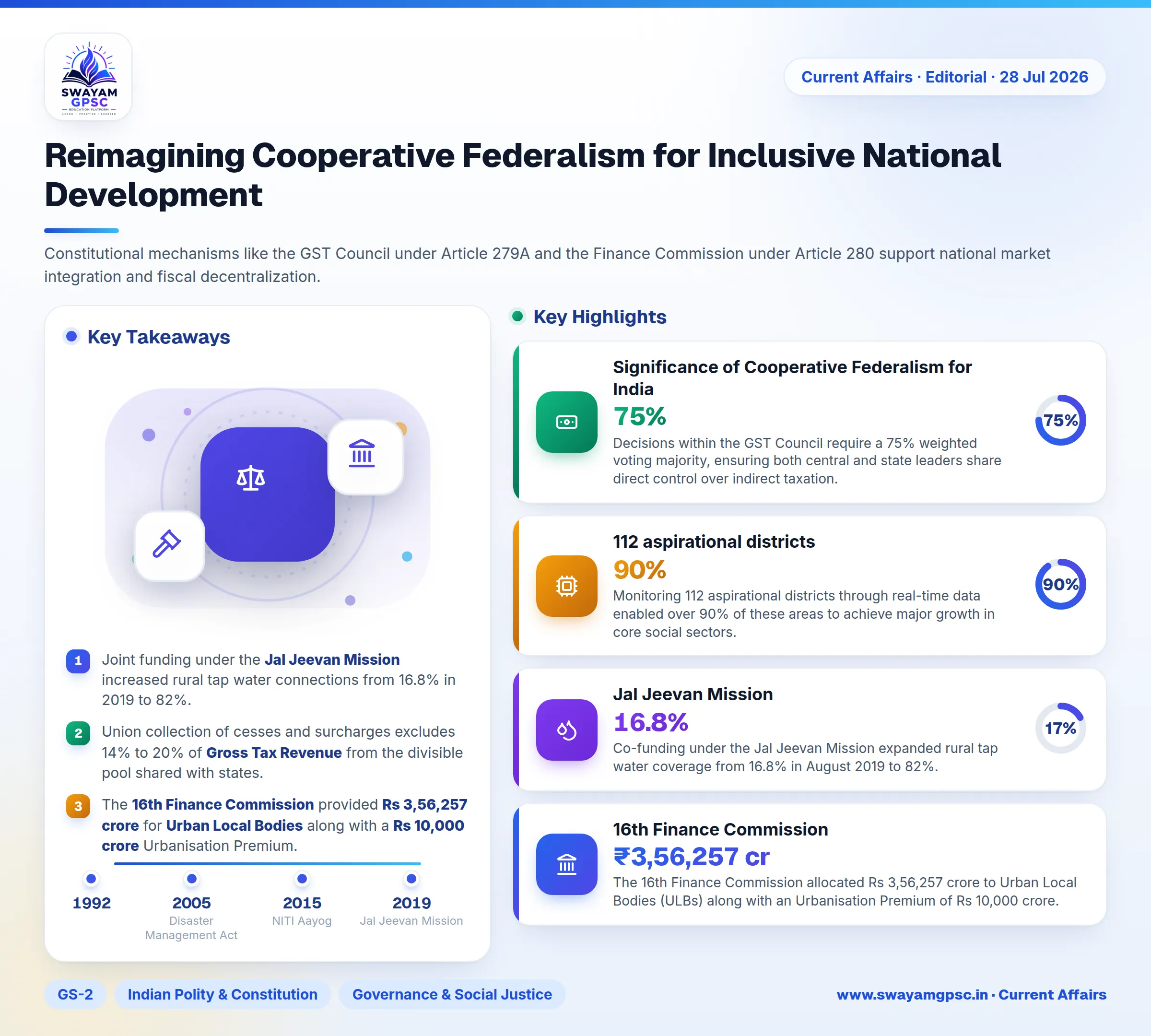
Reimagining Cooperative Federalism for Inclusive National Development
#GS-2 #Indian Polity & Constitution #Governance & Social Justice #Federalism #Constitutional Bodies #Centre-State Relations
Why in News
- Cooperative federalism connects the diverse regions of India through institutions like the **GST Council** and **NITI Aayog**.
- Persistent issues like fiscal gaps, central laws overriding states, and conflict with Governors continue to create administrative hurdles.
- Strengthening joint policy discussions and state financial independence remains essential to achieve balanced growth across all regions.
Significance of Cooperative Federalism for India
- Constitutional mechanisms like the **GST Council** under **Article 279A** and the **Finance Commission** under **Article 280** support national market integration and fiscal decentralization.
- Decisions within the **GST Council** require a **75%** weighted voting majority, ensuring both central and state leaders share direct control over indirect taxation.
- The government formed **NITI Aayog** in **2015** to replace the former Planning Commission and promote bottom-up policy planning.
- Monitoring **112 aspirational districts** through real-time data enabled over **90%** of these areas to achieve major growth in core social sectors.
- Central and state authorities coordinate emergency operations under the **Disaster Management Act, 2005** and the **Epidemic Diseases Act, 1897**.
- During the **Covid-19** emergency, central agencies managed logistics and vaccines while state teams directed local medical delivery and lockdowns.
- Joint funding frameworks under **Article 282** usually split costs **60:40** for standard states and **90:10** for northeastern and Himalayan states.
- Co-funding under the **Jal Jeevan Mission** expanded rural tap water coverage from **16.8%** in August **2019** to **82%**.
- Constitutional mechanisms under **Article 263** for the **Inter-State Council**, along with **Zonal Councils**, resolve inter-state disputes through structured dialogue.
- Negotiations resolved long disputes over projects like the **Kishau Multipurpose Dam** and the **Haryana-Rajasthan Yamuna Water Project**.
- Standard indices like the **Business Reforms Action Plan (BRAP)** and the **Good Governance Index (GGI)** drive positive competition among states.
- State governments completed **7,500** specific reform goals, strengthening local business conditions and drawing record **FDI** inflows.
- Central recruitment through **Article 312** creates **All India Services** that align national policy execution with local regional administration.
- Joint security efforts reduced **Left-Wing Extremism (LWE)** across formerly affected districts over the past decade.
- The **73rd and 74th Constitutional Amendment Acts** of **1992** institutionalized grassroots local governance through village councils and urban municipalities.
- The **16th Finance Commission** allocated **Rs 3,56,257 crore** to **Urban Local Bodies (ULBs)** along with an **Urbanisation Premium** of **Rs 10,000 crore**.
Challenges
- States with low **total fertility rates (TFR)** worry about losing Lok Sabha seats during delimitation, despite the **16th Finance Commission** giving a **10%** weight to GDP contribution.
- Union reliance on non-shareable cesses and surcharges regularly takes **14% to 20%** of **Gross Tax Revenue (GTR)**, reducing the general divisible revenue pool.
- Rigid matching-fund requirements of **60:40** or **90:10** under Centrally Sponsored Schemes divert state capital away from local regional priorities.
- Gubernatorial delays in signing state bills under **Article 200** led states like **Kerala**, **Tamil Nadu**, **Punjab**, and **Telangana** to file petitions in the Supreme Court.
- Parliament frequently passes broad national frameworks on **7th Schedule** Concurrent List topics without consulting state assemblies beforehand.
- Irregular meetings of the **Inter-State Council** under **Article 263** force states to litigate water and territorial disputes directly in court.
- Strict central verification guidelines under **SDRF** and **NDRF** delay financial relief disbursements during regional natural disasters.
- Disagreements over compensation timelines and revenue distribution under **Article 279A** create mistrust inside the **GST Council**.
Way Forward
- Creating an **Autonomous Federal Stabilization Fund** can provide state governments with automatic counter-cyclical grants during severe economic downturns.
- Transforming the **Inter-State Council** under **Article 263** into a permanent digital forum will enable pre-legislative consensus on major national bills.
- Replacing rigid conditional schemes with untied development grants tied to multidimensional poverty indices gives states room to address local requirements.
- Enacting a statutory legislative compact will mandate prior review of Concurrent List bills by **NITI Aayog** and state assemblies.
- Amending **Article 200** to set a strict **90-day** deadline for Governors to approve state bills will eliminate administrative delays.
- Establishing a **Federal Green Transition and Carbon Dividend Facility** will compensate coal-dependent states as they move toward renewable energy.
- Enforcing time-bound setup of **State Finance Commissions (SFCs)** will ensure direct funding flows to local municipal bodies.
Conclusion
- Cooperative federalism forms the foundation of India's democratic system and long-term socio-economic progress.
- Resolving structural financial imbalances, legislative overlaps, and institutional delays will turn federal principles into practical joint governance.