Regulating Social Media Addiction and Protecting Children Online
#GS-2 #Governance & Social Justice #Indian Polity & Constitution #Current Events #GS-3 #Science & Technology #IT & Computers #Social Media #Government Policies & Interventions
Key takeaways
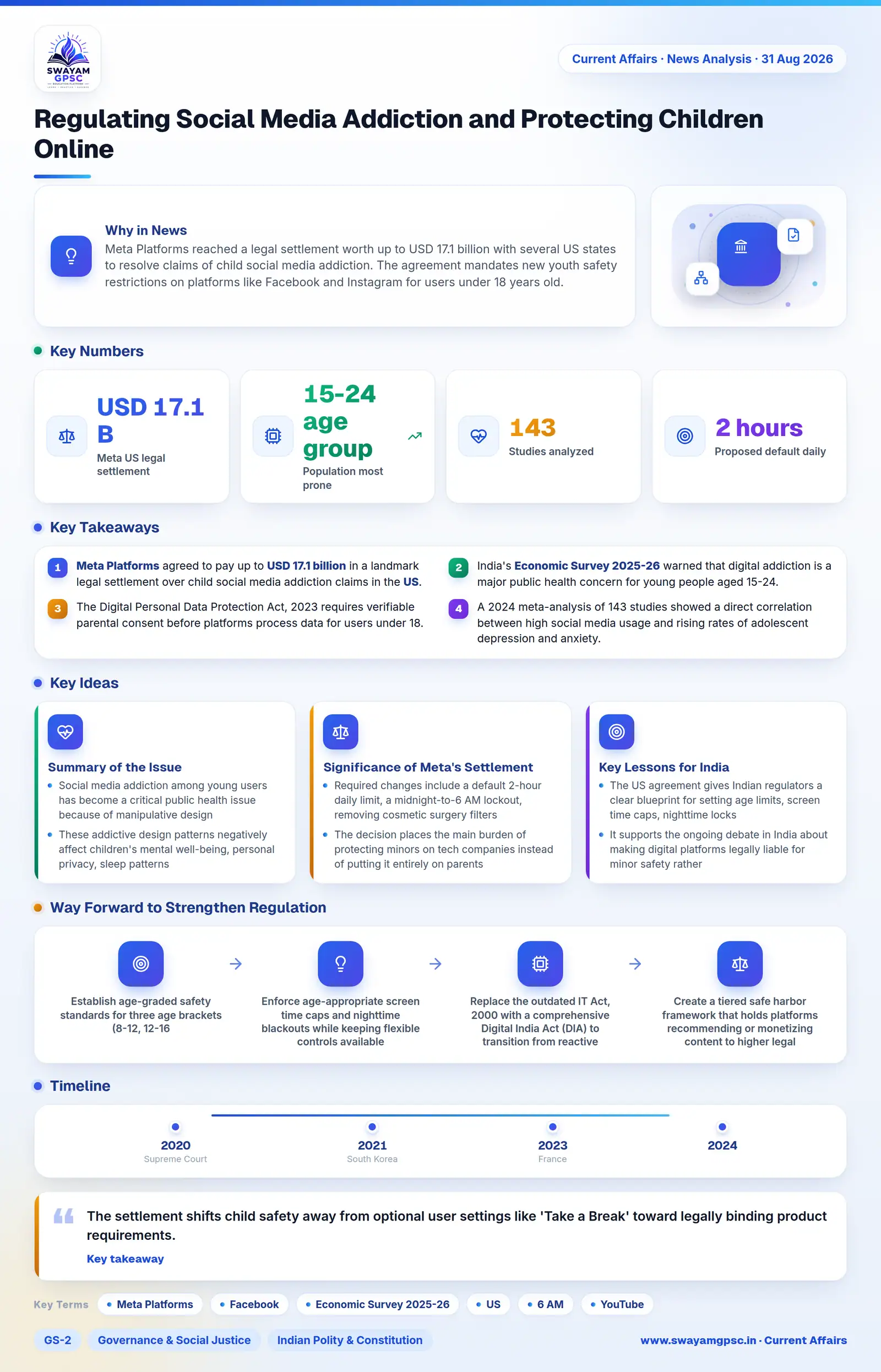
- Meta Platforms agreed to pay up to USD 17.1 billion in a landmark legal settlement over child social media addiction claims in the US.
- India's Economic Survey 2025-26 warned that digital addiction is a major public health concern for young people aged 15-24.
- The Digital Personal Data Protection Act, 2023 requires verifiable parental consent before platforms process data for users under 18.
- A 2024 meta-analysis of 143 studies showed a direct correlation between high social media usage and rising rates of adolescent depression and anxiety.
Why in News
- Meta Platforms reached a legal settlement worth up to USD 17.1 billion with several US states to resolve claims of child social media addiction.
- The agreement mandates new youth safety restrictions on platforms like Facebook and Instagram for users under 18 years old.
- This settlement is relevant to India because the Economic Survey 2025-26 highlighted digital addiction as a serious public health concern among citizens aged 15-24.
- Indian policymakers are currently exploring mandatory age limits, daily usage restrictions, and mandatory parental consent tools for minors.
- The US court settlement gives India a working framework that relies on age verification, daily usage limits, nighttime lockouts, parental controls, and independent auditing.
Summary of the Issue
- Social media addiction among young users has become a critical public health issue because of manipulative design features, algorithmic feeds, and excessive screen exposure.
- These addictive design patterns negatively affect children's mental well-being, personal privacy, sleep patterns, education, and social growth.
- India needs a comprehensive regulatory system that enforces child data privacy, age verification, algorithmic checks, safety design rules, and digital literacy.
- This regulatory model must protect young users while preserving individual privacy, free speech, and access to positive digital resources.
Significance of Meta's Settlement
- The settlement shifts child safety away from optional user settings like 'Take a Break' toward legally binding product requirements.
- Required changes include a default 2-hour daily limit, a midnight-to-6 AM lockout, removing cosmetic surgery filters, and outside audit oversight.
- The decision places the main burden of protecting minors on tech companies instead of putting it entirely on parents and children.
- The legal action relies on laws like the US Children’s Online Privacy Protection Act (COPPA) (1998) to hold companies accountable for gathering children's data without parental consent.
- This legal precedent could compel other large platforms like YouTube and TikTok to introduce similar safety controls for minor users.
Key Lessons for India
- The US agreement gives Indian regulators a clear blueprint for setting age limits, screen time caps, nighttime locks, and parental verification.
- It supports the ongoing debate in India about making digital platforms legally liable for minor safety rather than relying on voluntary family supervision.
- The decision shows why regulators must enforce uniform rules across all social platforms so children cannot simply move to less regulated apps.
How Social Media Platforms Hook Children
- Social media platforms use principles from behavioral psychology and neuroscience within the Attention Economy to maximize user screen time.
- Platforms use unpredictable rewards like likes, tags, comments, and notifications to trigger dopamine releases in the brain's mesolimbic system, creating psychological dependency.
- Design features like infinite scrolling and automatic video playback remove natural stopping points, leading users to consume content continuously.
- Advanced Artificial Intelligence (AI) algorithms track micro-behavior, such as video pauses, to create personalized feeds that prioritize engagement over user safety.
- Platform features like disappearing stories and read receipts exploit a teenager's need for social approval, creating a strong fear of missing out.
Impacts of Social Media Addiction on Children
- Heavy social media exposure leads to higher rates of anxiety, depression, loneliness, low self-esteem, and body image issues, particularly among adolescent girls.
- A 2024 meta-analysis of 143 studies involving over one million teenagers confirmed that high platform usage directly correlates with increased rates of anxiety and depression.
- Excessive device usage can harm the prefrontal cortex and the amygdala, reducing attention spans, emotional self-control, and impulse management.
- Late-night device use and blue light exposure block melatonin production, ruining sleep quality and harming overall cognitive growth.
- Cutting off access suddenly can trigger withdrawal symptoms like irritability, emotional distress, and compulsive behavior in dependent children.
- High smartphone usage leads to lower academic grades, reduced face-to-face social contact, and weaker real-world interpersonal skills.
Global Responses to Social Media Addiction
- Countries like Australia, Malaysia, and Indonesia have introduced strict bans or required parental approval for users under 16.
- South Korea previously ran the Cinderella/Shutdown Law to block online gaming for youth under 16 between midnight and 6 AM before repealing it in 2021.
- The US enforces the Children’s Online Privacy Protection Act (COPPA) (1998) for data collection under 13 and the Children’s Internet Protection Act (CIPA) (2000) for filtering content in public schools.
- The EU uses the General Data Protection Regulation (GDPR) (2018) to protect data privacy and enforce strict parental approval rules for underage users.
- The UK enforces the Age-Appropriate Design Code, requiring platforms to protect child privacy and safety by default.
- France passed a 2023 law requiring parental authorization for users under 15 to join social platforms, with fines for non-compliant companies.
- China limits internet access for minors using age-tier limits, imposing strict daily time caps and nighttime bans.
Indian Legal and Regulatory Framework
- The Digital Personal Data Protection Act (DPDP Act), 2023 regulates how companies process personal data belonging to individuals under 18 years old.
- The DPDP Act, 2023 mandates verifiable consent from a parent or guardian before any processing of a child's personal data can begin.
- The law states that all data processing involving children must actively protect the child's general well-being.
- The DPDP Act, 2023 prohibits platforms from tracking children's behavior, monitoring their online actions, or serving them targeted advertisements.
- The Information Technology (IT) Rules, 2021 ask social media intermediaries to maintain a safe online space, but the framework relies heavily on self-regulation.
Challenges in Regulating Social Media
- Self-declared age entry forms are easily bypassed by children, while KYC or biometric age verification raises serious privacy, surveillance, and data security risks.
- Tech companies earn revenue based on screen time and user engagement, creating a direct conflict between profits and user safety.
- Many parents lack the technical skills needed to set up parental controls, making age restriction policies difficult to enforce at home.
- Regulators must balance free speech under Article 19(1)(a) with reasonable restrictions under Article 19(2) of the Constitution.
- In Anuradha Bhasin vs. Union of India (2020), the Supreme Court declared that accessing the internet to exercise speech and business rights is protected under Article 19.
- Vaguely defining harmful content can cause platforms to over-moderate content, creating a chilling effect on legitimate online speech.
- The IT Rules, 2021 require messaging apps to track the first originator of messages, which critics argue weakens end-to-end encryption and user privacy.
- Section 79 of the IT Act, 2000 offers safe harbor immunity to platforms, but active content recommendation and ad monetization blur the line between passive hosts and active publishers.
- Algorithms built on engagement promote sensationalism and hate speech, while secret proprietary code makes independent regulatory audits difficult.
- AI tools creating deepfakes, voice clones, and synthetic media make verifying authentic content difficult for safety teams.
- Foreign platform headquarters and offshore servers create delays in collecting digital evidence and taking down harmful material across borders.
- High message volumes and India's regional languages make automated moderation tools prone to misinterpreting context, nuance, or sarcasm.
- Relying on notice-and-takedown systems means safety teams act only after bad content spreads, while fragmented agencies create policy enforcement gaps.
- Imposing blanket bans to protect children risks cutting them off from digital education, creative outlets, social connectivity, and essential skill building.
Way Forward to Strengthen Regulation
- Establish age-graded safety standards for three age brackets (8-12, 12-16, and 16-18) to reflect varying developmental needs.
- Enforce age-appropriate screen time caps and nighttime blackouts while keeping flexible controls available for parents.
- Replace the outdated IT Act, 2000 with a comprehensive Digital India Act (DIA) to transition from reactive takedowns to preventive rules.
- Create a tiered safe harbor framework that holds platforms recommending or monetizing content to higher legal standards than passive hosting services.
- Set up an independent, quasi-judicial digital regulatory authority to monitor tech platforms, hear appeals, and protect constitutional rights.
- Mandate safety-by-design standards by requiring regular algorithm audits, banning dark patterns like infinite scroll, and setting child privacy settings to high by default.
- Require AI content watermarking and digital provenance metadata to help users identify synthetic media and deepfakes quickly.
- Use privacy-friendly tools like Zero-Knowledge Proofs and metadata analysis for enforcement instead of breaking encryption, keeping surveillance under judicial supervision.
- Improve global regulatory collaboration by aligning with rules like the EU Digital Services Act (DSA) and updating Mutual Legal Assistance Treaties (MLATs).
- Integrate digital wellness, source verification, and algorithm awareness into school curricula to help students build healthy online habits.
- Follow models like Punjab, which introduced AI classes from Class I to XII, by expanding digital literacy to cover safe social media practices.
- Expand specialized treatment facilities like AIIMS Delhi’s Behavioural Addictions Clinic to offer early diagnosis and counseling for digital addiction.
Conclusion
- India should move away from choosing between total access or complete bans, adopting instead a balanced, rights-based regulatory framework.
- This approach must combine child safety, personal privacy, constitutional free speech, digital literacy, and firm platform accountability.
- The primary focus must remain on forcing digital platforms to be safe by design rather than simply blocking young people from accessing the digital world.