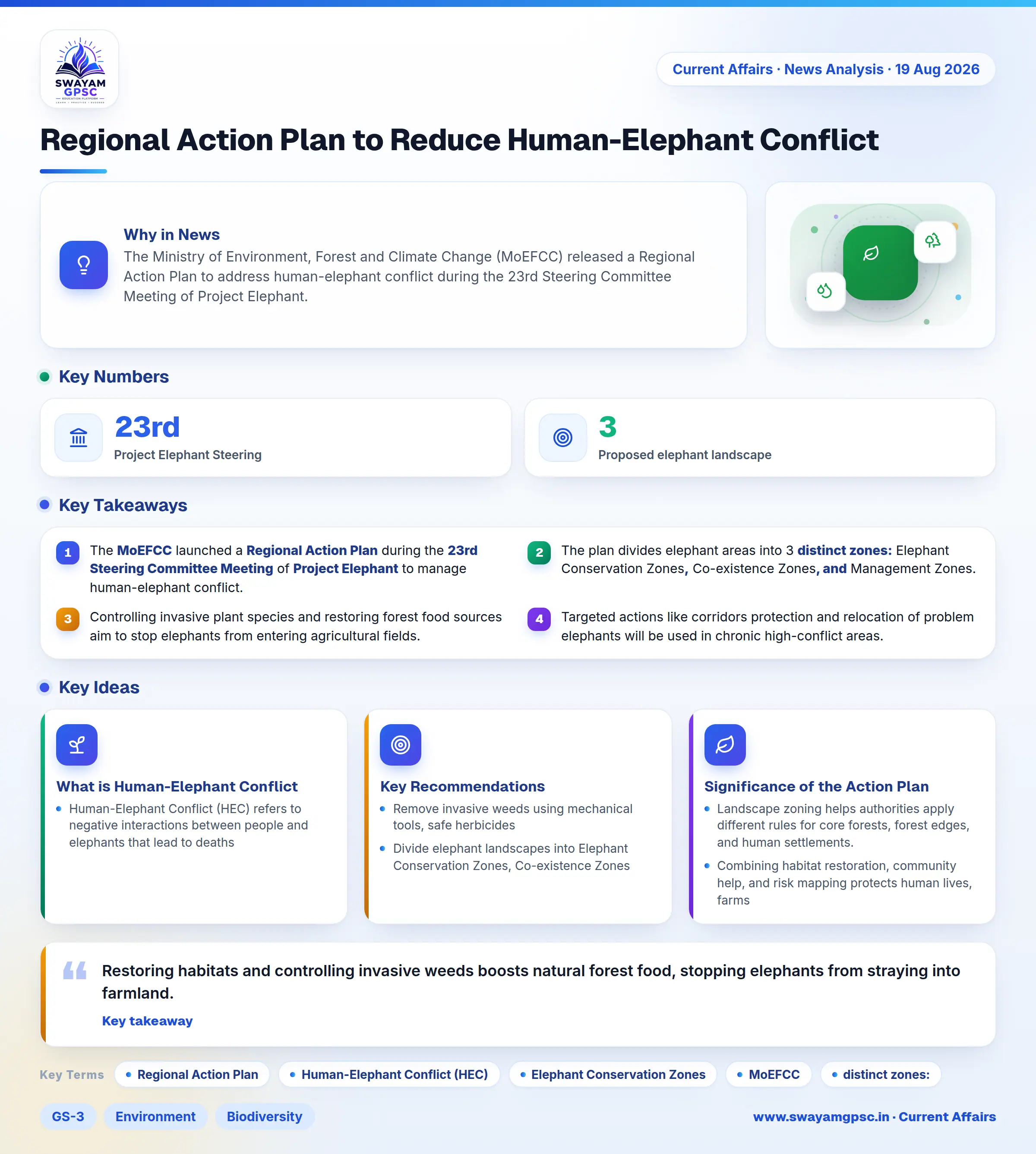
Regional Action Plan to Reduce Human-Elephant Conflict
#GS-3 #Environment #Biodiversity #Wildlife Protection #Human-Wildlife Conflict #Project Elephant #GS-2 #National
Key takeaways
- The MoEFCC launched a Regional Action Plan during the 23rd Steering Committee Meeting of Project Elephant to manage human-elephant conflict.
- The plan divides elephant areas into 3 distinct zones: Elephant Conservation Zones, Co-existence Zones, and Management Zones.
- Controlling invasive plant species and restoring forest food sources aim to stop elephants from entering agricultural fields.
- Targeted actions like corridors protection and relocation of problem elephants will be used in chronic high-conflict areas.
Why in News
- The Ministry of Environment, Forest and Climate Change (MoEFCC) released a Regional Action Plan to address human-elephant conflict during the 23rd Steering Committee Meeting of Project Elephant.
What is Human-Elephant Conflict
- Human-Elephant Conflict (HEC) refers to negative interactions between people and elephants that lead to deaths, injuries, crop damage, property loss, and direct threats to livelihoods.
Key Recommendations
- Remove invasive weeds using mechanical tools, safe herbicides, and biological methods to protect the natural food plants of elephants.
- Divide elephant landscapes into Elephant Conservation Zones, Co-existence Zones, and Management Zones based on land use and conflict severity.
- Improve core forest habitats with better fodder and water sources to keep elephants inside forest boundaries.
- Protect elephant corridors and migration routes using scientific assessments and planned regional land management.
- Map high-risk conflict areas to apply targeted preventive steps instead of using a single uniform approach.
- Strengthen community involvement so locals living near forests can actively help reduce conflict risks.
- Relocate or rehabilitate problematic elephants in heavy conflict zones using smart tech and adaptive management strategies.
Significance of the Action Plan
- Restoring habitats and controlling invasive weeds boosts natural forest food, stopping elephants from straying into farmland.
- Landscape zoning helps authorities apply different rules for core forests, forest edges, and human settlements.
- Combining habitat restoration, community help, and risk mapping protects human lives, farms, and wild elephant numbers.