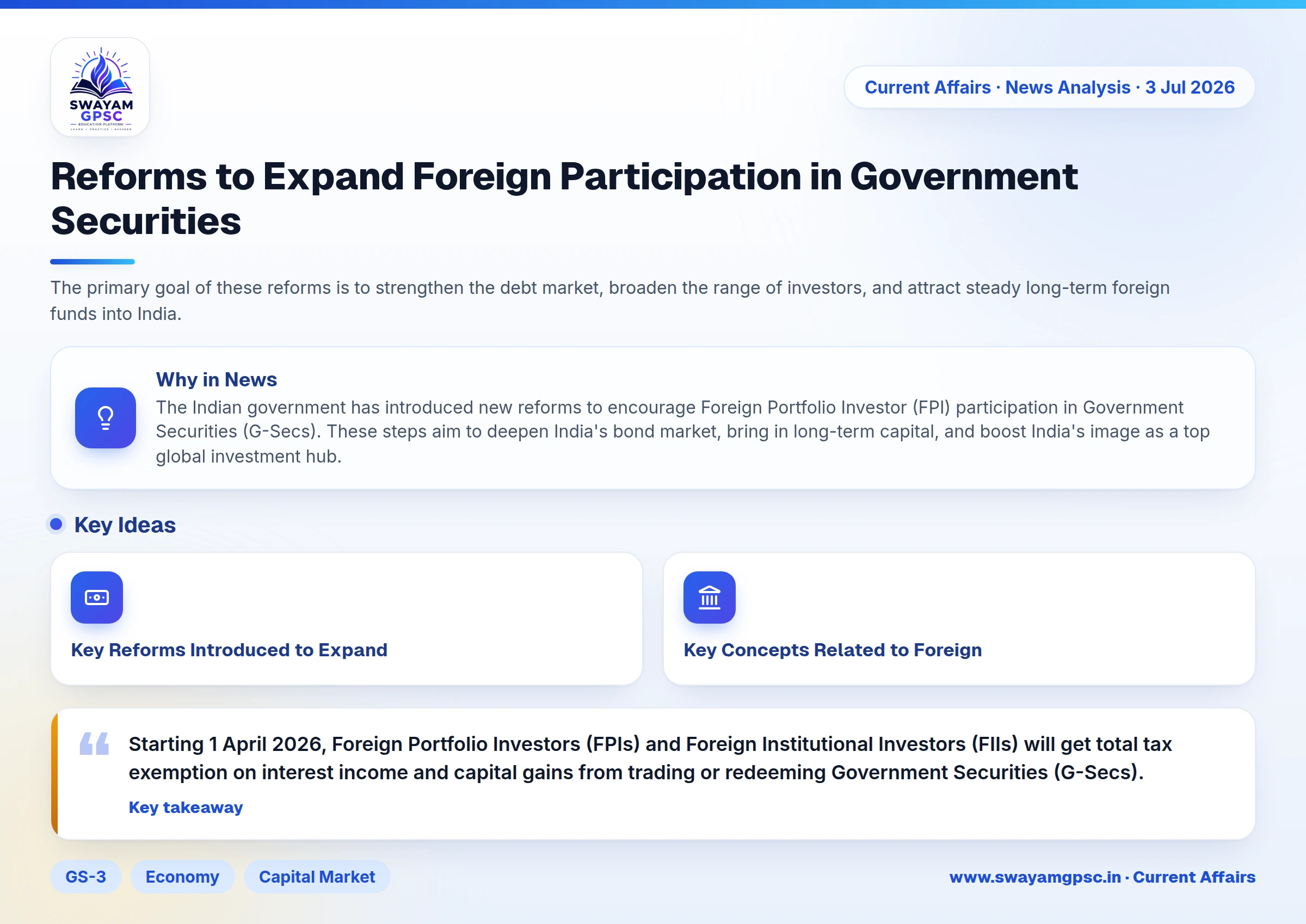
Reforms to Expand Foreign Participation in Government Securities
#GS-3 #Economy #Capital Market #Fiscal Policy #Monetary Policy #Taxation #Banking #Current Events #National
Why in News
- The Indian government has introduced new reforms to encourage Foreign Portfolio Investor (FPI) participation in Government Securities (G-Secs). These steps aim to deepen India's bond market, bring in long-term capital, and boost India's image as a top global investment hub.
Key Reforms Introduced to Expand Foreign Participation
- The primary goal of these reforms is to strengthen the debt market, broaden the range of investors, and attract steady long-term foreign funds into India.
- Starting 1 April 2026, Foreign Portfolio Investors (FPIs) and Foreign Institutional Investors (FIIs) will get total tax exemption on interest income and capital gains from trading or redeeming Government Securities (G-Secs).
- The government has expanded the Fully Accessible Route (FAR) to include new 15-year, 30-year, and 40-year Government Securities (G-Secs), alongside Sovereign Green Bonds (SGrBs) in eligible tenors.
- Under the Fully Accessible Route (FAR), foreign investors can purchase selected Government Securities (G-Secs) without facing the cap limits that apply under the regular General Route.
- For investments coming through the General Route, authorities have removed the short-term investment limits, concentration limits, and individual security investment caps.
- The total investment ceilings stay unchanged at 6% for outstanding Central Government Securities (CGSs) and 2% for State Government Securities (SGSs).
- The government merged the earlier General and Long-Term investment categories for Foreign Portfolio Investors (FPIs) into a single unified limit for Central and State bonds.
- These policy changes aim to attract big foreign institutional players, including pension funds, insurance companies, and sovereign wealth funds.
- These reforms will improve trading liquidity, assist accurate price discovery, lower government borrowing costs, and enhance the transmission of monetary policy.
- Higher foreign participation will generate funds for infrastructure, manufacturing, and green initiatives, while making it easier to include Indian bonds in global market indices.
Key Concepts Related to Foreign Investment in Government Securities
- A Foreign Institutional Investor (FII) is a specific category of FPI where institutional entities like mutual funds, pension funds, and hedge funds pool money to invest directly in financial markets.
- A Foreign Portfolio Investor (FPI) includes foreign individuals or entities that buy financial assets like stocks and Government Securities (G-Secs) without taking over management control of the companies.
- Government Securities (G-Secs) are tradable debt instruments issued by Central or State Governments to raise money for public projects, cover fiscal deficits, and manage liquidity.
- The Bank for International Settlements (BIS) is a global financial institution owned by central banks that promotes monetary cooperation and acts as a bank for central banks.
- Long-Term Capital Gains (LTCG) refer to profits made from selling listed Government Securities (G-Secs) held for more than 12 months or unlisted ones held for over 24 months.
- Short-Term Capital Gains (STCG) are profits earned from selling listed Government Securities (G-Secs) held for up to 12 months or unlisted ones held for up to 24 months.