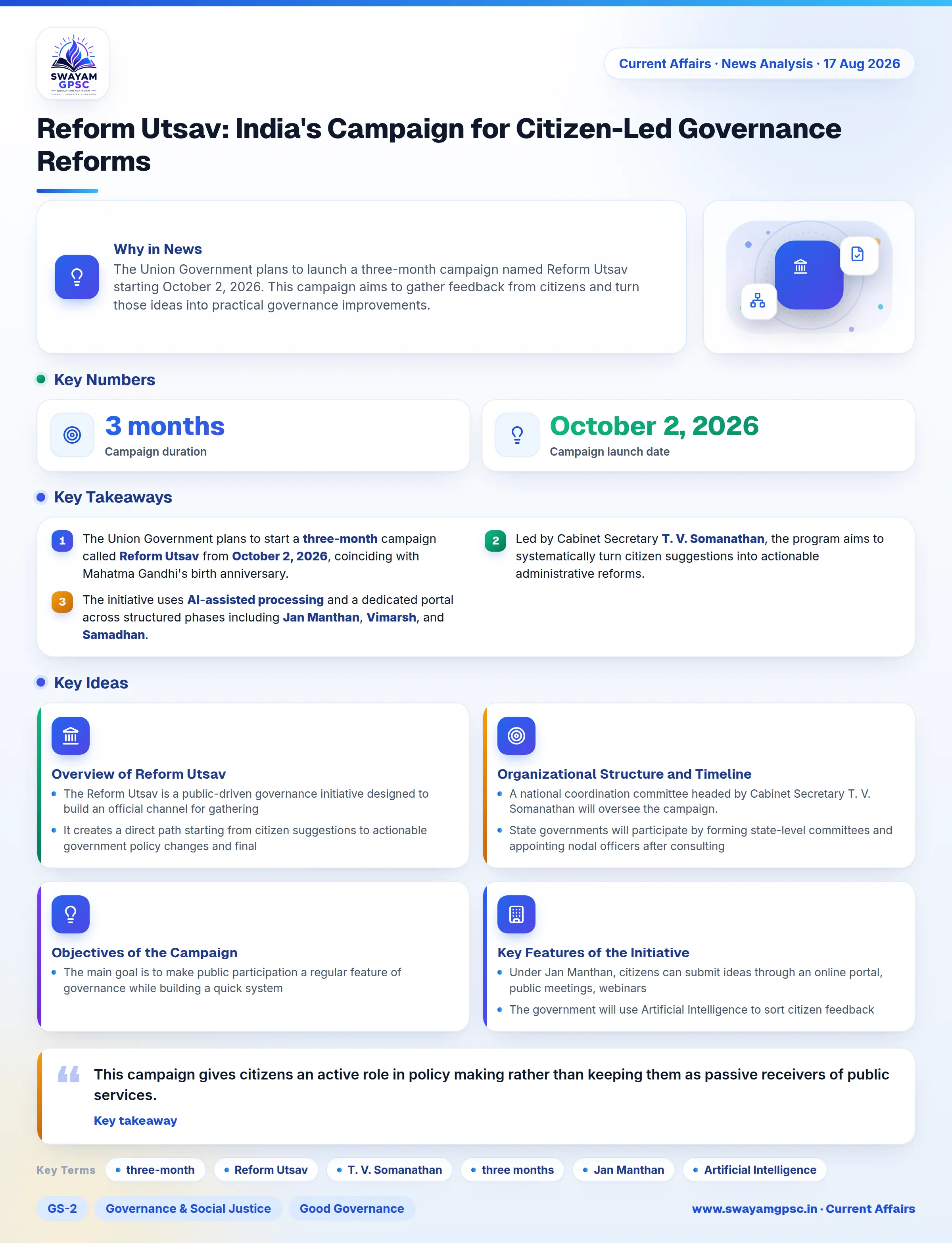
Reform Utsav: India's Campaign for Citizen-Led Governance Reforms
#GS-2 #Governance & Social Justice #Good Governance #E-Governance #Civil Services #GS-4 #Ethics #Accountability #Current Events #National
Key takeaways
- The Union Government plans to start a three-month campaign called Reform Utsav from October 2, 2026, coinciding with Mahatma Gandhi's birth anniversary.
- Led by Cabinet Secretary T. V. Somanathan, the program aims to systematically turn citizen suggestions into actionable administrative reforms.
- The initiative uses AI-assisted processing and a dedicated portal across structured phases including Jan Manthan, Vimarsh, and Samadhan.
Why in News
- The Union Government plans to launch a three-month campaign named Reform Utsav starting October 2, 2026.
- This campaign aims to gather feedback from citizens and turn those ideas into practical governance improvements.
Overview of Reform Utsav
- The Reform Utsav is a public-driven governance initiative designed to build an official channel for gathering and acting on citizen feedback.
- It creates a direct path starting from citizen suggestions to actionable government policy changes and final implementation.
Organizational Structure and Timeline
- A national coordination committee headed by Cabinet Secretary T. V. Somanathan will oversee the campaign.
- State governments will participate by forming state-level committees and appointing nodal officers after consulting Chief Secretaries.
- The initiative will last for three months, launching on October 2, 2026, which marks the birth anniversary of Mahatma Gandhi.
Objectives of the Campaign
- The main goal is to make public participation a regular feature of governance while building a quick system to prioritize and execute administrative reforms.
Key Features of the Initiative
- Under Jan Manthan, citizens can submit ideas through an online portal, public meetings, webinars, and awareness drives.
- The government will use Artificial Intelligence to sort citizen feedback, alongside a multilingual call center to help people communicate easily.
- During Vimarsh, experts will evaluate suggestions to select quick solution items and prepare detailed plans for larger systemic changes.
- Through Samadhan & Sankalp Siddhi, the coordination committee will hold review meetings every two weeks to monitor progress on selected reforms.
Significance of the Campaign
- This campaign gives citizens an active role in policy making rather than keeping them as passive receivers of public services.
- It transforms citizen feedback into trackable actions, strengthening official accountability, transparency, and governance quality.
Exam Relevance
- In GS Paper II, this topic connects to government policies, transparency, e-governance, and civil services.
- In GS Paper IV, it provides practical examples of ethical administration, public accountability, and responsive governance.
- For essay writing, it serves as a strong case study on technology usage, participatory democracy, and administrative reform.