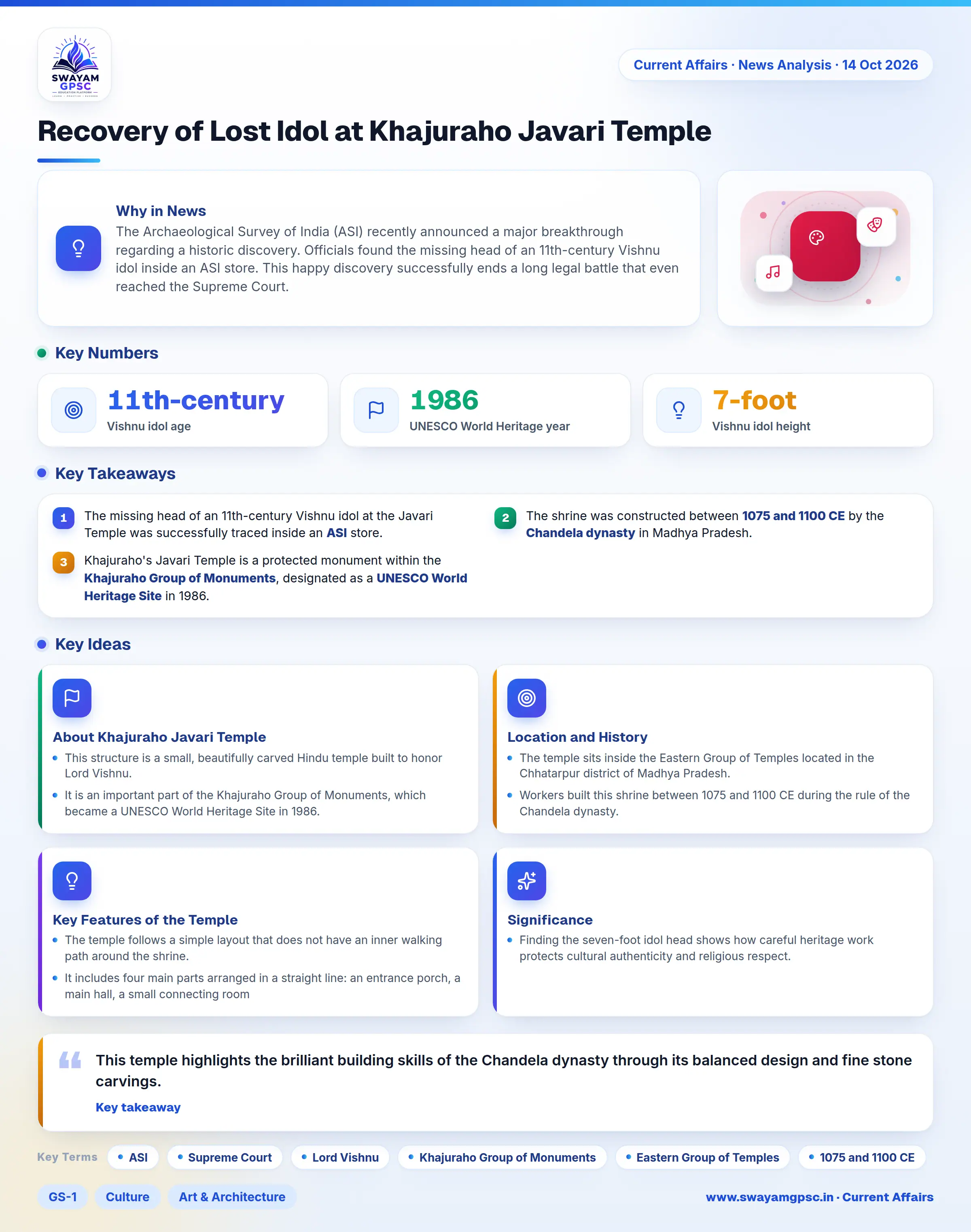
Recovery of Lost Idol at Khajuraho Javari Temple
#GS-1 #Culture #Art & Architecture #Heritage #Ancient India #Madhya Pradesh #Current Events #National
Key takeaways
- The missing head of an 11th-century Vishnu idol at the Javari Temple was successfully traced inside an ASI store.
- The shrine was constructed between 1075 and 1100 CE by the Chandela dynasty in Madhya Pradesh.
- Khajuraho's Javari Temple is a protected monument within the Khajuraho Group of Monuments, designated as a UNESCO World Heritage Site in 1986.
Why in News
- The Archaeological Survey of India (ASI) recently announced a major breakthrough regarding a historic discovery. Officials found the missing head of an 11th-century Vishnu idol inside an ASI store.
- This happy discovery successfully ends a long legal battle that even reached the Supreme Court.
About Khajuraho Javari Temple
- This structure is a small, beautifully carved Hindu temple built to honor Lord Vishnu.
- It is an important part of the Khajuraho Group of Monuments, which became a UNESCO World Heritage Site in 1986.
Location and History
- The temple sits inside the Eastern Group of Temples located in the Chhatarpur district of Madhya Pradesh.
- Workers built this shrine between 1075 and 1100 CE during the rule of the Chandela dynasty.
- Local stories say the name comes either from a religious landowner who paid for the building or from a local word linked to farming.
Key Features of the Temple
- The temple follows a simple layout that does not have an inner walking path around the shrine.
- It includes four main parts arranged in a straight line: an entrance porch, a main hall, a small connecting room, and the inner sanctum.
- The entrance porch features a famous stone arch carved to look like mythical water creatures.
- The main tower rises high into the sky and is decorated with tiny duplicate spires built over a raised stone base.
- The outside walls feature two to three rows of carvings showing celestial dancers, gods, mythical beasts, and traditional couples.
- The doorway leading to the inner room displays carvings of the holy trinity alongside the nine planetary deities on the upper lintel.
Significance
- This temple highlights the brilliant building skills of the Chandela dynasty through its balanced design and fine stone carvings.
- Finding the seven-foot idol head shows how careful heritage work protects cultural authenticity and religious respect.