Recognising Ecocide as a Core International Crime
#GS-3 #Environment #Pollution #Sustainable Development #Current Events #International
Why in News
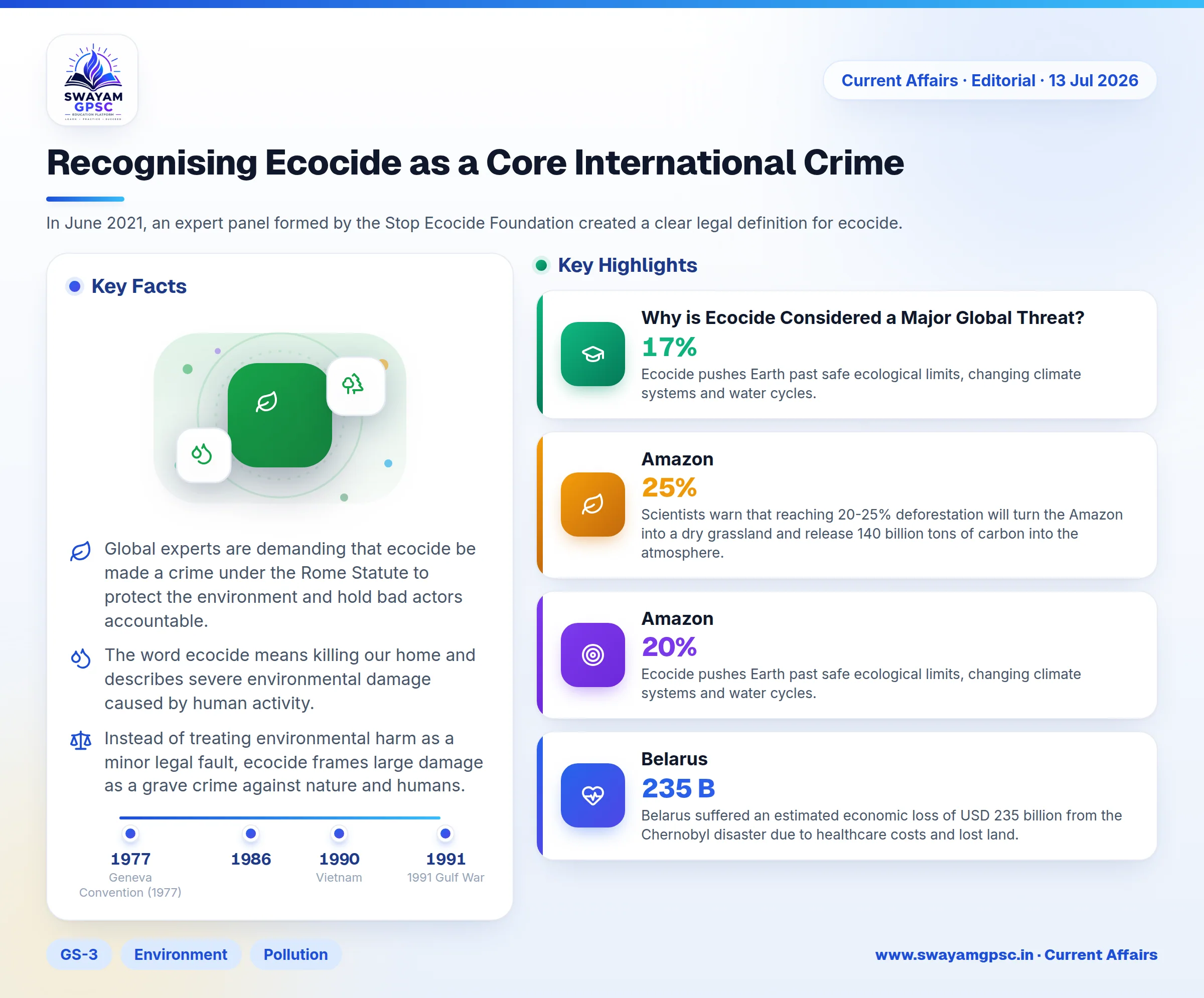
- Global experts are demanding that ecocide be made a crime under the Rome Statute to protect the environment and hold bad actors accountable.
What is Ecocide?
- The word ecocide means killing our home and describes severe environmental damage caused by human activity.
- Instead of treating environmental harm as a minor legal fault, ecocide frames large damage as a grave crime against nature and humans.
- In June 2021, an expert panel formed by the Stop Ecocide Foundation created a clear legal definition for ecocide.
- The panel defined ecocide as unlawful or reckless acts committed with the knowledge that they could cause severe, widespread, or long-term harm to nature.
- An act is considered wanton when a person recklessly ignores damage that clearly outweighs any social or economic benefits.
- Severe damage means deep harm that disrupts ecosystems, human life, or natural resources.
- Widespread damage means harm that spreads beyond a local area, crosses national borders, or hurts an entire species.
- Long-term damage means harm that nature cannot repair within a reasonable period.
- Scientist Arthur Galston coined the term ecocide in 1970 to describe chemical damage caused by Agent Orange during the Vietnam War (1955-1975).
- Swedish Prime Minister Olof Palme brought the term into global diplomacy at the 1972 UN Conference on the Human Environment in Stockholm.
- International law currently does not penalize ecocide as an independent crime during peacetime.
- Protocol I of the Geneva Convention (1977) bans environmental destruction during war, but proving direct intention is very difficult.
- Article 8 of the Rome Statute punishes environmental destruction only during armed conflicts if it exceeds military needs.
- Campaigners want the International Criminal Court (ICC) to add ecocide as its 5th core international crime.
- Vietnam became the 1st country to ban ecocide in 1990, while Belgium became the 1st European nation to do so in 2024.
- India lacks a specific ecocide law and relies on civil statutes like the Environment Protection Act, 1986 to issue small fines.
Why is Ecocide Considered a Major Global Threat?
- Ecocide pushes Earth past safe ecological limits, changing climate systems and water cycles. For example, destruction of 17% to 20% of the Amazon rainforest threatens global weather.
- Scientists warn that reaching 20-25% deforestation will turn the Amazon into a dry grassland and release 140 billion tons of carbon into the atmosphere.
- Uncontrolled industrial work and toxic waste destroy natural habitats and speed up the Sixth Mass Extinction.
- During the Vietnam War, chemical spraying wiped out 20% of South Vietnam's forests and 36% of its coastal mangroves.
- Massive ecological destruction creates huge economic losses and places heavy financial burdens on taxpayers.
- The 1986 Chernobyl Nuclear Disaster rendered vast farmlands unusable and created a radioactive wasteland.
- Belarus suffered an estimated economic loss of USD 235 billion from the Chernobyl disaster due to healthcare costs and lost land.
- Ukraine spent 5% to 7% of its national budget for years to manage the long-term impact of the Chernobyl disaster.
- Environmental damage spreads across national borders through shared rivers, oceans, and air currents.
- The 2010 Deepwater Horizon Spill leaked 4.9 million barrels of oil and polluted 1,700 kilometers of coast across international boundaries.
- Armies often destroy natural resources as a war strategy, leaving land toxic for future generations.
- In the 1991 Gulf War, retreating forces set fire to 600 oil wells in Kuwait, creating toxic lakes that still poison groundwater today.
- Destroying healthy soil and water resources threatens global food supplies and destroys farming livelihoods.
- Diverting rivers for crop watering reduced the Aral Sea to under 10% of its original size, killing a fishing trade that produced 40,000 tons of fish each year.
- Resource destruction forces people to leave their homes, creating social conflicts over remaining water and fertile land.
- Recent fighting in Gaza destroyed 97% of tree crops, 95% of bushes, and 82% of farms, putting 500,000 people at risk of severe famine and 1 million in a food emergency.
Steps Necessary to Establish Ecocide as an International Crime
- Countries should amend Article 5 of the Rome Statute to give the International Criminal Court (ICC) authority over ecocide in peacetime.
- Legal systems should replace strict intent rules with a knowledge of risk standard, making leaders guilty if they knew great harm would occur.
- Nations must pass clear domestic ecocide laws, following steps taken by Belgium, Mauritius, Philippines, Ghana, and Peru.
- Legal frameworks must shift to an ecocentric model that gives natural features like rivers and forests direct legal rights.
- The ICC Trust Fund for Victims should be updated to pay for soil cleaning, tree planting, and ecosystem recovery.
- Courts must invest in scientific forensics and train judges to review satellite imagery and chemical toxicity data accurately.
Conclusion
- Recognizing ecocide as an international crime is essential to protect planetary boundaries and stop deliberate nature destruction.
- Establishing clear global legal accountability will deter corporate pollution, protect future generations, and help restore broken ecosystems.