RBI Scam Compensation Framework for Digital Transactions
#GS-3 #Economy #Banking #Cyber Security #National #Prelims
Why in News
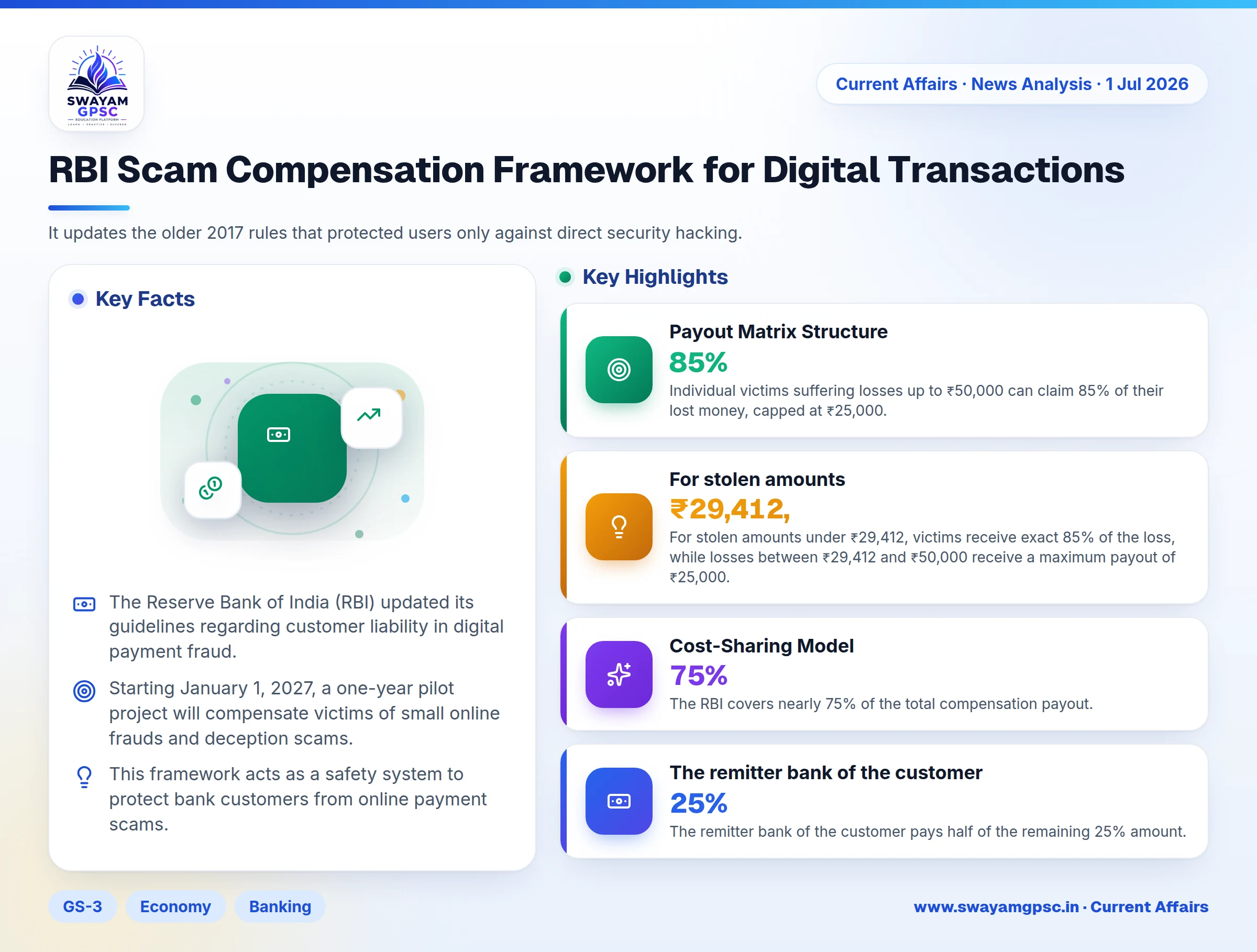
- The Reserve Bank of India (RBI) updated its guidelines regarding customer liability in digital payment fraud.
- Starting January 1, 2027, a one-year pilot project will compensate victims of small online frauds and deception scams.
About the Compensation Framework
- This framework acts as a safety system to protect bank customers from online payment scams.
- It updates the older 2017 rules that protected users only against direct security hacking.
- The policy introduces Fraudulent Electronic Banking Transactions (EBTs) as a legal term, so victims get money back even if fraud forced them to reveal details.
- The Reserve Bank of India (RBI) controls and regulates this protection framework.
Objectives of the Framework
- It offers monetary help to victims of digital arrests, phishing attacks, and stolen OTP frauds.
- The framework shifts the legal burden onto banks, requiring them to prove customer carelessness before denying claims.
Payout Matrix Structure
- Individual victims suffering losses up to ₹50,000 can claim 85% of their lost money, capped at ₹25,000.
- For stolen amounts under ₹29,412, victims receive exact 85% of the loss, while losses between ₹29,412 and ₹50,000 receive a maximum payout of ₹25,000.
- The system completely excludes online scam losses that exceed ₹50,000.
- A customer can use this financial remedy only once in their lifetime, and joint accounts allow only one claim.
Cost-Sharing Model
- The RBI covers nearly 75% of the total compensation payout.
- The remitter bank of the customer pays half of the remaining 25% amount.
- The beneficiary bank pays the other half of the remaining 25% loss, though the remitter bank covers this if money moves abroad.
Customer and Bank Negligence Rules
- Customers lose compensation eligibility if they ignore direct warning alerts or fail to update their registered contact numbers and emails with the bank.
- Banks are held negligent if they fail to send transaction alerts, lack a 24x7 reporting system, or delay taking action after a customer complaint.
- Users carry zero liability if leaks occur at third-party payment gateways, telecom platforms, or aggregators.
Timelines and Grievance Rules
- A customer must report the fraud within 5 calendar days to both their bank and the 1930 National Cyber Crime Helpline to qualify for relief.
- Banks must settle domestic fraud cases within 45 calendar days and international cases within 60 calendar days while restoring lost interest.
- For credit card frauds, banks must issue a temporary shadow refund within 5 calendar days to stop interest charges during the probe.
- Banks must send free and instant SMS messages for all digital transactions above ₹500 to keep offline users informed.