RBI Record Surplus Transfer and its Implications
#GS-3 #Economy #Monetary Policy #Fiscal Policy #Growth & Development #Inflation #Banking #Infrastructure #Indian Polity & Constitution #Federalism #Constitutional Bodies
Key takeaways
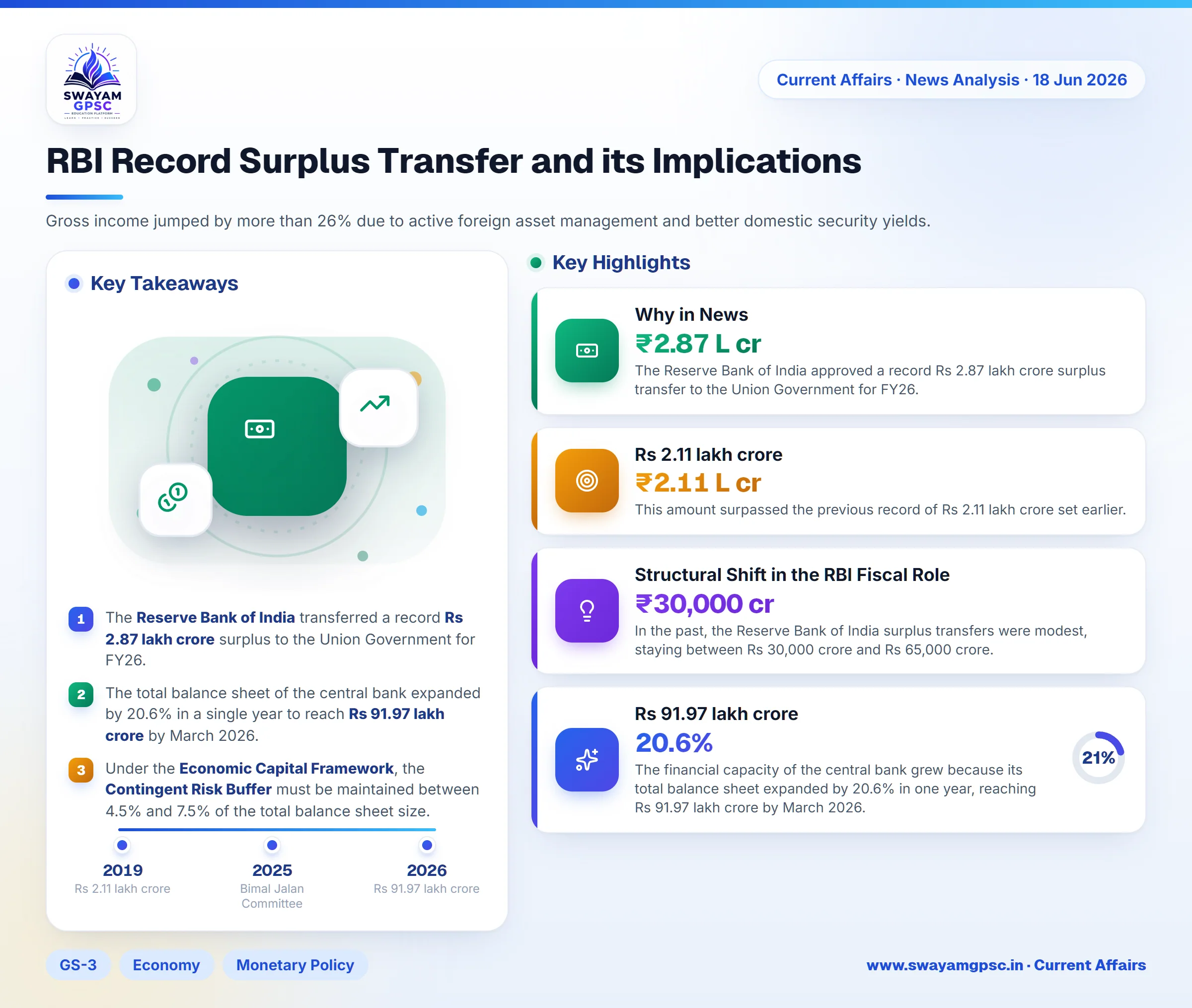
- The Reserve Bank of India transferred a record Rs 2.87 lakh crore surplus to the Union Government for FY26.
- The total balance sheet of the central bank expanded by 20.6% in a single year to reach Rs 91.97 lakh crore by March 2026.
- Under the Economic Capital Framework, the Contingent Risk Buffer must be maintained between 4.5% and 7.5% of the total balance sheet size.
- Because the surplus counts as non-tax revenue, it bypasses the divisible tax pool under Article 270, leaving State governments with zero automatic financial share.
Why in News
- The Reserve Bank of India approved a record Rs 2.87 lakh crore surplus transfer to the Union Government for FY26.
- This amount surpassed the previous record of Rs 2.11 lakh crore set earlier.
- While this aligns with the Economic Capital Framework guidelines, the massive scale has started debates on central bank independence and fiscal federalism.
Summary
- The giant surplus transfer gives the Union Government vital non-tax revenue to support fiscal consolidation, cut borrowing pressures, and fund capital spending.
- At the same time, relying heavily on central bank earnings raises worries about institutional independence and fiscal federalism because these funds completely skip State governments.
Structural Shift in the RBI Fiscal Role
- In the past, the Reserve Bank of India surplus transfers were modest, staying between Rs 30,000 crore and Rs 65,000 crore.
- After 2019, following the revised Bimal Jalan Committee Economic Capital Framework rules, these transfers grew rapidly to Rs 2.11 lakh crore in FY24 and hit Rs 2.87 lakh crore in FY26.
- The financial capacity of the central bank grew because its total balance sheet expanded by 20.6% in one year, reaching Rs 91.97 lakh crore by March 2026.
- Gross income jumped by more than 26% due to active foreign asset management and better domestic security yields.
- Unlike regular tax collection that faces political resistance or market borrowing that creates interest debt, central bank transfers create fiscal space very smoothly.
- To handle global risks and oil price swings, the central bank regularly balances its reserves by selling gold and buying foreign-currency assets.
- These steps stabilize the rupee and generate large earnings from foreign exchange deals, which add directly to the central bank surplus.
Economic Capital Framework
- The Economic Capital Framework, created by the Bimal Jalan Committee and adopted in 2019, decides how much risk buffer the Reserve Bank of India must keep.
- It also decides the surplus money that the central bank can safely send to the Union Government while balancing financial stability and fiscal needs.
- The main goal is keeping enough financial buffer for currency stability while sharing profits in a transparent, formula-based way.
- The framework requires the central bank to maintain a Contingent Risk Buffer between 4.5% and 7.5% of its total balance sheet to protect the economy against major financial shocks.
- Realized equity or the contingency fund acts as a safety cushion against unexpected losses and must stay between 5.5% and 6.5% of the balance sheet.
- Any amount above this threshold is automatically unlocked and transferred to the government.
- The broader economic capital metric, which covers the capital and general risk account, must stay between 20.8% and 25.4% of the balance sheet.
- To match changing global economic realities, the Bimal Jalan Committee suggested reviewing the framework every five years, and the first internal review happened in 2025.
Implications of RBI Growing Surplus Transfer
- The multi-lakh-crore dividend gives an instant cushion to the Union Budget, letting the government lower its Fiscal Deficit without cutting public spending.
- By using non-tax revenues to fill budget gaps, the government borrows less money from the market.
- This drop in borrowing lowers the yields on Government Securities, which reduces the cost of loans across the entire banking system.
- These non-inflationary funds give the Centre the financial strength to keep building public infrastructure like roads and railways even when the global economy slows down.
- Unlike Western central banks that hurt their balance sheets through direct quantitative easing, India uses a unique model where the central bank earns high yields on foreign assets and sends the profits directly to the government.
Concerns with Rising RBI Surplus Transfers
- The entire surplus transfer counts as non-tax revenue for the Union Government.
- Under Article 270 of the Constitution, this money completely skips the divisible pool of taxes shared with States.
- States handle more than 60% of India's development and welfare spending under strict borrowing limits set by Article 293, but they get zero automatic share from this massive public surplus.
- Central bank credibility depends on staying independent from the executive branch of government.
- If giant dividend payouts become a regular expectation in every annual Union Budget, the central bank might feel pressured to chase profits instead of focusing on pure monetary stability.
- The primary job of the Reserve Bank of India is keeping prices stable and controlling inflation under the Flexible Inflation Targeting framework.
- Relying too much on central bank profits can cause fiscal dominance, where interest rate decisions get compromised because they affect the bank's ability to pay dividends.
- Maximized payouts during global crises reduce the central bank's long-term ability to absorb major macroeconomic shocks without asking the government for financial help.
Measures Needed to Address Concerns Over RBI Surplus Transfers
- The government should use these surplus dividends strictly for capital spending or paying off debt, rather than funding regular budget deficits or short-term subsidies.
- Future Finance Commissions must study the rising share of non-divisible revenues at the Centre and adjust tax sharing rules to maintain fairness for States.
- The Reserve Bank of India must keep its portfolio choices safe from outside pressure.
- Asset management, foreign exchange actions, and gold sales must focus only on liquidity and inflation goals rather than profit targets.
- The central bank and the Ministry of Finance should provide clear public reports on whether these high dividend payouts can last over the long term without harming financial safety.
Way Forward
- Ensure the Reserve Bank of India keeps conservative risk buffers under its Economic Capital Framework to protect its Rs 92 lakh crore balance sheet before sending money to the government.
- Create a system where the Central Government voluntarily shares part of its non-tax revenue windfalls with States that face strict borrowing limits under Article 293.
- Make detailed reporting mandatory for major gold sales and foreign asset purchases to prove that reserve management protects financial stability instead of just boosting state income.
- Set up independent academic reviews to monitor the link between central bank earnings and government budgets so the institution stays autonomous.
Conclusion
- The record surplus transfer shows that the central bank plays a growing role in funding government needs alongside its main job of maintaining monetary stability.
- While this money helps lower borrowing pressures, protecting central bank independence and fiscal federalism is essential for long-term economic health.