RBI Holds Repo Rate and Lowers GDP Growth Forecast
#GS-3 #Economy #Banking Sector & NBFCs #Monetary Policy #Capital Market #Quick Facts For Prelims
Key takeaways
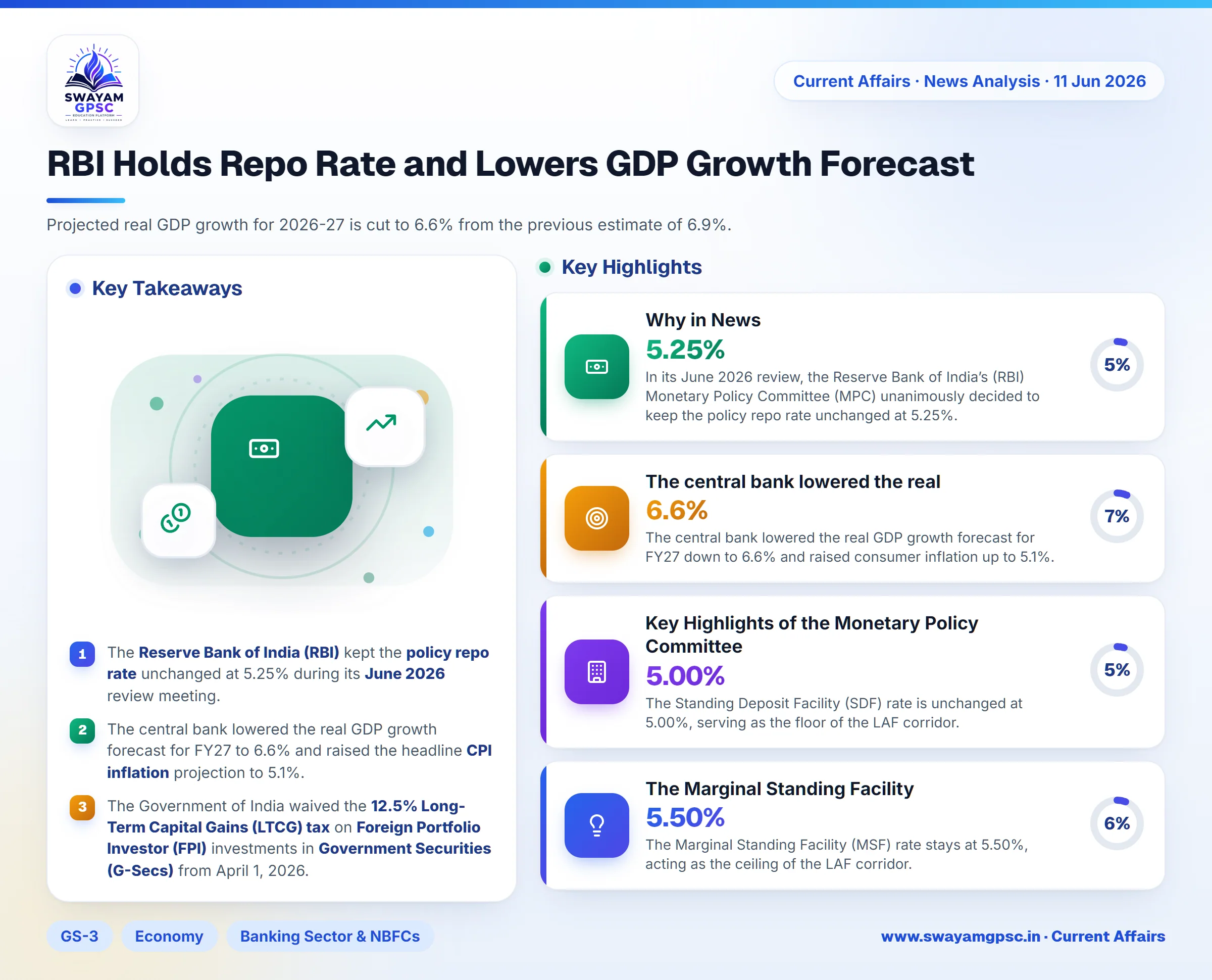
- The Reserve Bank of India (RBI) kept the policy repo rate unchanged at 5.25% during its June 2026 review meeting.
- The central bank lowered the real GDP growth forecast for FY27 to 6.6% and raised the headline CPI inflation projection to 5.1%.
- The Government of India waived the 12.5% Long-Term Capital Gains (LTCG) tax on Foreign Portfolio Investor (FPI) investments in Government Securities (G-Secs) from April 1, 2026.
- Global conflicts pushed crude oil prices to an average of USD 110/barrel during April and May 2026.
Why in News
- In its June 2026 review, the Reserve Bank of India’s (RBI) Monetary Policy Committee (MPC) unanimously decided to keep the policy repo rate unchanged at 5.25%.
- The central bank lowered the real GDP growth forecast for FY27 down to 6.6% and raised consumer inflation up to 5.1%.
- Authorities also introduced a wide package of fiscal and regulatory steps to attract foreign capital and stabilize the domestic currency.
Key Highlights of the Monetary Policy Committee
- The policy repo rate remains steady at 5.25% under the Liquidity Adjustment Facility (LAF).
- The Standing Deposit Facility (SDF) rate is unchanged at 5.00%, serving as the floor of the LAF corridor.
- The Marginal Standing Facility (MSF) rate stays at 5.50%, acting as the ceiling of the LAF corridor.
- The Bank Rate is maintained at a steady level of 5.50%.
- Projected real GDP growth for 2026-27 is cut to 6.6% from the previous estimate of 6.9%.
- Headline Consumer Price Index (CPI) inflation is raised by 50 basis points to 5.1% for FY27.
- Core inflation is officially pegged at 4.7%.
- The committee chose to continue with a Neutral stance to keep its policy data-dependent.
- This neutral approach allows the RBI to change interest rates in either direction based on incoming macroeconomic data without committing to a rigid cycle.
Key Macroeconomic Risks Identified
- Ongoing global conflicts have driven Indian basket crude oil prices to an average of USD 110/barrel between April and May 2026.
- Higher oil prices have directly increased input costs for industrial plastics, chemicals, and base metals.
- A forecast of a sub-normal Southwest Monsoon alongside emergent El Niño conditions creates severe structural risks for agricultural output and rural demand.
- The RBI warned that temporary spikes in food and energy prices must be carefully monitored to prevent them from pushing up general wages and long-term inflation expectations.
Strategic Measures to Attract Foreign Capital and Stabilize the Rupee
- The government waived the 12.5% Long-Term Capital Gains (LTCG) tax and income tax on interest earned by Foreign Portfolio Investors (FPIs) from investments in Government Securities (G-Secs), effective from April 1, 2026.
- This step protects the debt market after foreign investors pulled out over Rs 2.6 lakh crore from Indian equities, causing the Indian Rupee to depreciate.
- The RBI added 15-year, 30-year, and 40-year tenor G-Secs along with Sovereign Green Bonds (SGBs) into the FAR framework, allowing non-residents to invest without quantitative limits.
- Caps on short-term investments and concentration limits for FPI investments via the General Route were completely removed, leaving only macro limits of 6% of outstanding Central G-Secs and 2% of State Government Securities.
- Investment limits for Non-Resident Indians (NRIs) and Overseas Citizens of India (OCIs) in listed equities without prior SEBI registration have been increased.
- Similar parity is extended to individual Persons Resident Outside India (PROIs) under updated FEMA regulations.
- The central bank will run concessional forex swap windows until September 30, 2026, to support External Commercial Borrowings (ECBs) by Public Sector Undertakings.
- Authorized Dealer banks will receive full hedging cost cover until September 30, 2026, for raising fresh 3-to-5-year Foreign Currency Non-Resident (Bank) deposits.
- The mandatory timeline for bringing export earnings back to India has been cut from 15 months down to 9 months to boost immediate dollar liquidity.
- The RBI governor stressed that the massive foreign exchange reserves buffer will be deployed to stop extreme volatility and defend orderly market conditions.
Frequently Asked Questions
- The repo rate is the short-term lending rate charged by the RBI to commercial banks, which was kept at 5.25% in June 2026.
- The Fully Accessible Route (FAR) lets non-resident investors buy specific government bonds without investment caps.
- A Neutral stance gives the central bank the freedom to raise or lower interest rates depending on changing economic conditions.
- Measures to attract foreign money include LTCG tax exemptions, the expansion of FAR, relaxed FPI rules, and special forex swap facilities.