RBI Annual Report 2025-26
#GS-3 #Economy #Growth #Inflation #Monetary Policy #Banking #Infrastructure #Agriculture #GS-2 #Government Policies & Interventions #Good Governance #Current Events #National
Key takeaways
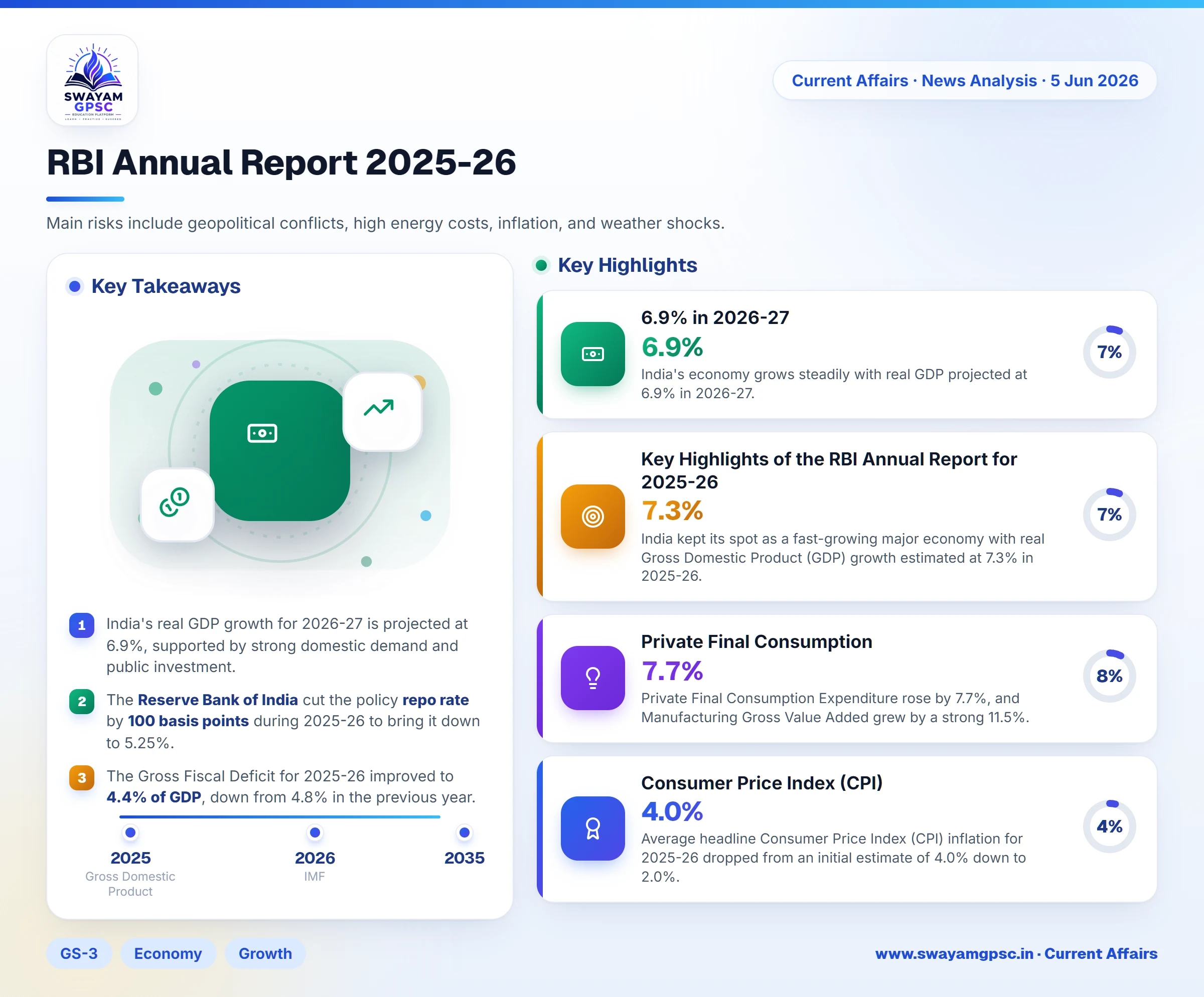
- India's real GDP growth for 2026-27 is projected at 6.9%, supported by strong domestic demand and public investment.
- The Reserve Bank of India cut the policy repo rate by 100 basis points during 2025-26 to bring it down to 5.25%.
- The Gross Fiscal Deficit for 2025-26 improved to 4.4% of GDP, down from 4.8% in the previous year.
- India's merchandise trade deficit widened to USD 333.2 billion in 2025-26, with China becoming the top trading partner.
Why in News
- The Reserve Bank of India (RBI) published its Annual Report for 2025-26 recently.
- The central bank noted that India's economy stays strong despite global troubles like the West Asia conflict and high energy prices.
Summary
- India's economy grows steadily with real GDP projected at 6.9% in 2026-27.
- Internal strength comes from domestic demand, fiscal management, strong bank balance sheets, and public investment.
- Main risks include geopolitical conflicts, high energy costs, inflation, and weather shocks.
- To fight these risks, the government and the RBI rely on new steps like the Economic Stabilisation Fund (ESF) and the IndiaAI Mission.
Key Highlights of the RBI Annual Report for 2025-26
- India kept its spot as a fast-growing major economy with real Gross Domestic Product (GDP) growth estimated at 7.3% in 2025-26.
- Private Final Consumption Expenditure rose by 7.7%, and Manufacturing Gross Value Added grew by a strong 11.5%.
- Growth benefited from better manufacturing output, higher rural demand, and steady urban spending.
- Average headline Consumer Price Index (CPI) inflation for 2025-26 dropped from an initial estimate of 4.0% down to 2.0%.
- The Monetary Policy Committee (MPC) explained that volatile food prices caused this sharp drop while core inflation stayed steady.
- The Gross Fiscal Deficit (GFD) for 2025-26 stood at 4.4% of GDP, improving from 4.8% in the previous year.
- The GFD target for 2026-27 is set at 4.3% of GDP, continuing a steady drop from the pandemic peak of 9.2%.
- Gross tax revenue went up by 7.4% due to good corporate tax collections.
- Non-tax revenue jumped by 24.4% because of higher receipts.
- Capital expenditure stayed stable at 3.1% of GDP and is budgeted to rise by 11.5% in 2026-27.
- The central government debt-to-GDP ratio is projected to drop to 55.6% in 2026-27.
- States budgeted a fiscal deficit of 3.3% of GDP for 2025-26.
- The 16th Finance Commission (FC-XVI) kept the state share at 41% of divisible taxes and added a new weight for state GDP contribution.
- The merchandise trade deficit widened to USD 333.2 billion in 2025-26.
- Exports for items like petroleum goods and rice fell during the year.
- China overtook the US to become India's biggest trading partner in 2025-26.
- India finalized trade pacts with the UK, Oman, and New Zealand, and concluded talks with the EU.
- Net services exports grew by 15.3% between April and December 2025.
- Software and business services made up 77.8% of total service exports.
- Workers' remittances grew by 10.1% in the same period.
- The cost of sending money to India averaged 5.3%, which is better than the global average but higher than the Sustainable Development Goals (SDG) target.
- The Current Account Deficit (CAD) stayed low at USD 30.2 billion or 1.1% of GDP.
- Net Foreign Direct Investment reached USD 7.7 billion, placing India second globally in greenfield announcements.
- Foreign exchange reserves dropped by USD 30.8 billion as capital flows lagged behind the current account gap.
- Reserves covered about 11 months of imports and equaled around 90% of total external debt.
- The external debt-to-GDP ratio remained safe at 20.4%.
- The Monetary Policy Committee (MPC) cut the policy repo rate by 100 basis points to 5.25% during the year.
- The Cash Reserve Ratio (CRR) was reduced in steps to 3.0% to inject liquidity into the system.
- Bank credit expanded in double digits with strong demand from services and retail sectors.
- Lending rates for banks dropped following the repo rate cuts.
- Employment is expected to benefit from the launch of the Four Labour Codes.
- Credit to micro and small businesses grew by 33.1%, helping job creation.
Economic Prospects and Strategic Initiatives for 2026-27
- The IMF projects global growth to slow down to 3.1% and global inflation to rise to 4.4% due to geopolitical conflicts.
- India expects real GDP growth of 6.9% and CPI inflation of 4.6% for 2026-27.
- The MPC kept the repo rate at 5.25%, and the government kept the inflation target at 4% with a tolerance band.
- The fiscal deficit is aimed at 4.3% of GDP, backed by the new Economic Stabilisation Fund (ESF).
- Agriculture depends heavily on the monsoon, with El Niño posing risks and the Indian Ocean Dipole (IOD) offering support.
- The budget focuses on seven key sectors like semiconductors and biopharma.
- India updated its climate goals to reach 60% non-fossil electric capacity by 2035.
- Rules allow 100% FDI in satellite manufacturing to attract foreign investment.
- India ranks third globally in AI readiness, driven by the IndiaAI Mission.
- The RBI plans to expand digital currency pilots and launch the MuleHunter.ai framework.
Other Key Publications by RBI
- The Report on Trend and Progress of Banking in India offers deep details on lender health.
- The State Finances report tracks the budget positions of all state governments.
- The Report on Currency and Finance covers deep structural economic themes.
- The Financial Stability Report reviews risks to the financial system.
- The Monetary Policy Report explains the logic behind rate decisions.
- The Handbook of Statistics on the Indian Economy provides long-term data series.
Primary Global Economic Risks Identified by the RBI
- Geopolitical tensions remain the biggest threat to world economic growth.
- The IMF lowered its global growth forecast for 2026 due to supply chain snags.
- Higher energy prices and shipping delays are pushing up global inflation.
- Financial markets face risks from shifting valuations in technology stocks.
- Countries must work together across fiscal and monetary fronts to manage rising debt risks.
Way Forward
- Use advanced data analytics and the Supervisory Data Quality Index (sDQI) to spot bad loans early.
- Roll out the Digital Payments Intelligence Platform (DPIP) and MuleHunter.ai to stop digital financial fraud.
- Keep strict control over the fiscal deficit to leave enough credit space for private businesses.
- Promote the use of Special Rupee Vostro Accounts (SRVAs) to cut cross-border transaction costs.
- Expand the Bharat-VISTAAR platform to give farmers real-time digital crop advice.
Conclusion
- India's economy stays resilient thanks to solid domestic demand and clean balance sheets.
- External shocks and weather patterns still require careful monitoring by policymakers.