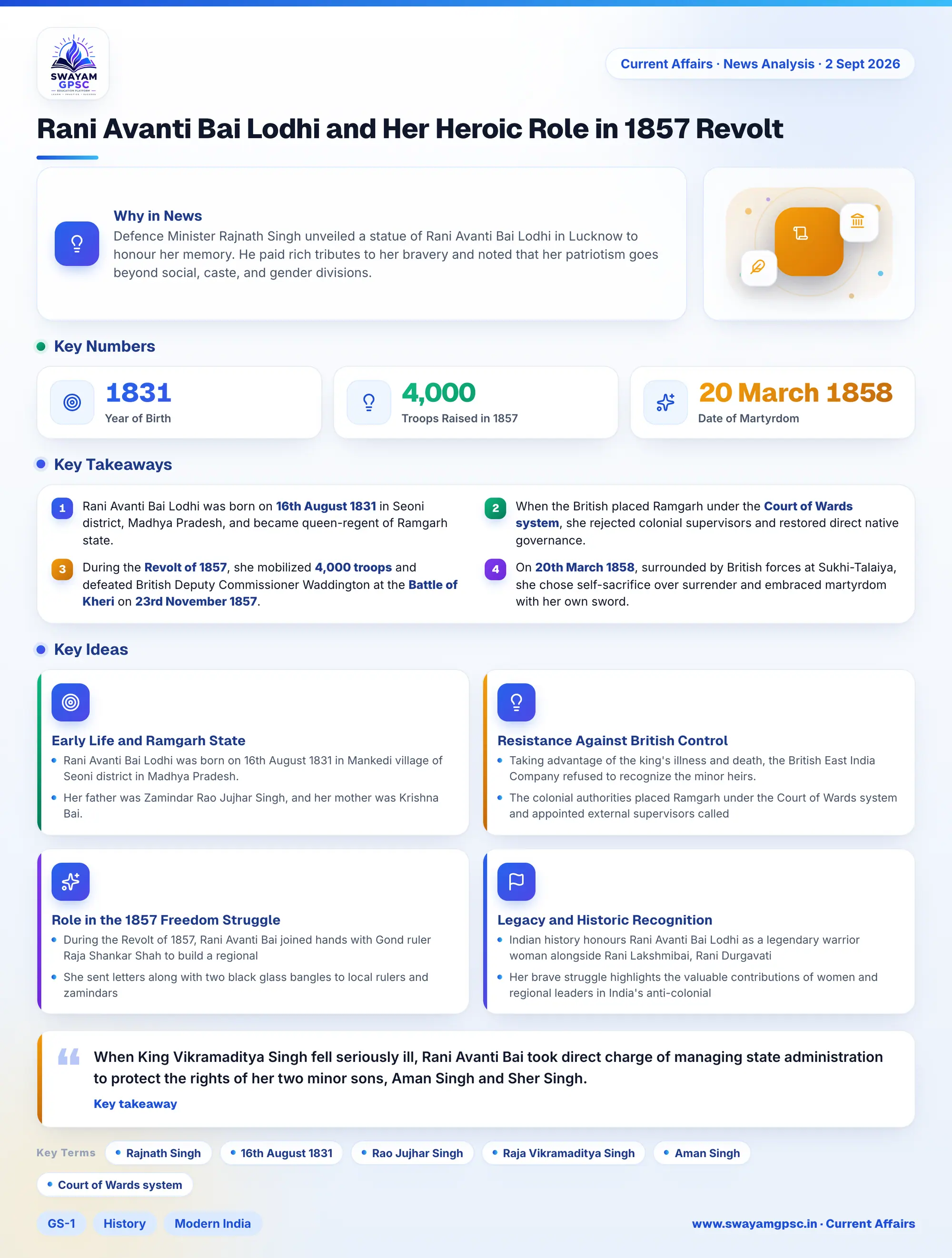
Rani Avanti Bai Lodhi and Her Heroic Role in 1857 Revolt
#GS-1 #History #Modern India #Freedom Struggle #Important Personalities #Culture #Heritage #1857 Revolt #GS-2 #Current Events #National
Key takeaways
- Rani Avanti Bai Lodhi was born on 16th August 1831 in Seoni district, Madhya Pradesh, and became queen-regent of Ramgarh state.
- When the British placed Ramgarh under the Court of Wards system, she rejected colonial supervisors and restored direct native governance.
- During the Revolt of 1857, she mobilized 4,000 troops and defeated British Deputy Commissioner Waddington at the Battle of Kheri on 23rd November 1857.
- On 20th March 1858, surrounded by British forces at Sukhi-Talaiya, she chose self-sacrifice over surrender and embraced martyrdom with her own sword.
Why in News
- Defence Minister Rajnath Singh unveiled a statue of Rani Avanti Bai Lodhi in Lucknow to honour her memory.
- He paid rich tributes to her bravery and noted that her patriotism goes beyond social, caste, and gender divisions.
- He drew a direct parallel between the 1857 warrior queen and modern Indian women in the armed forces who perform combat duties today.
Early Life and Ramgarh State Administration
- Rani Avanti Bai Lodhi was born on 16th August 1831 in Mankedi village of Seoni district in Madhya Pradesh.
- Her father was Zamindar Rao Jujhar Singh, and her mother was Krishna Bai.
- From a young age, she received training in horse riding, sword fighting, and administrative skills.
- She married Raja Vikramaditya Singh, son of King Lakshman Singh of the Ramgarh princely state, located in present-day Dindori and Mandla districts.
- When King Vikramaditya Singh fell seriously ill, Rani Avanti Bai took direct charge of managing state administration to protect the rights of her two minor sons, Aman Singh and Sher Singh.
Resistance Against British Control
- Taking advantage of the king's illness and death, the British East India Company refused to recognize the minor heirs.
- The colonial authorities placed Ramgarh under the Court of Wards system and appointed external supervisors called Sarbarahkars.
- Rani Avanti Bai rejected this foreign interference and threw out the British-appointed officials from Ramgarh.
- She took full control of the state and instructed local farmers not to obey British revenue orders.
- This bold action earned her popular support among the farming and tribal communities across the Mahakoshal region.
Role in the 1857 Freedom Struggle
- During the Revolt of 1857, Rani Avanti Bai joined hands with Gond ruler Raja Shankar Shah to build a regional anti-British alliance.
- She sent letters along with two black glass bangles to local rulers and zamindars, urging them to fight or wear bangles in defeat.
- She raised a strong force of 4,000 troops to attack colonial outposts.
- On 23rd November 1857, her forces defeated British Deputy Commissioner Waddington in the Battle of Kheri near Mandla, forcing the enemy to flee.
- When reinforced British armies launched a counter-attack with help from the King of Rewa, she moved to the hilly forests of Devhargarh to fight guerrilla warfare.
- On 20th March 1858, surrounded by British troops at Sukhi-Talaiya, she chose to fall on her sword and embraced martyrdom rather than surrender.
Legacy and Historic Recognition
- Indian history honours Rani Avanti Bai Lodhi as a legendary warrior woman alongside Rani Lakshmibai, Rani Durgavati, and Jhalkari Bai.
- Her brave struggle highlights the valuable contributions of women and regional leaders in India's anti-colonial movement.
- The nation remembers her sacrifice through memorials, educational institutions, and public ceremonies.
- As a mark of respect, Uttar Pradesh named the Rani Avanti Bai Lodhi Women Battalion of the Provincial Armed Constabulary at Badaun in her honour.