Ramesh Chand Committee on Sugarcane Farmers' Issues
#GS-2 #Governance & Social Justice #Good Governance #GS-3 #Economy #Agriculture #Current Events #National #Sugarcane #Ethanol Blended Petrol (EBP) Programme
Key takeaways
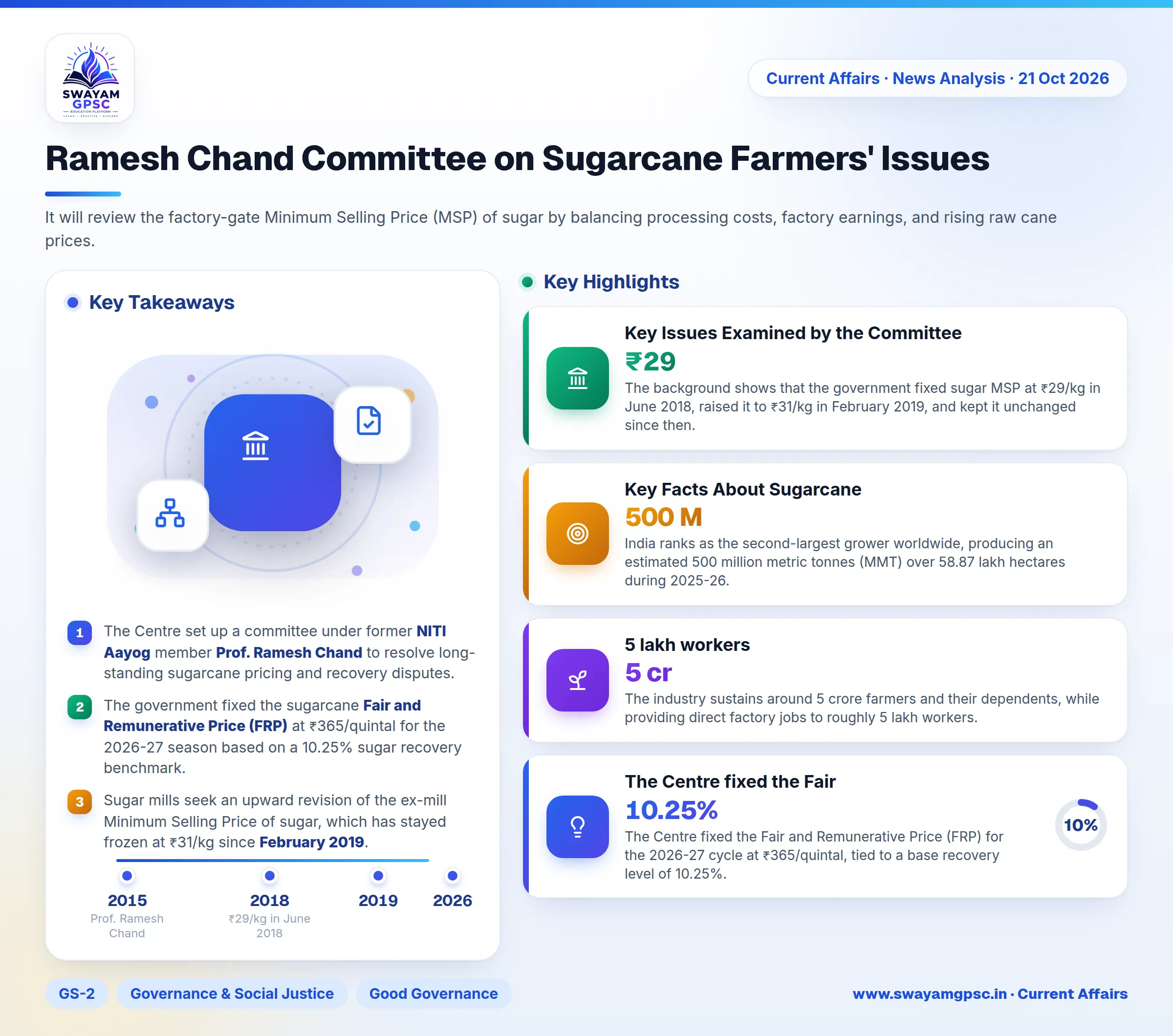
- The Centre set up a committee under former NITI Aayog member Prof. Ramesh Chand to resolve long-standing sugarcane pricing and recovery disputes.
- The government fixed the sugarcane Fair and Remunerative Price (FRP) at ₹365/quintal for the 2026-27 season based on a 10.25% sugar recovery benchmark.
- Sugar mills seek an upward revision of the ex-mill Minimum Selling Price of sugar, which has stayed frozen at ₹31/kg since February 2019.
- India produced an estimated 500 million metric tonnes (MMT) of sugarcane across 58.87 lakh hectares in 2025-26, with Uttar Pradesh and Maharashtra leading production.
- The sugarcane sector directly supports roughly 5 crore farmers and their dependents alongside 5 lakh workers across allied processing industries.
Why in News
- The Central Government set up a high-level committee under Prof. Ramesh Chand, a former member of NITI Aayog.
- This panel will study the major problems faced by sugarcane growers and suggest practical policy solutions to resolve them.
Key Issues Examined by the Committee
- The panel will look into farmers' demands for better profits by reviewing current input expenses and overall crop cultivation costs.
- It will review the factory-gate Minimum Selling Price (MSP) of sugar by balancing processing costs, factory earnings, and rising raw cane prices.
- The background shows that the government fixed sugar MSP at ₹29/kg in June 2018, raised it to ₹31/kg in February 2019, and kept it unchanged since then.
- The committee will inspect laboratory testing and reporting systems to ensure transparent, independent checks on sugar recovery rates.
- It will evaluate weighing procedures at sugar factories to ensure weighing scales are properly calibrated and free from tampering.
- It will analyze weight cuts applied to mechanically harvested cane to determine real field losses and protect farmers from unfair financial deductions.
Key Facts About Sugarcane
- Sugarcane is a long-duration cash crop belonging to the grass family Poaceae, developed mainly by crossing Saccharum officinarum and Saccharum spontaneum.
- The plant thrives in warm, humid weather with plenty of sunshine and needs deep, fertile, well-draining loamy soil along with heavy irrigation.
- India ranks as the second-largest grower worldwide, producing an estimated 500 million metric tonnes (MMT) over 58.87 lakh hectares during 2025-26.
- Uttar Pradesh and Maharashtra lead national harvest volumes, while southern states like Karnataka and Tamil Nadu also harvest substantial quantities.
- The industry sustains around 5 crore farmers and their dependents, while providing direct factory jobs to roughly 5 lakh workers.
- The Centre fixed the Fair and Remunerative Price (FRP) for the 2026-27 cycle at ₹365/quintal, tied to a base recovery level of 10.25%.
- Processors turn harvested stalks into refined sugar, jaggery, ethanol, and molasses, while burning crushed fiber residues called bagasse for paper and green electricity.
- Pioneering crop research takes place at the ICAR-Sugarcane Breeding Institute, Coimbatore and the ICAR-Indian Institute of Sugarcane Research, Lucknow.
- Cane juice and molasses supply India's Ethanol Blended Petrol (EBP) Programme, helping cut crude oil imports while creating new income streams for mills.
Frequently Asked Questions
- The government formed the committee primarily to address growing concerns among cane farmers regarding fair returns and profitable payments.
- The panel is led by Prof. Ramesh Chand, who served as a distinguished agricultural member at NITI Aayog from 2015 to 2026.
- The core mandate focuses on setting fair crop rates for farmers and adjusting the outdated factory-level minimum floor price for processed sugar.
- The ex-mill Minimum Selling Price represents the lowest legal floor rate at which processing mills are allowed to sell bulk sugar in the open market.
- Sugar recovery measures the exact percentage of commercial white sugar extracted from every quintal of crushed raw sugarcane stalk.