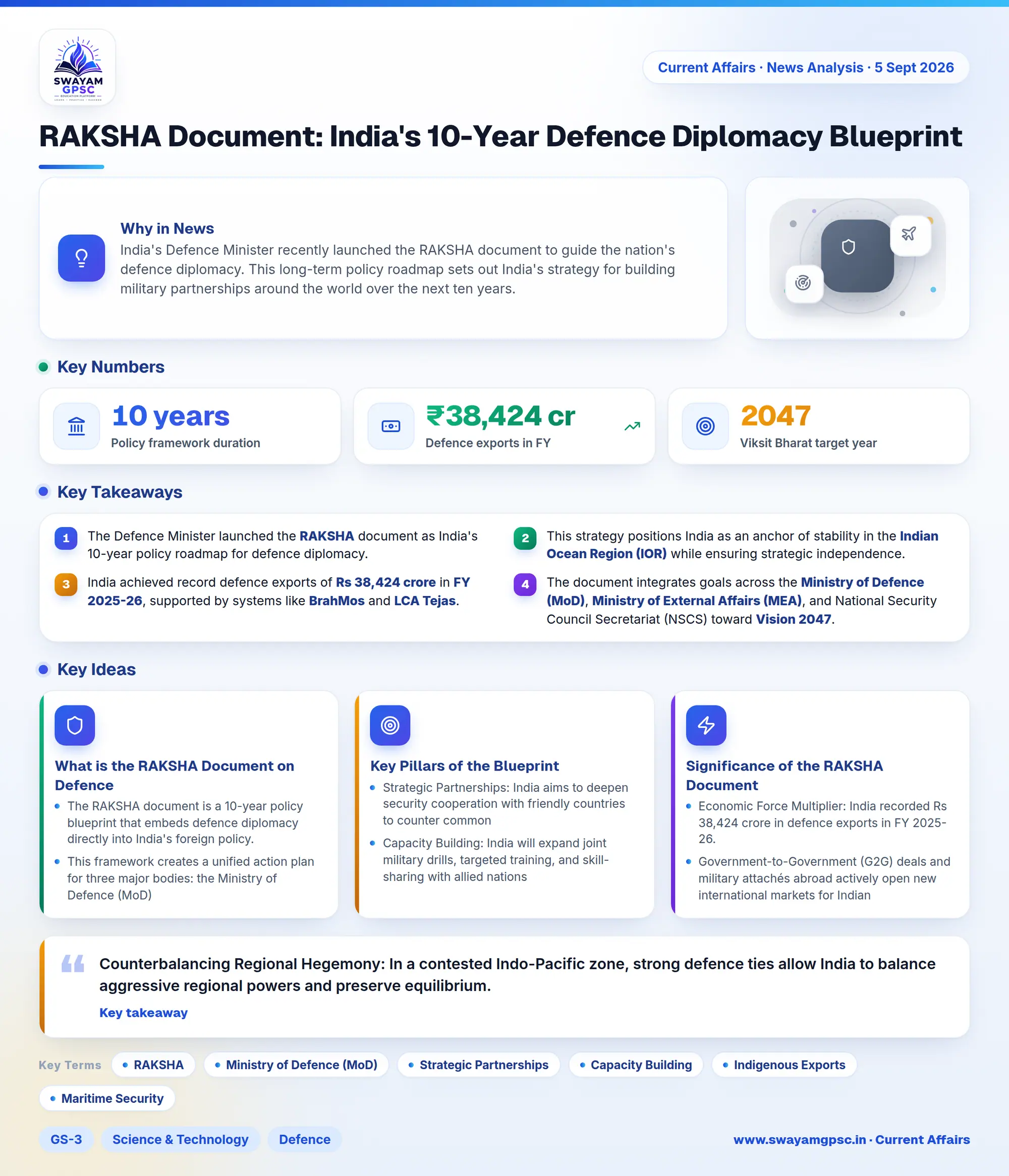
RAKSHA Document: India's 10-Year Defence Diplomacy Blueprint
#GS-3 #Science & Technology #Defence #GS-2 #Current Events #International #National #Defence Diplomacy
Key takeaways
- The Defence Minister launched the RAKSHA document as India's 10-year policy roadmap for defence diplomacy.
- This strategy positions India as an anchor of stability in the Indian Ocean Region (IOR) while ensuring strategic independence.
- India achieved record defence exports of Rs 38,424 crore in FY 2025-26, supported by systems like BrahMos and LCA Tejas.
- The document integrates goals across the Ministry of Defence (MoD), Ministry of External Affairs (MEA), and National Security Council Secretariat (NSCS) toward Vision 2047.
Why in News
- India's Defence Minister recently launched the RAKSHA document to guide the nation's defence diplomacy. This long-term policy roadmap sets out India's strategy for building military partnerships around the world over the next ten years.
- Defence diplomacy uses military resources and security cooperation as diplomatic tools. It helps nations build mutual trust, deepen security ties, and maintain regional peace without using military force.
What is the RAKSHA Document on Defence Diplomacy
- The RAKSHA document is a 10-year policy blueprint that embeds defence diplomacy directly into India's foreign policy. It moves India away from its older, cautious stance toward an active global role that guards regional stability while protecting strategic independence.
- This framework creates a unified action plan for three major bodies: the Ministry of Defence (MoD), the Ministry of External Affairs (MEA), and the National Security Council Secretariat (NSCS).
Key Pillars of the Blueprint
- Strategic Partnerships: India aims to deepen security cooperation with friendly countries to counter common geopolitical threats and keep the region safe.
- Capacity Building: India will expand joint military drills, targeted training, and skill-sharing with allied nations, especially across the Global South.
- Indigenous Exports: The framework boosts Make in India and Atmanirbharata by shifting away from buyer-seller relationships toward joint development, co-production, and technology sharing.
- India plans to turn itself from a major arms buyer into a leading exporter of advanced military technologies.
- Maritime Security: India reinforces its role as a Net Security Provider and First Responder in the Indian Ocean Region (IOR) to protect vital sea routes and keep navigation open.
- This approach supports India's Indo-Pacific vision of a free and rules-based maritime order under the SAGAR (Security and Growth for All in the Region) initiative.
Significance of the RAKSHA Document
- Counterbalancing Regional Hegemony: In a contested Indo-Pacific zone, strong defence ties allow India to balance aggressive regional powers and preserve equilibrium.
- Economic Force Multiplier: India recorded Rs 38,424 crore in defence exports in FY 2025-26. Exporting systems like BrahMos, LCA Tejas, and advanced artillery generates revenue and powers local manufacturing.
- Government-to-Government (G2G) deals and military attachés abroad actively open new international markets for Indian defence technology.
- Securing the Global Commons: By leading Humanitarian Assistance and Disaster Relief (HADR) and anti-piracy missions, India builds international trust and improves operational cooperation with coastal nations.
- Complementing Defence Forces Vision 2047: The framework aligns military modernization with the national goal of becoming a fully developed nation (Viksit Bharat) by 2047.