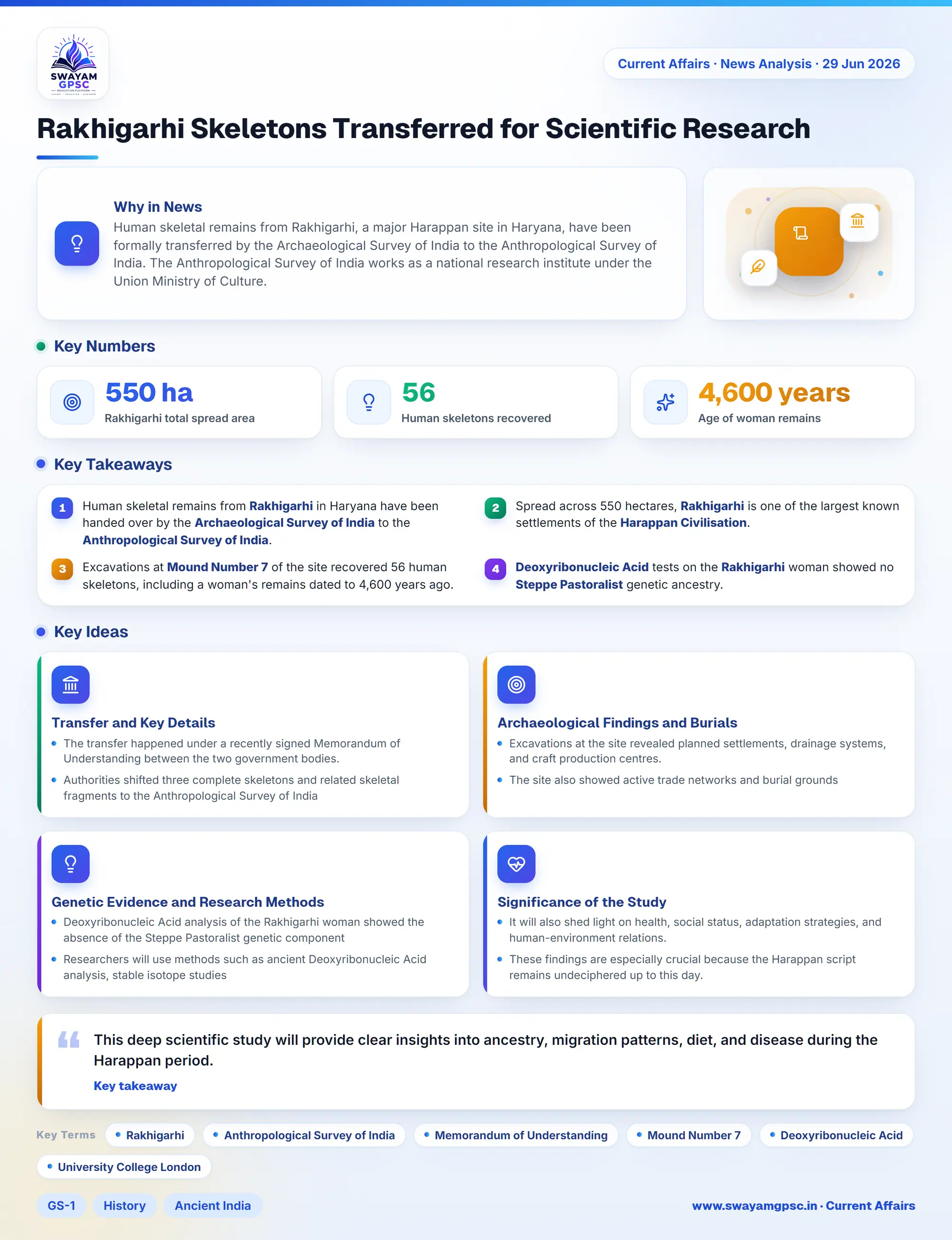
Rakhigarhi Skeletons Transferred for Scientific Research
#GS-1 #History #Ancient India #Culture #Heritage #Rapid Fire CA #Quick Facts For Prelims
Key takeaways
- Human skeletal remains from Rakhigarhi in Haryana have been handed over by the Archaeological Survey of India to the Anthropological Survey of India.
- Spread across 550 hectares, Rakhigarhi is one of the largest known settlements of the Harappan Civilisation.
- Excavations at Mound Number 7 of the site recovered 56 human skeletons, including a woman's remains dated to 4,600 years ago.
- Deoxyribonucleic Acid tests on the Rakhigarhi woman showed no Steppe Pastoralist genetic ancestry.
Why in News
- Human skeletal remains from Rakhigarhi, a major Harappan site in Haryana, have been formally transferred by the Archaeological Survey of India to the Anthropological Survey of India.
- The Anthropological Survey of India works as a national research institute under the Union Ministry of Culture.
- Both institutions completed this transfer to conduct detailed scientific studies on the ancient remains.
Transfer and Key Details
- The transfer happened under a recently signed Memorandum of Understanding between the two government bodies.
- Authorities shifted three complete skeletons and related skeletal fragments to the Anthropological Survey of India laboratory located in Kolkata.
- Rakhigarhi covers an area of about 550 hectares, making it one of the largest known settlements of the Harappan Civilisation, which is also called the Indus Valley Civilisation or Indus-Saraswati Civilisation.
Archaeological Findings and Burials
- Excavations at the site revealed planned settlements, drainage systems, and craft production centres.
- The site also showed active trade networks and burial grounds, pointing to continuous habitation from the Early Harappan to the Mature Harappan periods.
- Experts identified Mound Number 7 at Rakhigarhi as a major burial area, recovering 56 human skeletons from there.
- These finds include the remains of a woman dated to around 4,600 years ago.
Genetic Evidence and Research Methods
- Deoxyribonucleic Acid analysis of the Rakhigarhi woman showed the absence of the Steppe Pastoralist genetic component, which feeds into debates on Aryan migration into India.
- Researchers will use methods such as ancient Deoxyribonucleic Acid analysis, stable isotope studies, osteological assessment, palaeopathological investigation, and environmental reconstruction.
- The project involves collaboration with premier institutions like the Birbal Sahni Institute of Palaeosciences, University College London, and Banaras Hindu University.
Significance of the Study
- This deep scientific study will provide clear insights into ancestry, migration patterns, diet, and disease during the Harappan period.
- It will also shed light on health, social status, adaptation strategies, and human-environment relations.
- These findings are especially crucial because the Harappan script remains undeciphered up to this day.