Pumped Storage Hydropower Development in India
#GS-3 #Economy #Infrastructure #Energy #Environment #Sustainable Development #Current Events #National #Renewable Energy #Hydropower
Key takeaways
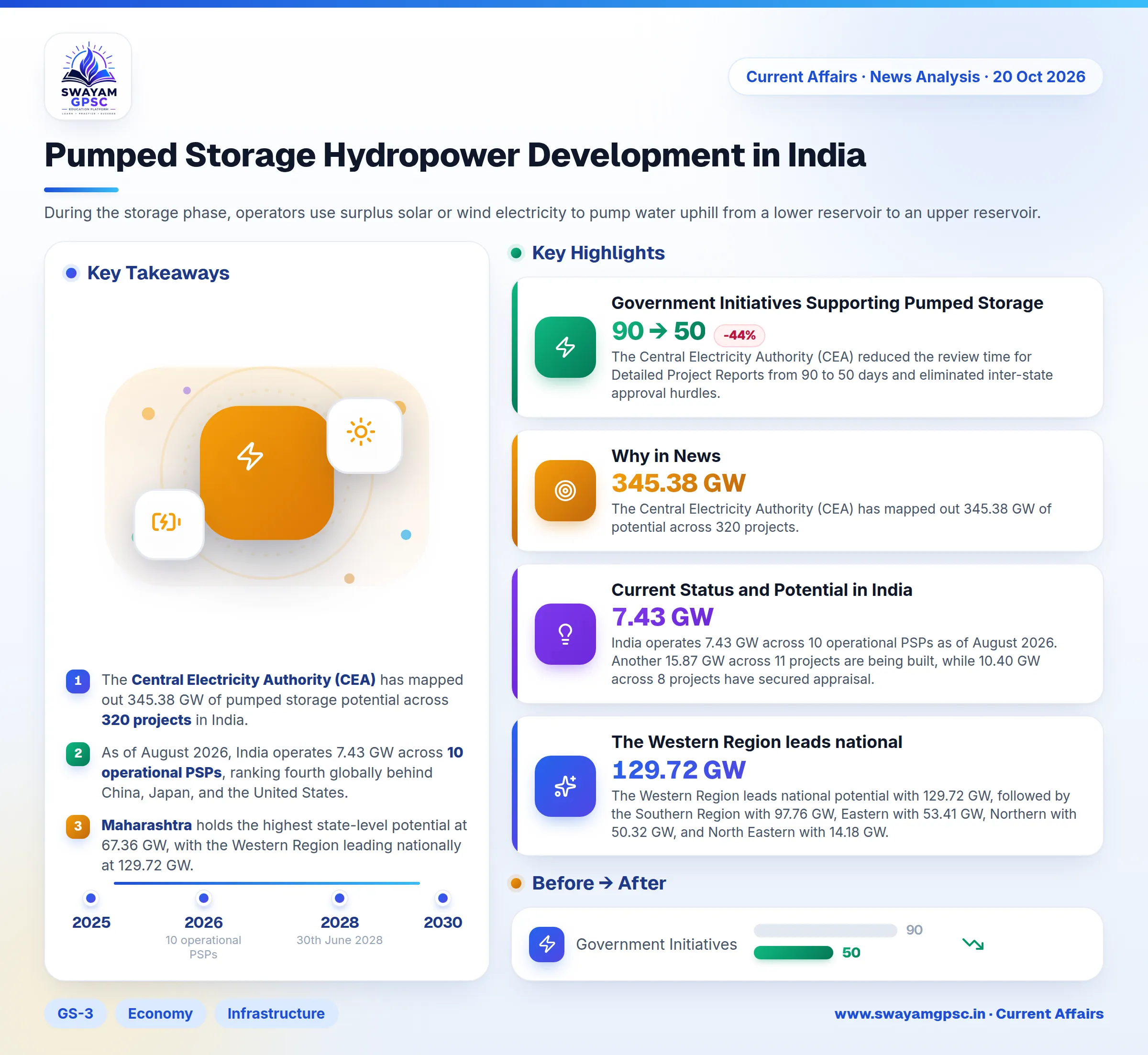
- The Central Electricity Authority (CEA) has mapped out 345.38 GW of pumped storage potential across 320 projects in India.
- As of August 2026, India operates 7.43 GW across 10 operational PSPs, ranking fourth globally behind China, Japan, and the United States.
- Maharashtra holds the highest state-level potential at 67.36 GW, with the Western Region leading nationally at 129.72 GW.
- Projects awarded by 30th June 2028 receive a complete 100% Inter-State Transmission System (ISTS) charge waiver lasting 25 years.
- India projects total storage needs of 73.93 GW by 2031-32 to support its target of 500 GW of non-fossil capacity by 2030.
Why in News
- India is speeding up the deployment of Pumped Storage Projects (PSPs) to support its shift toward clean green energy.
- The Central Electricity Authority (CEA) has mapped out 345.38 GW of potential across 320 projects.
- The authority also projects a substantial expansion in total national capacity by 2035-36.
Understanding Pumped Storage Hydropower
- Pumped Storage Hydropower (PSH) acts as a massive natural water battery. It stores excess power using water and gravity, releasing it when electricity demand shoots up.
- During the storage phase, operators use surplus solar or wind electricity to pump water uphill from a lower reservoir to an upper reservoir.
- During the generation phase, the stored water rushes back downhill through turbines to produce electricity during peak hours or cloudy, windless days.
- Water circulates back and forth between both reservoirs continuously, allowing repeated cycles of clean energy storage and power generation.
- These projects solve the intermittency problem of solar and wind systems by soaking up extra power and returning it to the grid when needed.
Comparing Energy Storage Technologies
- Battery Energy Storage Systems (BESS) react quickly to short bursts of demand. They help balance grid frequency and fit easily near solar parks or cities.
- Pumped Storage Projects (PSPs) deliver large capacity over many hours with decades of operational life. However, they need specific hilly geography and take longer to build.
Types of Pumped Storage Systems
- On-stream pumped storage systems build both the upper and lower reservoirs directly along an existing river, stream, or channel.
- Off-stream open-loop pumped storage places one reservoir on a natural flowing river and the other reservoir completely away from any natural stream.
- Another off-stream open-loop variation links a natural watercourse reservoir with an artificial basin built away from perennial rivers.
- Engineers now favor off-stream systems because they speed up construction and protect delicate river ecosystems from major disruptions.
Current Status and Potential in India
- India operates 7.43 GW across 10 operational PSPs as of August 2026. Another 15.87 GW across 11 projects are being built, while 10.40 GW across 8 projects have secured appraisal.
- The country holds an estimated 345.38 GW across 320 PSPs, which includes 56.67 GW from 62 on-stream sites and 288.71 GW from 258 off-stream projects.
- The Western Region leads national potential with 129.72 GW, followed by the Southern Region with 97.76 GW, Eastern with 53.41 GW, Northern with 50.32 GW, and North Eastern with 14.18 GW.
- Among individual states, Maharashtra tops the country with an identified potential of 67.36 GW.
- The CEA estimates that India will need 73.93 GW of total energy storage by 2031-32, split between 26.69 GW of pumped storage and 47.24 GW of Battery Energy Storage Systems (BESS).
- Projections show an addition of 100.81 GW of capacity between 2025-26 and 2035-36, lifting cumulative installed capacity to about 105.56 GW.
- According to the International Renewable Energy Agency (IRENA), global pumped capacity reached 159.8 GW by late 2025. China led with 66 GW, Japan had 22 GW, the United States held 19 GW, and India ranked fourth with 7.18 GW.
Government Initiatives Supporting Pumped Storage
- The Ministry of Power issued the Guidelines to Promote Development of Pumped Storage Projects (PSPs) in April 2023 to fast-track installations.
- The central government offers direct financial aid for roads, bridges, rail links, ropeways, telecom, and transmission lines around project sites.
- The Tariff-Based Competitive Bidding (TBCB) Guidelines, 2025 create an open, competitive marketplace for procuring stored hydropower capacity.
- Projects awarded by 30th June 2028 enjoy a full 100% Inter-State Transmission System (ISTS) charge waiver for 25 years from their start date.
- The Central Electricity Authority (CEA) reduced the review time for Detailed Project Reports from 90 to 50 days and eliminated inter-state approval hurdles.
- The Ministry of Environment, Forest and Climate Change (MoEFCC) created simpler Category B2 clearance rules for eligible projects, easing baseline data rules and borehole testing.
- National transmission planning now combines energy storage with grid development, cutting transmission bottlenecks and helping green power flow smoothly.
- The Jal Vidyut DPR portal tracks field surveys and project investigations digitally in real time, making inter-agency coordination much easier.
- In August 2025, authorities raised the project cost ceiling needing CEA review to Rs 3,000 crore, completely exempting off-stream closed-loop projects from this requirement regardless of cost.
Way Forward
- Pumped hydro provides long-duration storage and grid strength, making it indispensable for India's clean energy ambitions.
- As India marches toward its goal of 500 GW of non-fossil capacity by 2030, policy reforms, fast approvals, and grid investments will secure a resilient power system.