Provisional Estimates of GDP for FY 2025-26
#Economy #Growth & Development #Fiscal Policy #GS-3
Key takeaways
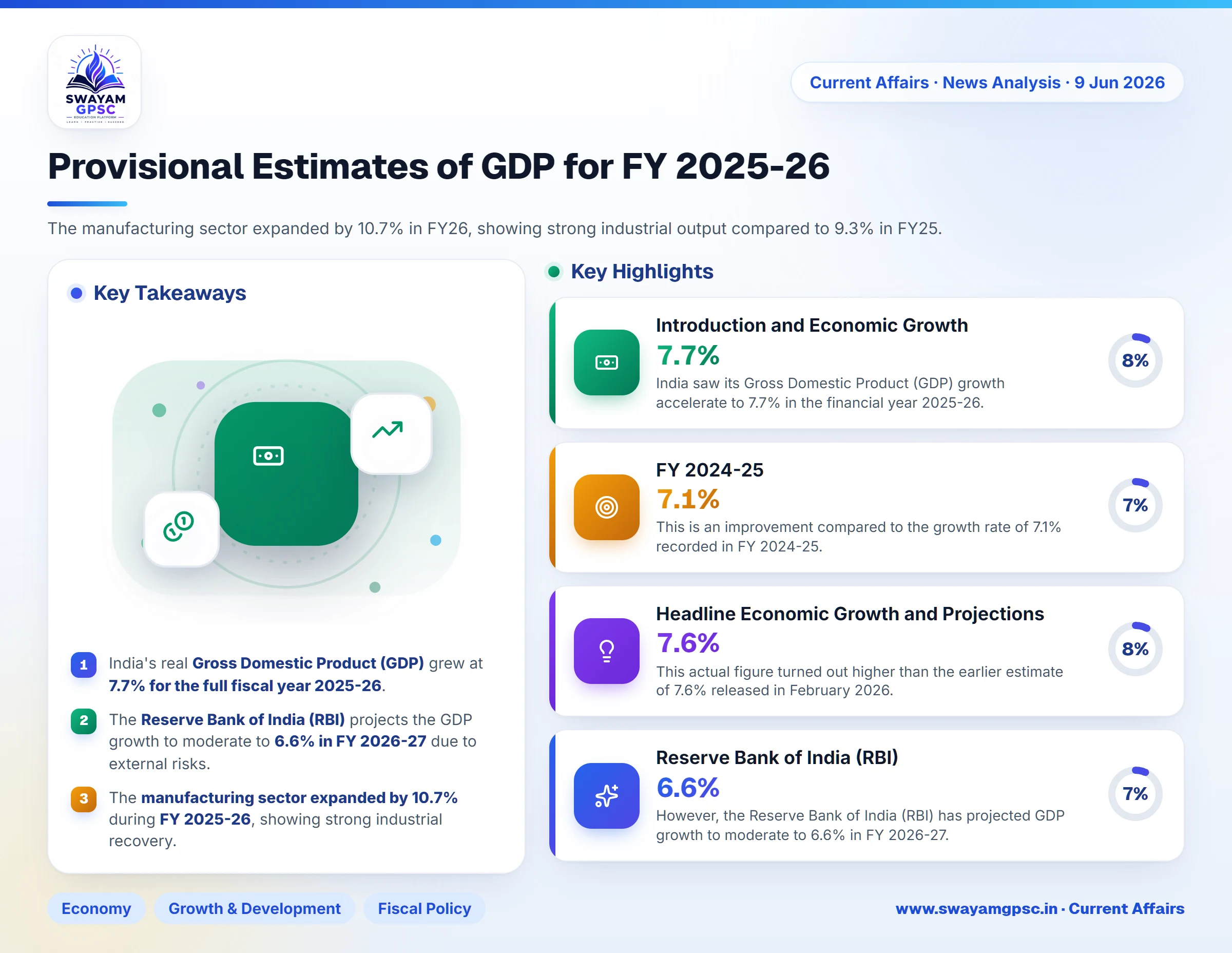
- India's real Gross Domestic Product (GDP) grew at 7.7% for the full fiscal year 2025-26.
- The Reserve Bank of India (RBI) projects the GDP growth to moderate to 6.6% in FY 2026-27 due to external risks.
- The manufacturing sector expanded by 10.7% during FY 2025-26, showing strong industrial recovery.
- India updated its GDP base year to 2022-23, with the revised series released in February 2026.
Introduction and Economic Growth
- The Ministry of Statistics and Programme Implementation (MoSPI) published the provisional national income estimates for the country.
- India saw its Gross Domestic Product (GDP) growth accelerate to 7.7% in the financial year 2025-26.
- This is an improvement compared to the growth rate of 7.1% recorded in FY 2024-25.
Headline Economic Growth and Projections
- The real GDP of India expanded by 7.7% for the full fiscal year 2025-26.
- This actual figure turned out higher than the earlier estimate of 7.6% released in February 2026.
- However, the Reserve Bank of India (RBI) has projected GDP growth to moderate to 6.6% in FY 2026-27.
- This slowdown will happen because of risks coming from the geopolitical crisis in West Asia and expectations of a lower-than-normal monsoon.
Sectoral Performance Heterogeneity
- The manufacturing sector expanded by 10.7% in FY26, showing strong industrial output compared to 9.3% in FY25.
- The contact-intensive service sector covering trade, repair, hotels, transport, and communication quickened to an 11% growth rate in FY26 from 6.6% previously.
- On the other hand, the agriculture and allied sectors slowed down to 3% growth in FY26 from 4.2% in FY25, pointing to climate vulnerability.
Key Macroeconomic Demand Drivers
- The Private Final Consumption Expenditure (PFCE) quickened significantly to 7.7% in FY26 from 5.8% in FY25, showing strong demand in cities and villages.
- The Gross Fixed Capital Formation (GFCF) grew by 8.2% in FY26 against 6.4% in FY25, serving as a proxy for steady investment and infrastructure creation.
Gross Domestic Product
- GDP calculates the total monetary value of all final goods and services made inside a country during a set time.
- Economists measure GDP either as Nominal GDP (at current prices) or Real GDP (inflation-adjusted).
- Potential GDP is the maximum output an economy can reach without causing inflation.
- India updated its GDP base year to 2022-23, releasing the new series in February 2026 to capture formalization, digitalization, and post-pandemic changes.